
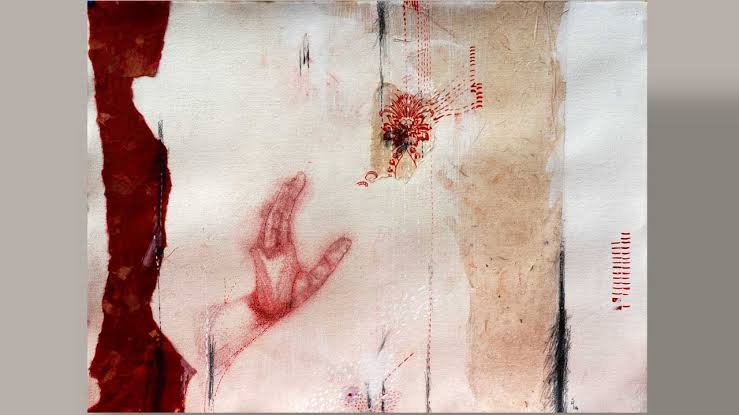
How does one review the retrospective of an artist whose presence extends so far beyond the works hanging on the walls? There are paintings and photographs, fragments of paper, political histories and personal archives; there is the artist, the teacher, the activist, the daughter, and somewhere between all of them, Salima Hashmi. To encounter more than six decades of her life and practice in a single exhibition is slightly overwhelming. Yet Dast-i-Tah-i-Sang, currently on view at COMO Museum, brings these many dimensions together without reducing Hashmi to a single narrative.
The exhibition unfolds almost like a life being remembered. Paintings give way to drawings, collages, photographs and archival material; images of a younger Hashmi appear among traces of the institutions, movements and historical moments she participated in. More than 100 works, spanning the 1960s to the present, have been brought together. What could easily have become an overwhelming chronology is sensitively organised, leading the visitor from one aspect of her practice into another. Rather than simply looking back at a career, the exhibition allows different moments of a life to remain in conversation with one another.
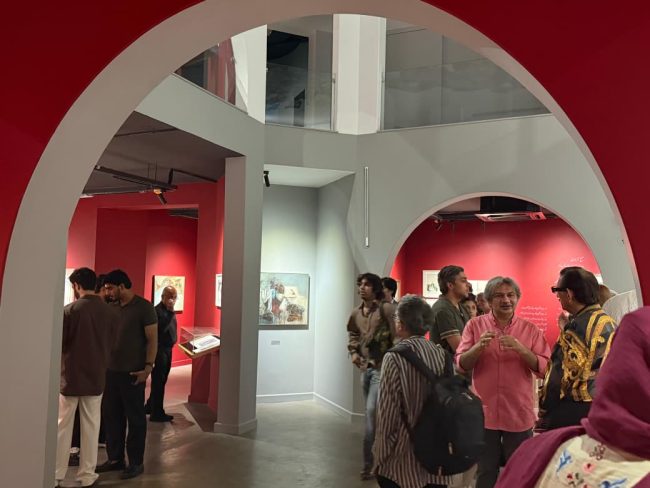
Perhaps the title offers the clearest way into these rooms. Hashmi recalls Faiz Ahmed Faiz explaining Dast-i-Tah-i-Sang, literally “hand under the stone,” as the weight of the convictions one chooses not to abandon. His own stone, he told Alys Faiz, was humanism. Hashmi has spoken of how deeply this shaped her understanding of art: that it should remain committed, reveal facets of truth and ultimately enrich human life. As one moves through the exhibition, the phrase begins to feel less like a title and more like the thread holding its many parts together.
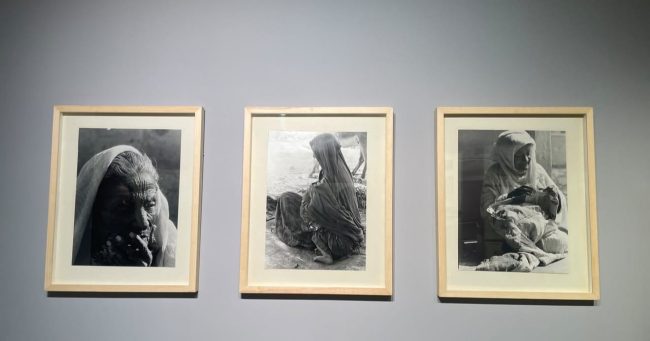
This becomes particularly visible in the works concerned with women. Hashmi’s practice developed through years in which the female body itself became a politically contested territory. During the Zia era, censorship and the increasing regulation of women’s lives were met by feminist organising and cultural resistance. Within the retrospective, works from these years sit alongside archival traces of the world from which they emerged. Seen together, the relationship between political history and lived experience becomes increasingly difficult to overlook. Women are not merely symbols through which an argument is made; bodies carry the consequences of ideology. Works from Alive in My Times, for instance, acquire their force not only as drawings but as records of an atmosphere in which questions of visibility, freedom and womanhood had immediate consequences.
And yet Dast-i-Tah-i-Sang is most affecting when it refuses to let resistance become its only language. Among the works, Homage to Love (1992) held me particularly long. Encountering tenderness within a practice surrounded by histories of censorship and political struggle changes how one understands that struggle. Love and vulnerability are not departures from the political here. They suggest another kind of persistence: the insistence on remaining capable of tenderness in circumstances that might otherwise harden you.
Elsewhere, the questions expand outward. No Man’s Land turns towards territory, belonging and disputed borders, while Yeh Daagh Daagh Ujala brings Hashmi into conversation with the poetic language of Faiz. The retrospective never produces one easily identifiable “Salima Hashmi style.” Oil painting, collage, photography, drawing and mixed media coexist without being forced into a single visual vocabulary. Perhaps this refusal to settle into one language is itself significant: different moments seem to have demanded different ways of being seen.
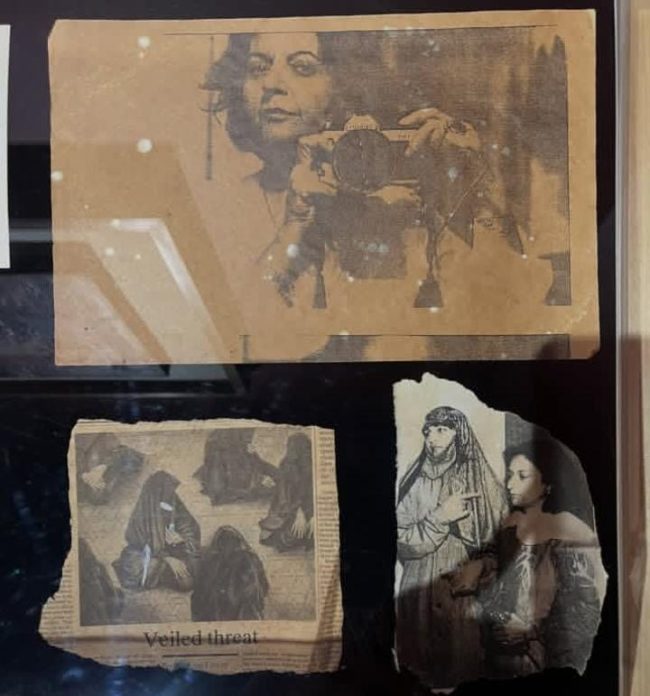
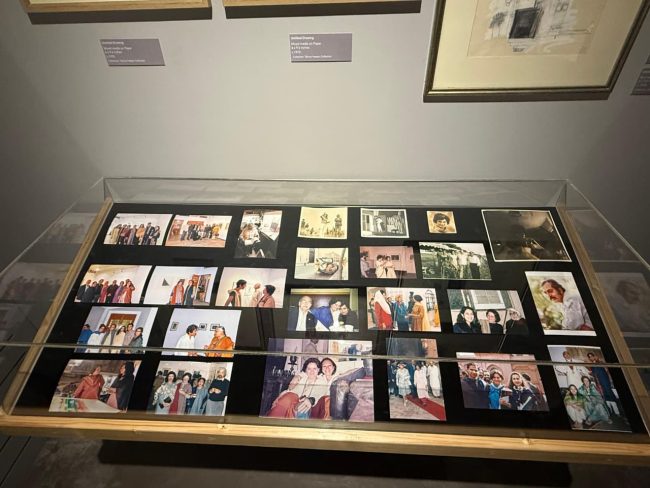
The archival material gives these shifts a human scale. Photographs of Hashmi when she was young are not merely nostalgic interruptions between artworks. They remind us that the histories now gathered neatly within a museum were once an unfolding present. Moving between photographs, documents and artworks, one encounters someone living through these moments without knowing how they would eventually be historicised. The archive makes the retrospective feel less like a record of accomplishment and more like evidence of a life spent observing, responding and participating.
It also becomes impossible to understand Hashmi solely through what she produced in the studio. Her contribution extends through education, curating, writing, media and activism, and through generations of artists she has taught and mentored. Within the exhibition, however, these do not read as a checklist of achievements. They enlarge our understanding of the artworks themselves, revealing a practice that has consistently moved outward,from the private act of making towards classrooms, institutions and public life.
By the final rooms, the scale of Hashmi’s career matters less than the continuity running beneath it. Dast-i-Tah-i-Sang does not leave us merely counting works, exhibitions, institutions or accomplishments. It leaves us thinking about what an artist chooses to carry, and what it costs to continue carrying it.
Faiz called his stone humanism. Across changing mediums, governments and histories, Hashmi appears to have returned to a similar belief: that art must remain answerable to human life. The achievement of this retrospective is that it does not simply tell us so. It allows us to watch that belief take different forms across a lifetime, and to see how rarely she appears to have removed her hand from beneath the stone.