
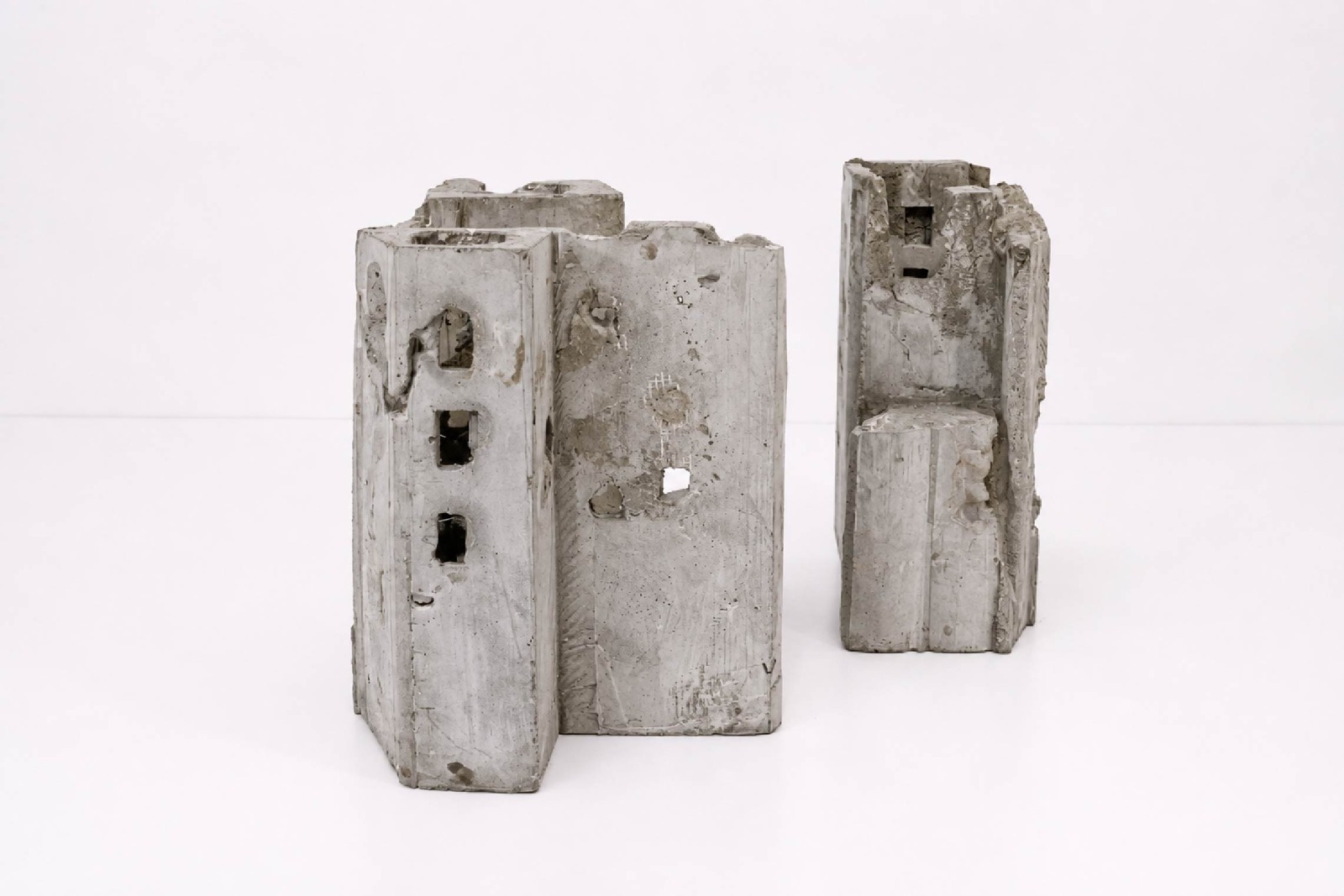
There is something intriguing about a building that no longer holds the lives it was built to contain. Its walls may remain standing, its windows may still open towards the outside world, yet the people, conversations and memories that once gave it meaning have disappeared. What remains is an architecture of absence. Nausheen Saeed’s Elsewhere, Perhaps, presented at Canvas Gallery, enters this uncertain territory through sculptures and works on paper that move between structures, ruins and the fragile act of remembering.
The exhibition’s artist statement begins with a poem by Joseph Fasano, in which the speaker is asked to witness what cannot be changed. It is a compelling point of departure for a body of work that seems concerned with what remains after something has been altered beyond recognition. Yet Saeed offers no specific event or location through which to understand these structures. They resemble buildings, abandoned dwellings and architectural fragments, but their identities remain uncertain. Their openings suggest windows and entrances, while their enclosed spaces invite us to imagine the lives that might once have occupied them.
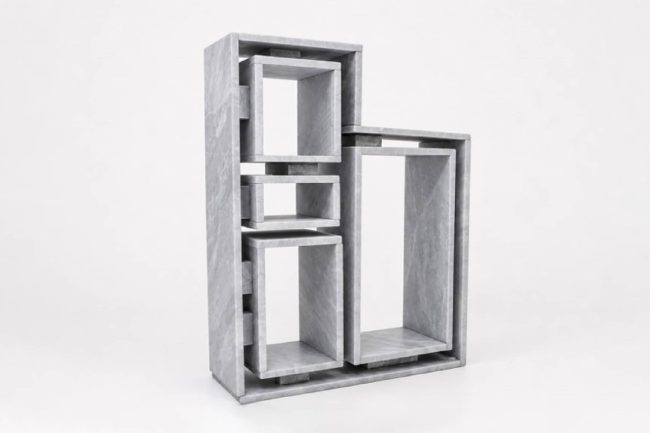
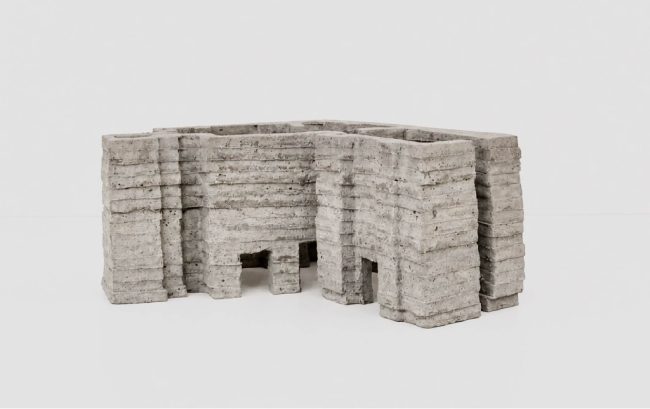
Concrete, a material associated with permanence and construction, becomes particularly interesting in Saeed’s hands. Her small architectural forms carry the appearance of structures that have endured time, yet their rough surfaces, broken edges and incomplete walls suggest vulnerability. Some appear almost intact, while others seem to have been reduced to fragments. Their miniature scale makes them strangely intimate, like places remembered from a distance or buildings whose original dimensions have become distorted by memory.
What makes these sculptures compelling is the space they leave unoccupied. Their windows open onto nothing, their walls enclose empty interiors, and their entrances lead towards spaces we cannot fully enter. There is also an interesting tension between the solidity of the material and the vulnerability of the forms. In Untitled VI, a large opening interrupts the concrete walls, exposing the structure’s interior. The damage appears almost bodily, as though something has been removed from within. Elsewhere, Untitled VIII abandons recognisable architecture altogether, presenting a collection of irregular concrete fragments.
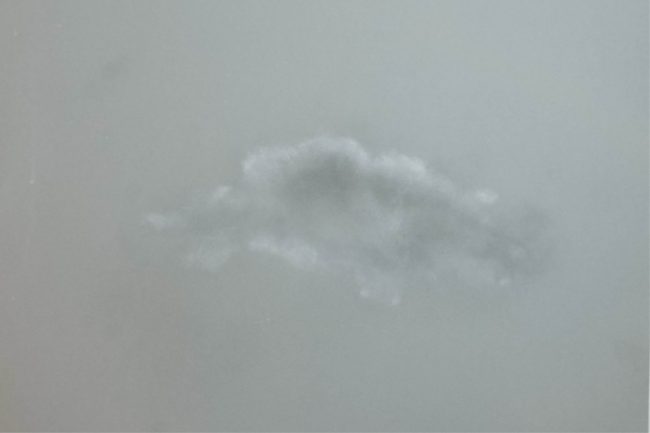
This tension becomes more pronounced in the contrast between Saeed’s sculptural works and her drawings. While the concrete structures possess weight and solidity, the charcoal works appear almost weightless. Dark, unsettled forms emerge from the paper, their edges dissolving into the surrounding surface. In the dry-pigment works, pale impressions become even more elusive, as though an image is slowly disappearing before it has fully taken shape.
There is something familiar about this instability. We often remember the feeling of a place more clearly than its exact appearance. A doorway survives in the mind while the room behind it disappears; a building remains recognisable even when we can no longer recall the people who once inhabited it. Saeed’s sculptures seem to give these uncertain memories a physical form, while the works on paper suggest their gradual dissolution. Together, they occupy the space between what can still be held onto and what has already begun to slip away.
Yet the exhibition’s ambiguity is both its strength and its limitation. Without a more specific point of reference, the architectural forms can remain suspended in a broad language of loss, inviting associations with abandoned homes, damaged cities or personal memory without committing to any one of them. The poem’s call to witness gives this uncertainty a sense of urgency, but the works leave the subject of that witnessing unresolved.
Perhaps this is also what makes Elsewhere, Perhaps linger. It does not offer a complete image of what has been lost, nor does it attempt to reconstruct what once existed. Instead, it asks us to remain with the fragments, the empty spaces and the forms that seem to be disappearing. Sometimes a place survives not through the life it continues to hold, but through the traces of a life that is no longer there.