
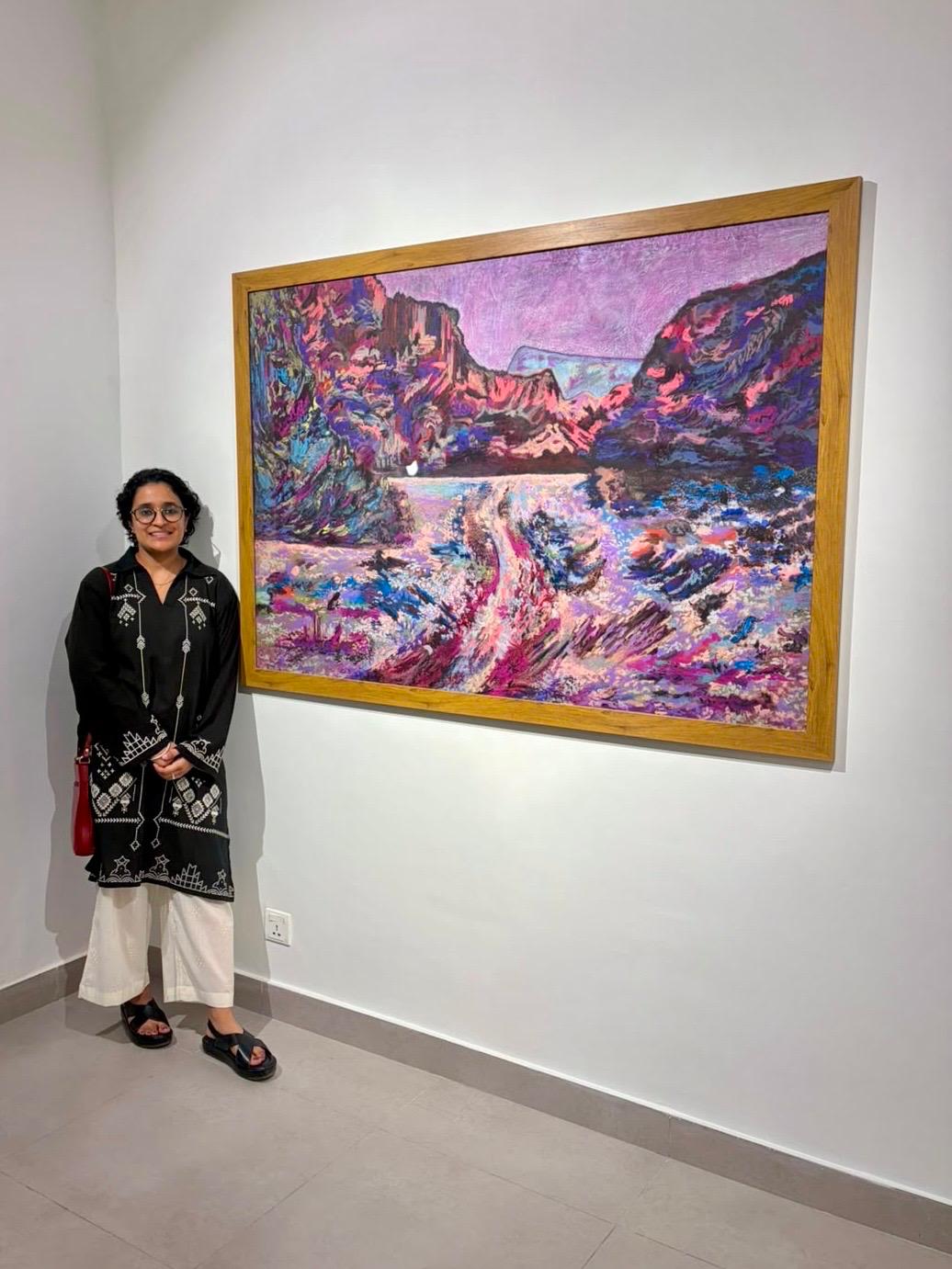
A Memory Catcher Visited My Town is a solo exhibition by artist Zahabia Khozema that took place at Vasl Gallery. The show grows out of the memories of a boy who grew up in an industrial town in central Punjab, Pakistan. As the town slowly disappears under the weight of capitalist expansion, economic hardship and climate change, Khozema’s paintings hold on to it through memory.
In the artist’s own words, a stone crusher, a goat grazer and a coal miner gather to await the arrival of a “memory catcher.” The coal miner lights a cigarette. The goat grazer lights a small fire under a Dherek tree at the foot of the Salt Range. On the sixth night before the monsoon, a thunderstorm falls into an eerie silence, and only the River Jhelum can still be heard. A boy from the workers’ colony climbs onto the school wall to watch the meeting by the fire.
Khozema’s work takes a narrative turn, drawing from memories of an industrial town in central Punjab. Her paintings piece together fragments of a fading place by telling the story of a boy and his connection to his hometown. Traces of the town appear throughout the work, but they are not documentary images. Instead, they feel like remembered scenes, caught somewhere between reality and imagination.
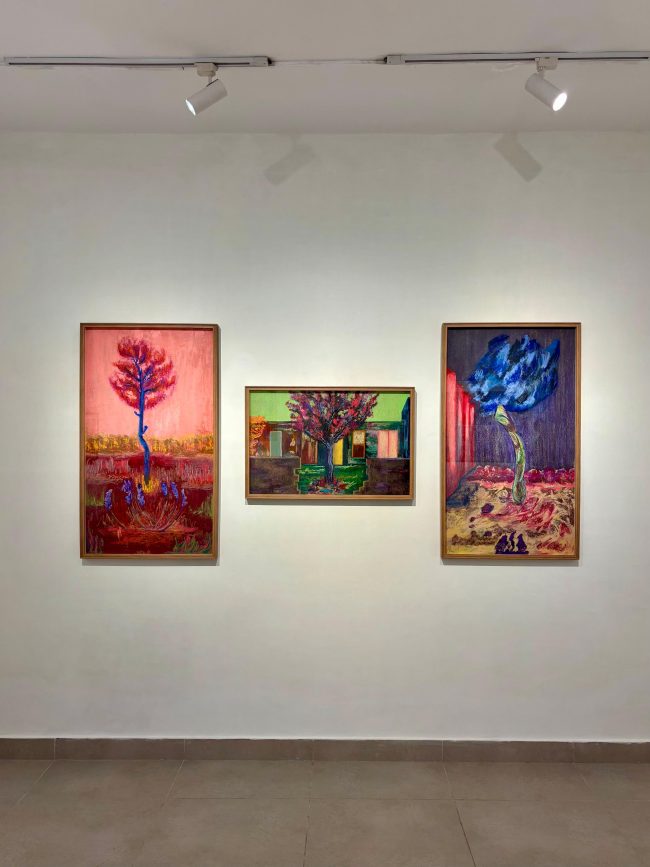
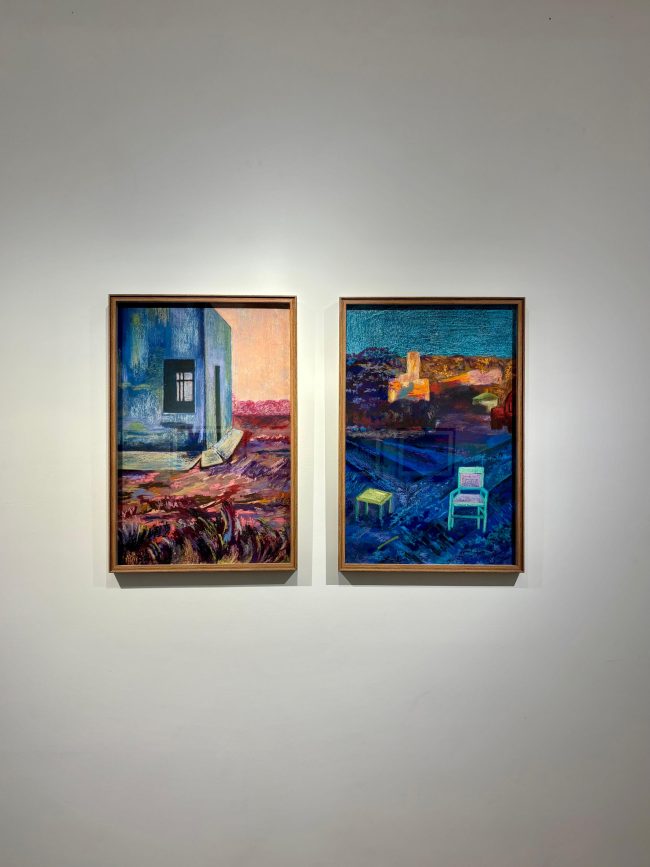
Her use of colour gives the paintings a dreamlike quality. Blues, oranges and greens collide across the canvas in bold contrasts, creating work that feels strangely alive even though no human figures appear in it. The industrial town at the centre of her practice has been shaped by environmental change, labour and slow disappearance, yet the paintings never tip into despair. Instead, colour becomes a way of holding on to feeling, even as the places themselves begin to fade.
The paintings rarely tie themselves to one exact place. Rivers, abandoned houses, flowering trees and open landscapes drift between dream and memory, in a space where certainty gives way to feeling. Rather than rebuilding the town with documentary precision, Khozema paints the emotional shape of remembering. Viewers move through spaces that feel familiar without ever being fully placed, as though built from scattered pieces of childhood.
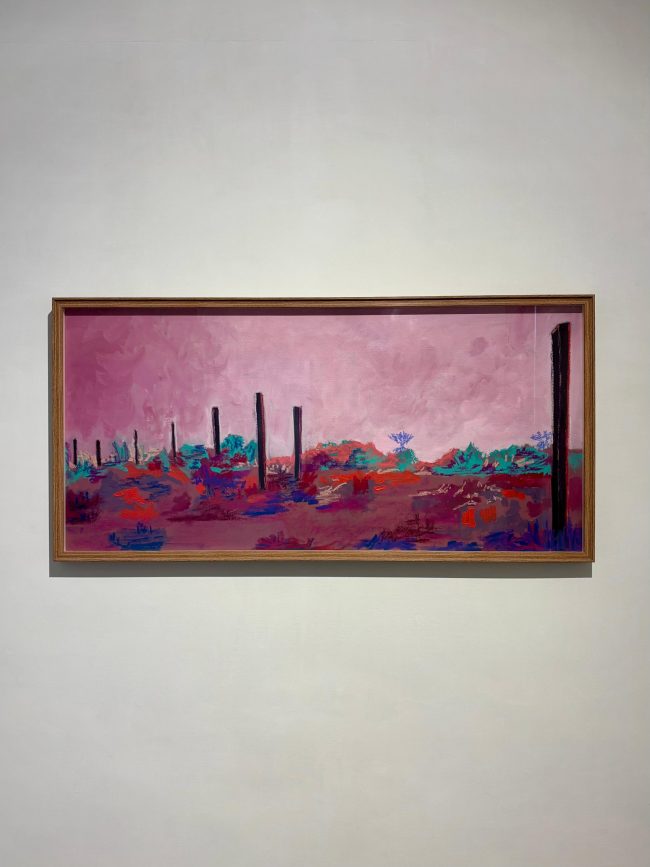
While deeply personal, the exhibition also points to larger political realities. The vanishing town is not framed as the inevitable result of time, but as the outcome of systems that value extraction over community and development over continuity. Climate change deepens this vulnerability further, a reminder that landscapes and livelihoods often disappear together. These ideas of capitalist erasure, economic hardship and environmental loss stay understated within the paintings themselves — Khozema lets them surface gradually, through mood and memory, so viewers feel the weight before they name the politics behind it.
A Memory Catcher Visited My Town ultimately becomes an act of resistance. By holding on to the emotional geography of a place, Khozema suggests that remembering can itself be a way of resisting disappearance. The exhibition stays with you well after you leave the gallery — not simply because it points to what has been lost, but because it asks what remains when an entire town survives only in the memories of the people who once called it home.
In Conversation with the Artist
When did the idea for this body of work first come to you?
I first heard about this place from a friend, three years ago. He’s from a small town in Punjab — the town you see reflected in this work. Through him, I learned about the politics of that land, and that’s where my interest in the story began. I had been thinking about it for three years, but the actual work only started last year, in April 2025.
Was there a specific image that set this off, and how did the title come about?
My friend had been documenting this place for a long time, and it was his photographs and the stories he told me that really pulled me in. It’s a small town in Punjab standing at the edge of disappearance, caught up in political instability — and the title grew out of that whole conversation with him.
How would you describe your personal connection to this body of work?
My last solo show was at VM Art Gallery, where I looked at the political and developmental pressures facing the residents of Gujjar Nala. When my friend first told me about this town, I was reluctant to take it on — it wasn’t my story. But as artists, once we’re drawn to something, it’s hard to let go of the urge to make it. I felt I had to express what I was feeling, even though the story wasn’t mine. Artists are sensitive to social and political issues, and we get pulled into them. This wasn’t a personal conflict for me, but by putting it into my work, I was amplifying a larger story that we’re all part of. It isn’t new to us — many of us have lived through something similar.
Is the absence of human figures intentional, and what’s the thinking behind it?
I showed part of this work earlier this year — some at VM Art Gallery, some at Alliance Francaise in Islamabad — and now I’m presenting it as a larger body of work in this solo show. I made it in pieces, and there are still paintings in the series I haven’t exhibited yet. I plan to show them soon, and human figures do appear in that unseen work.
Do you consider this a finished body of work, or will you keep working within this series?
Right now, it feels like this might be the end of the series. But as artists, we sometimes return to old subjects — something can reignite interest in a story we thought we’d finished telling. This work is tied to something that’s still happening; we’re all living through it. Who knows what shape it might take next.
The show was on view until August 6 at Vasl Gallery.