
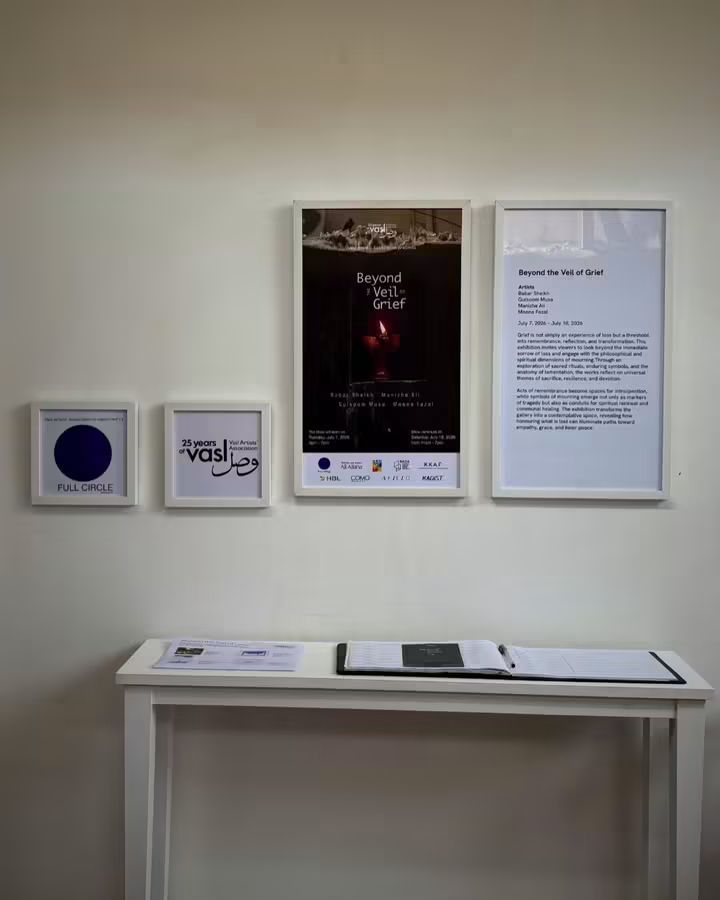
Beyond the Veil of Grief is a small, thoughtful exhibition, part of Vasl Artists’ Association’s 25th anniversary programming. Four artists — Babar Sheikh, Gulsoom Musa, Manizhe Ali, and Moona Fazal — work across film, video, and painting, joined by the shared theme of mourning. The show describes grief as a threshold, ritual as a path to renewal, and loss as something that can turn into empathy, grace, and inner peace. It is an ambitious framing, and while the works don’t always need such large language to explain them, they are strong enough to stand on their own.
At the heart of the exhibition is Muharram, and the mourning of Imam Hussain’s death at Karbala, as observed by Karachi’s Shia community. This isn’t the whole show, but it gives the exhibition its center of gravity, and the works connected to it are some of the most affecting in the room.Babar Sheikh’s Belief (2001), a six-minute film shot on the morning of Ashura in Kharadar, is the earliest piece here. It simply shows a mourning procession, without narration or explanation, and that plainness is its strength — the footage is allowed to speak for itself. Manizhe Ali’s two films extend this idea further. Passion for Hussain (2012) documents mourning as something a community renews every year, a devotion carried forward rather than performed once. Her second film, 28.12.2019, turns to the aftermath of the bombing of the Ashura procession on M.A. Jinnah Road, photographing the ruined façades left behind. (One small note for future printings: the title appears to misdate the event, which took place in December 2009.) Together, Ali’s films quietly make the exhibition’s central point — that mourning rituals are both what holds a community together, and what has been targeted precisely because of that.
Gulsoom Musa’s paintings bring a different texture to the show. Her gouache landscapes of Quetta are physically cut into fragments and set against blank paper, and the cutting is done with real precision. There is something moving in the idea that memory itself returns to us broken, in pieces rather than whole. Her video, The Graveyard Called Home, adds another layer — two children playing in a tree inside a graveyard, completely at ease. It’s a small, simple image, but a lasting one, and it captures something of what the exhibition is reaching for: the way life and loss sit close together, without contradiction.
Moona Fazal contributes one work, The Light That Remained, a one-minute film of a candle burning down in a stone niche, the wax pooling slowly. It is also the image chosen for the exhibition’s poster, and it’s easy to see why — it is the most immediately beautiful piece in the show, a simple and universal image of light persisting in the dark.If there is a small tension running through the exhibition, it’s between the scale of its framing and the specificity of the work itself. The wall text and curatorial language reach for something broad and universal. The artists, in their own words and their own images, tend to stay close to particular places and moments — a neighbourhood in Kharadar, a hometown in Quetta, a named road, a book called Sufi Karachi. The exhibition is at its best when it leans into that specificity, letting a single street or a single procession carry the weight, rather than reaching for abstraction. It’s a minor point, and one that takes nothing away from the works themselves — if anything, it’s a reminder that the strongest parts of the show are also its most grounded ones.Four artists is a modest number to build a 25th-anniversary show around, but the scale feels right for the subject. Grief doesn’t ask for spectacle, and a small room invites the kind of slow, attentive looking that a larger survey rarely allows. Visitors are given space to sit with each piece rather than move quickly past it.
What ties the exhibition together, more than any single wall text, is an image the artists seem to have arrived at separately: fire and light in the dark — a crowded street at dawn, a bombed façade rebuilt in memory, a single flame in a niche. Taken together, these images say something quiet and true about what a community carries forward after loss, and what it chooses to keep alight.
“Beyond the Veil of Grief” doesn’t try to overwhelm its audience. It asks for patience, and rewards it. That, more than anything, is reason enough to see i
The show was held at Vasl Artists’ Association in Karachi from July 7 to July 18, 2026