
There is perhaps no subject in art more familiar than the human figure, and yet it continues to resist exhaustion. Simone de Beauvoir, in her groundbreaking work ‘The Second Sex ’, wrote that the body is the instrument of our hold on the world. This is why the world appears different to us depending on how it is grasped by every individual and their experiences of the world.
‘Between Memory and Flesh’ approaches figuration as a means of thinking through the emotional, psychological and social conditions that shape contemporary life. The exhibition proposes the body as a shifting terrain where memory, longing, intimacy and transformation converge. The figure becomes less a portrait of an individual than a vessel through which life is lived and remembered.
Although the participating artists differ significantly in their visual languages, they are united by a shared understanding that the body carries traces of experiences that often exceed language. Collectively, the exhibition explores a broader perspective in contemporary Pakistani art, where figure painting has moved beyond realism and towards subjectivity. Flesh is never merely physical; it is constantly mediated through emotion and perception.
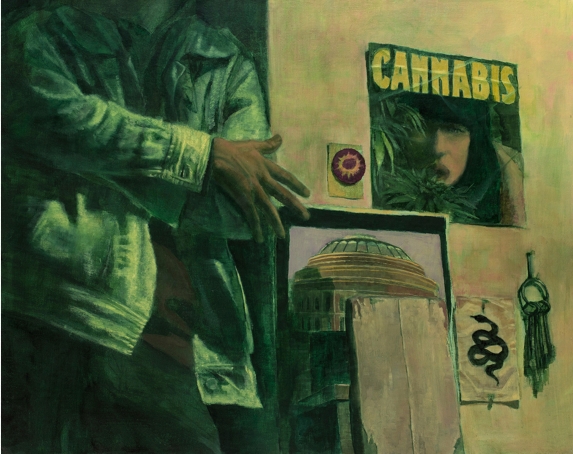
Abdul Wahab’s paintings locate memory within domestic space. His practice explores the relationship between interior environments and emotional states. He treats familiar rooms and everyday settings as storehouses of a life lived rather than neutral backgrounds. His movement between solitary and shared spaces suggests that identity is constructed not only through the body itself but also through the spaces the body inhabits. His emphasis on paint as a tactile surface where light and materiality become a part of memory is breathtaking.
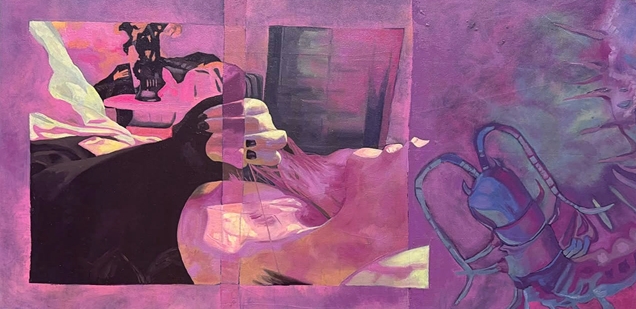
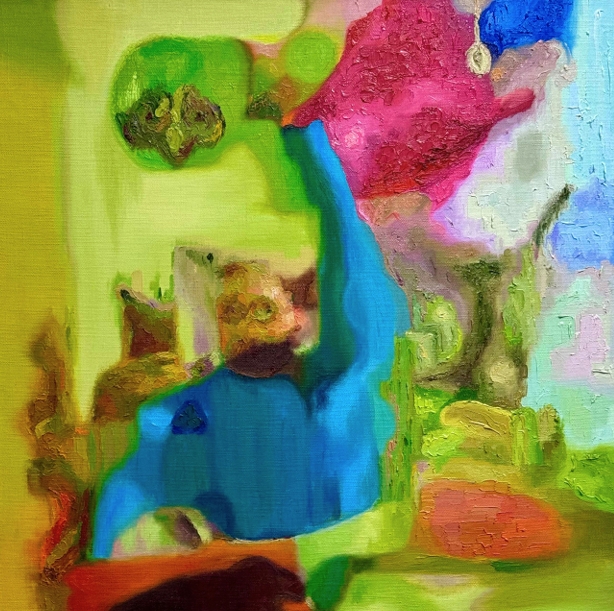
Memory takes a more metaphysical turn in Anaya Karim’s contribution. Her paintings investigate the porous relationship between the worldly and the spiritual, refusing to treat them as opposing domains. Instead, the sacred appears unexpectedly within everyday encounters with music, technology, nature, and human relationships. For Hamza Ahmed, the figure becomes a place of gradual psychological transformation. His paintings are concerned with the uneasy conversations around the subtle compromises people make in order to belong socially. Particularly curious is his reference to his own weak eyesight through which he presents how perception itself is unstable.
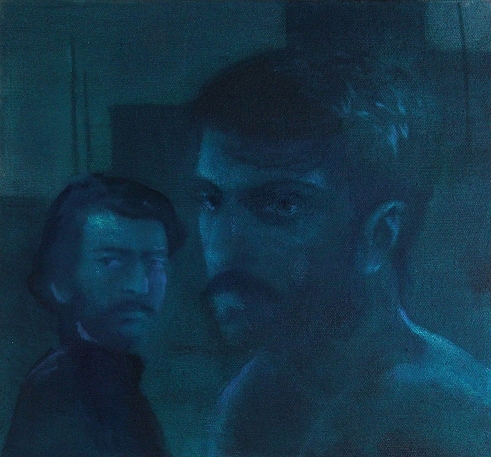
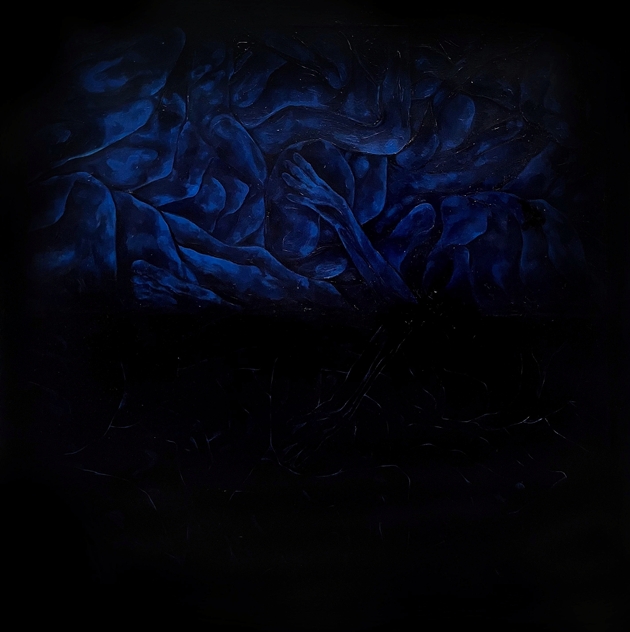
Questions of psychological existence become more evident in Hassan Churchill’s paintings. His work negates conventional portraiture by treating figures as bodies dealing with existential tension. Using blue as a dominant color in his practice, he draws attention to inherited masculine behaviours and emotional repression. Churchill presents the South Asian male body as simultaneously visible within society yet psychologically absent from it. Minahil Khan shifts attention from individual psychology towards interpersonal relationships. She paints intimacy as an unstable condition defined equally by closeness and distance. Her practice introduces a quieter, more relational dimension to the exhibition’s exploration of memory.
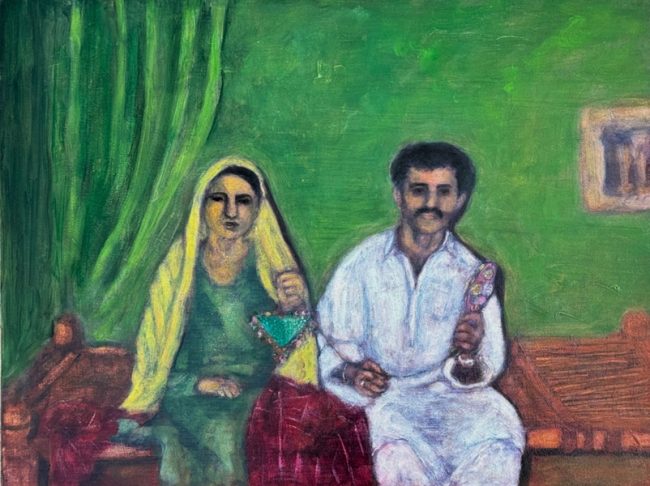
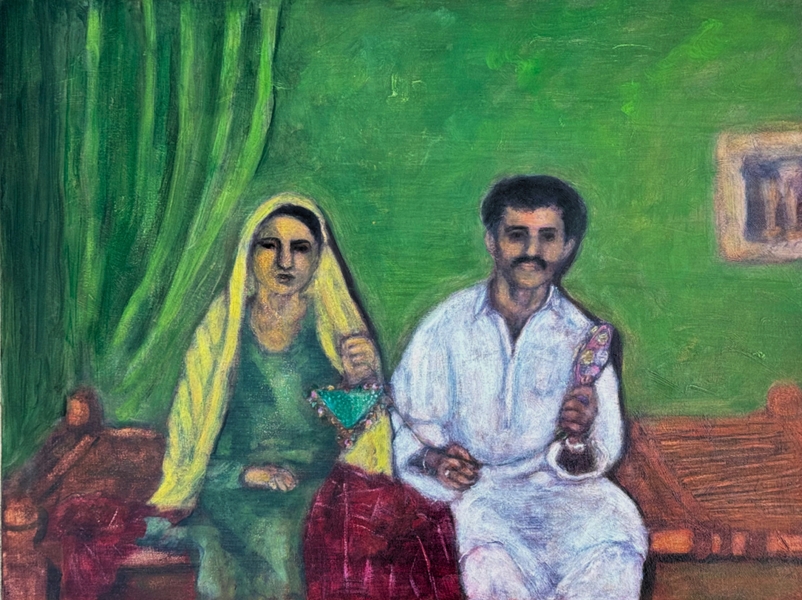
Sabir Hussayn approaches memory through personal archives, transforming family photographs into painted reflections on nostalgia and belonging. Unlike artists who treat memory as unstable or fragmented, Hussayn begins with existing documentary images whose apparent factuality becomes reinterpreted through painting. This translation from photograph to paint is significant: the mechanical record gives way to subjective recollection, allowing intimate family histories to resonate with broader questions of cultural continuity and collective memory. His practice demonstrates how personal archives often become shared cultural narratives once filtered through an artistic process.
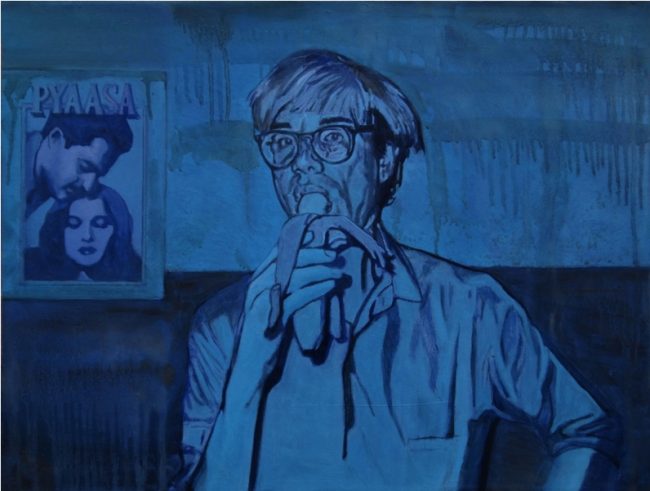
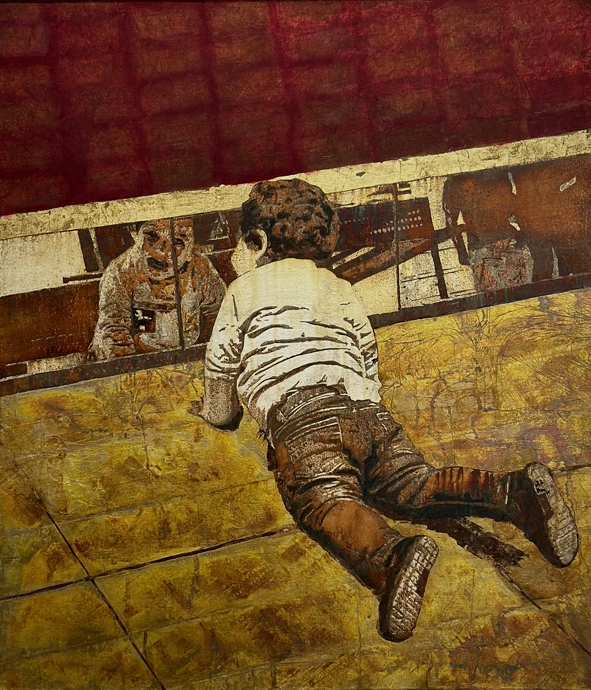
Popular culture enters the exhibition through Saad Qureshi’s monochromatic blue figures. His paintings present the sensitive parts of life through cinematic framing and carefully sustained ambiguity where desire, alienation, class, and performance come together without resolving into any fixed narratives. What is fascinating about his work is how it proposes that identity itself has become performative, shaped as much by mediated images and cultural scripts as by lived experiences. The materiality of memory reaches its fullest expression in Swarim Abid Hasan’s paintings. His figures inhabit unstable landscapes that are molded through conflict and shifting structures of power. Using the technique of oxidised silver leaf, metallic foils, and layered oil paint, Hasan builds surfaces that simultaneously shimmer and decay. These materials become theoretical strategies, signifying that memory is rooted within the very surface of painting.
Viewed together, ‘Between Memory and Flesh’ can be seen as avoiding reducing contemporary figurative painting to a single aesthetic position. Instead, it proves the remarkable pliability of the human figure as an abstract maneuver. Across the exhibition, bodies become archives and psychological landscapes through which artists question vulnerability, spirituality, gender, intimacy and history.
The exhibition refuses to offer definitive conclusions. The artists consistently privilege ambiguity over certainty. They remind us that contemporary figure painting is no more concerned with depicting how bodies appear and instead present us with an understanding of how they remember, endure and become.
The exhibition was displayed at Ejaz Art Gallery in Lahore in early July 2026. It featured works of Abdul Wahab, Anaya Karim, Hamza Ahmed, Hassan Churchill, Minahil Khan, Sabir Hussayn, Saad Qureshi and Swarim Abid Hasan.