
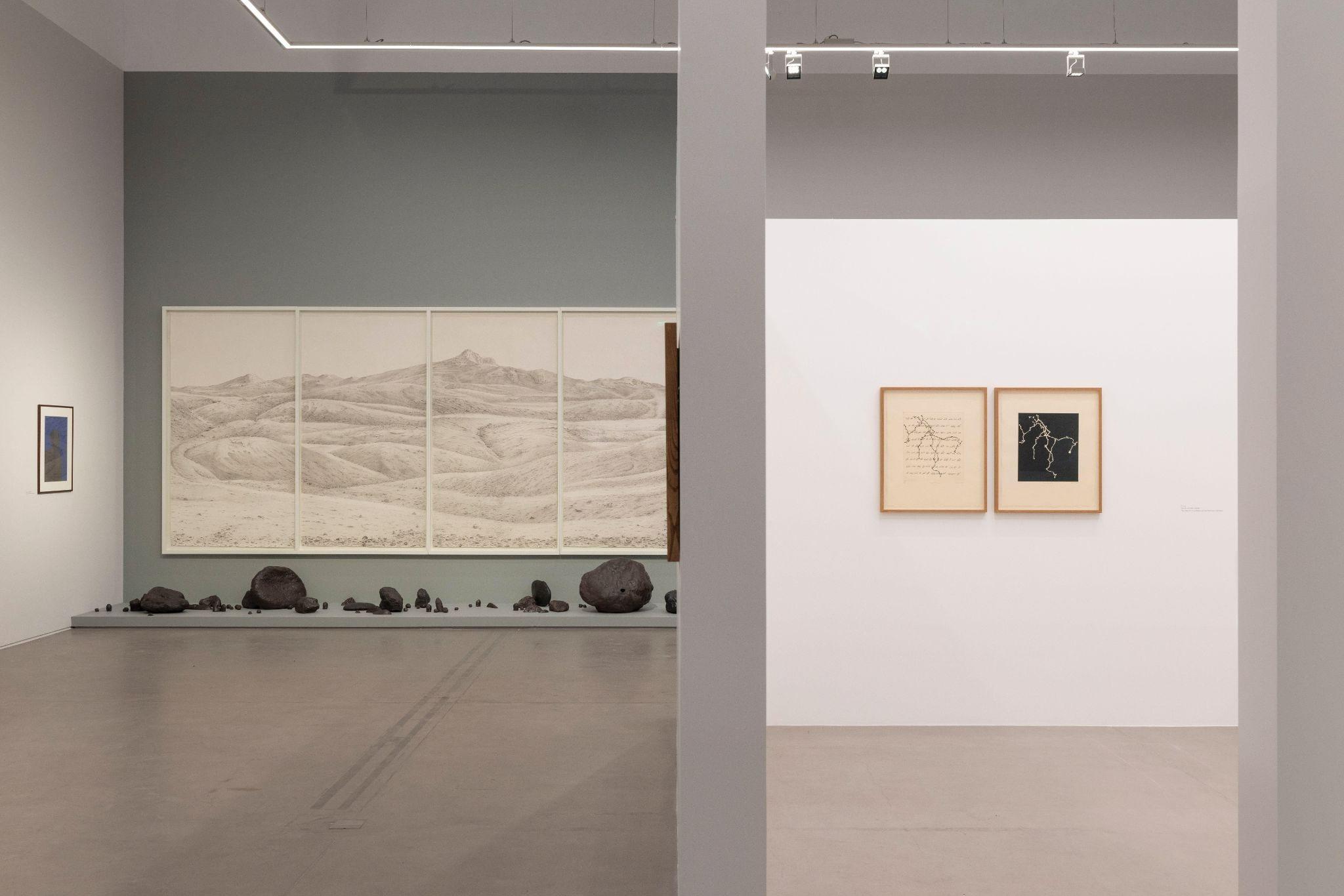
At Ishara Art Foundation, Dubai, Urdu Worlds is a proposition: that language is a structure through which entire lifeworlds are imagined, inhabited and remembered. Curated by Hammad Nasar, who is presently Director of Programmes and Content at Ibraaz, London, the exhibition brings into resonant dialogue the practices of Ali Kazim and Zarina, two artists whose works approach Urdu as a condition of being.
What is striking from the outset is the exhibition’s refusal to treat language as stable or self-evident. The works felt textural, fugitive and deeply personal. Zarina’s works, particularly Home is a Foreign Place and Urdu Proverbs, form an anchoring presence within the space. Her woodcuts, spare yet precise, operate like fragments of thought. Words such as sky, rain or fragrance are not illustrated so much as held, given form without being fully resolved. In Urdu Proverbs, the relationship between text and image becomes especially potent: idioms that resist translation find a second life through visual abstraction, suggesting that meaning often resides in what exceeds language rather than what is contained within it.
Kazim’s practice expands outward. His works, spanning painting, drawing, print, and video, situate Urdu within a terrain of material histories. In Alphabets, a series of etchings and aquatints, language is dispersed across scenes of urban and pastoral life, forming a kind of visual lexicon. Similarly, Tteela renders the الأرض as memory: mounds of archaeological fragments that gesture toward the persistence of past lives within the present. Kazim’s landscapes resist nostalgia; instead, they insist on continuity, on the uneasy cohabitation between what has been and what remains.
The curatorial framing is careful and generous, allowing both practices to retain their distinct rhythms while drawing out subtle resonances between them. Zarina’s works sit almost like a centre of gravity, around which Kazim’s more expansive installations circulate. This spatial relationship feels intentional: a movement between interiority and expanse, between the word as an intimate marker and the world as its unfolding.
A particularly compelling gesture is the inclusion of a reading room, where texts, ranging from collections of Urdu proverbs to The Conference of the Birds, extend the exhibition’s concerns beyond the visual.
What Urdu Worlds does especially well is hold complexity without overstatement. It resists the temptation to monumentalise Urdu as heritage, instead attending to its fragility, its entanglement with migration, exile and institutional framing. At the same time, the exhibition is not weighed down by this urgency. There is a lightness to how meaning is allowed to circulate, an openness that invites viewers to encounter the works without requiring fluency.
If there is a tension within the exhibition, it lies in its very premise: the translation of language into visual form risks aestheticising what is also deeply political. Yet, rather than resolving this tension, the exhibition sustains it productively. It asks what it means to encounter a language you may not fully understand, and whether such encounters can still produce forms of recognition, even intimacy.
Urdu Worlds succeeds by creating the conditions through which Urdu can be experienced differently. It offers no definitive vocabulary, no singular narrative. Instead, it lingers in the space between word and world, where meaning is partial, and where the act of looking becomes, itself, a form of reading.