
The 1952 play The Chairs by Romanian-French playwright Eugène Ionesco depicts two elderly people filling a room with seats for guests who never come. Their orator, when he finally arrives to deliver the great message of their lives, is deaf and mute. The chairs outlast everyone. They are the argument: who is expected, who is absent, who holds power over an empty room.
Seventy years later and several thousand miles away, Ayaz Jokhio built an exhibition around similar concerns and questions. Three Chairs, his solo show at The Barracks Art Museum in Lahore’s Nasir Bagh (Autumn, 2025), was framed by Henry David Thoreau’s line from Walden: “I had three chairs in my house; one for solitude, two for friendship, three for society.” It presented three kinetic works, each a chair, each a mechanism, each devastating in what it exposed the moment a visitor sat down. Jokhio’s practice has always arrived this way: unannounced, total, leaving the mindscape permanently altered.
Words such as chairman, professor’s chair, the Holy See, and the seat of government are linguistic fossils, remnants of the original equation between sitting and ruling. The word cathedra, the root of cathedral, simply means chair: a bishop’s authority resided literally in the place where he sat. Across faiths and centuries, the same logic held. The chair, in every tradition, preceded the person. The person borrowed their authority.
The Peacock Throne (Takht-i Tāvūs), seized by the Persian king Nader Shah from the Mughals, was not merely furniture but sovereignty made decorative, an empire condensed into a single gilded seat. The judge’s bench, elevated above the courtroom floor, was designed so that those seeking justice always looked upward. The Speaker’s chair in Parliament cannot be occupied by any other member; to approach it uninvited is a breach of the constitution itself. Even the electric chair, introduced in the United States more than a century ago, collapsed the full weight of state authority into a single object: the same form used for rest and domestic comfort, now the instrument of judicial death.
In the subcontinent, the chair—or rather the gaddi (an inherited symbol of absolute power)—carries a spiritual and feudal charge that no Western etymology quite captures, especially after the dismissal of hereditary lordship and primogeniture. The gaddi nasheen, literally the one who sits upon the cushioned seat, inherits not merely property but divine intercession: a Pir’s authority passes to his successor by occupying the same position, the same raised dais, the same physical seat his father and grandfather occupied before him.
In the subcontinent’s rural centres, a feudal landlord’s chair at the centre is the axis around which entire communities orbit—its occupant dispensing justice, settling disputes, commanding loyalty, and demanding silence long before the lethal injection was introduced.
Nor is the history of the chair separable from the history of plunder. After the Battle of Plassey, Robert Clive helped himself to Bengal’s treasury with a frankness that later empire-builders would find embarrassing to acknowledge. The chairs in which British viceroys received Indian petitioners—including Dalhousie’s, Curzon’s, and Mountbatten’s—were thrones in all but name, installed in palaces built on extracted wealth and occupied by men whose authority derived from a crown that had declared an entire subcontinent its property. The furniture of empire was not incidental to the enterprise; it was part of the argument. To be seated above the standing Indian was the daily re-enactment of the colonial claim.
It is perhaps no coincidence that the twentieth century’s most serious design thinking was lavished on the chair above all other objects. Designers returned to the chair again and again, not because they had not solved it, but because the chair, more than any other object, sits at the intersection of the body, society, and power. Every redesign is implicitly a question: who is this for, how should they be held, and what does the act of sitting tell them about their place in the world?
Solitude
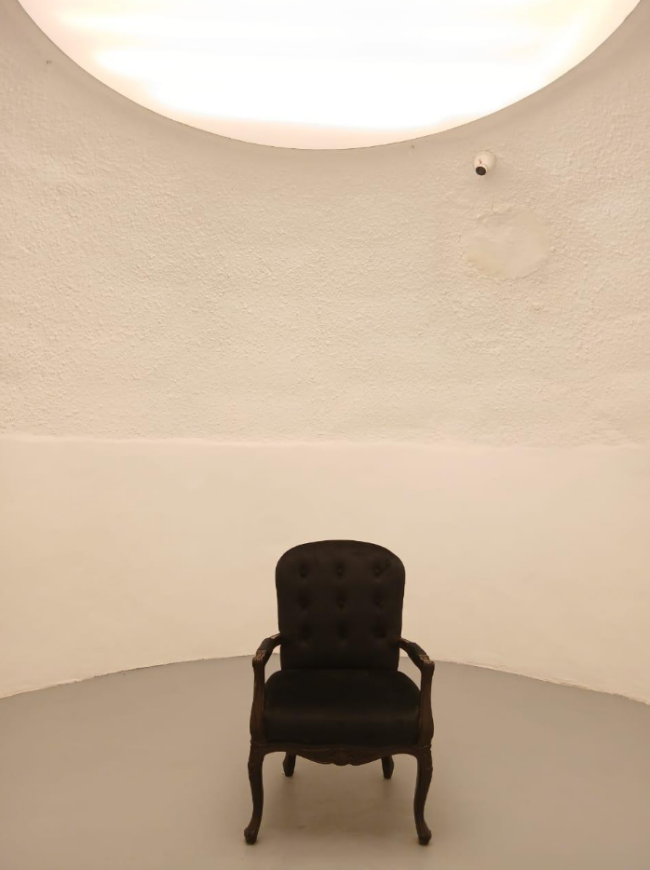
The exhibition begins with its most intimate and psychologically demanding work. Solitude presents a single dark, tufted Victorian armchair at the centre of a circular white room, with the overhead light flooding the space with an almost clinical brightness. A hidden push button was embedded invisibly in the seat; when a visitor sat down, the light went out. The room fell into complete darkness. The act of sitting alone extinguished everything.
The first instinct, for many visitors, would have been to stand back up. But there is something in Jokhio’s setup that invites you to remain, to let the darkness settle, to discover that the chair still holds you even when it has taken away your ability to see. This is the interior logic of solitude as the exhibition understands it: not emptiness, but a radical narrowing of the world to the self and whatever it carries.
It is here that Jokhio’s work touches the emotional territory of One Hundred Years of Solitude, specifically the fate of José Arcadio Buendía, the patriarch of Macondo, who retreats into his private laboratory until solitude is no longer a chosen condition but an inherited phenomenon passed down through generations like a surname. The man who withdraws from the world does not find peace; he finds the world shrinking around him until he is tied to a chestnut tree in the garden, talking to no one, visited by ghosts, and erased from the living record of his own family. The light does not go out on him dramatically. It simply, gradually, stops including him.
Jokhio’s Solitude compressed this into a single mechanical gesture. The chair looked like rest. You sat. The darkness was immediate and total. Whatever had illuminated the room before your arrival, you had cancelled it. In Pakistan, where the solitary voice—the writer who asks the wrong question or the artist who refuses the prescribed narrative—has historically found itself cancelled in ways that go well beyond metaphor, this was not a comfortable darkness to sit in. Solitude offered its visitor the precise sensation of disappearing in plain sight. The chair held you. The darkness held the chair. Outside, the world continued in the light you had switched off by the simple act of sitting down alone.
Friendship
If Solitude asked what happens to the individual who withdraws from the world, Friendship asked what kind of world they were withdrawing from—and who had been keeping it comfortable all along.
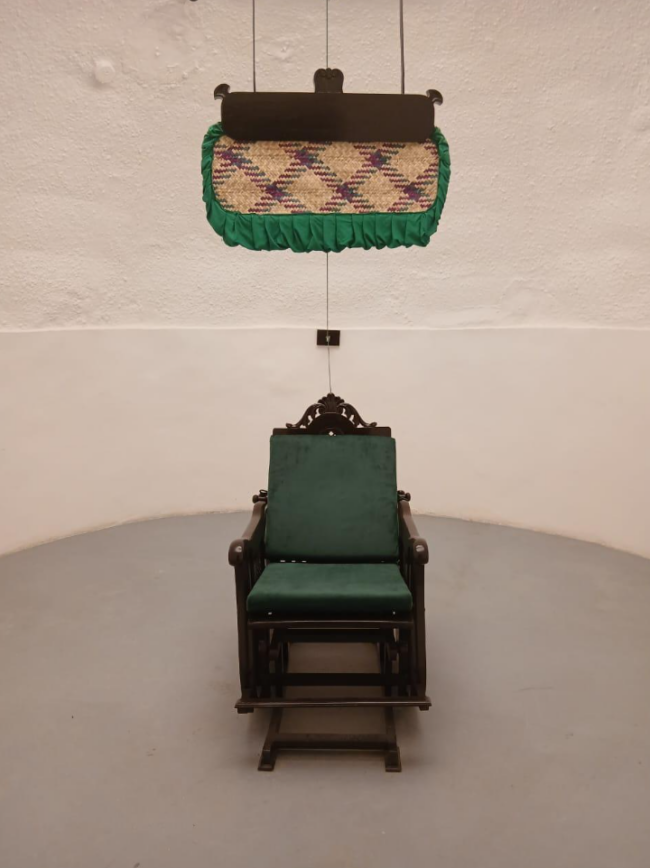
Moving from the first dome to the second, the visitor encountered a green-cushioned rocking chair connected by a pulley system to a traditional punkah, the embroidered cloth fan suspended overhead, swaying whenever the chair was set in motion.
The punkah is one of colonial India and Africa’s most precisely engineered social objects. Suspended above the courtrooms, drawing rooms, and clubs of the Raj, it was kept in motion by a punkah-wallah, typically from the lowest rung of the caste hierarchy, seated outside the room and pulling a rope through a hole in the wall for hours on end—invisible to those being cooled, indispensable to their comfort, absent from every official record.
The same courtrooms in which viceroys issued proclamations and district commissioners delivered verdicts that dispossessed thousands of their land were kept comfortable by men who do not appear in the court registers. The punkah-wallah did not exist as a person in the colonial account of the room; he existed only as a function, a mechanism, a moving part of the architecture.
Jokhio replaced him with a pulley. The rope still runs. The fan still sways. The body that used to pull has been engineered out, its effort absorbed into the mechanism and renamed convenience. What is genuinely disturbing is how completely the original relationship survives the removal of the original person. The colonial logic is not in the punkah-wallah; it is in the room, in the rope’s trajectory, in the chair itself.
Friendship, the title suggests with barely concealed irony, is what we call an arrangement when it works well for us, regardless of what it costs the other party—and regardless of whether that party is still in the room.
The Barracks Museum’s own building, a post-partition colonial-era military structure repurposed as a contemporary art space, silently reinforced this reading. Its walls were built to house one kind of power. The exhibition asked what kind of power still moves through them, unseen, when no one is paying attention.
Society
Having moved through the private darkness of Solitude and the quietly compromised comfort of Friendship, the onlooker finally arrives at the work that gathers everything together.
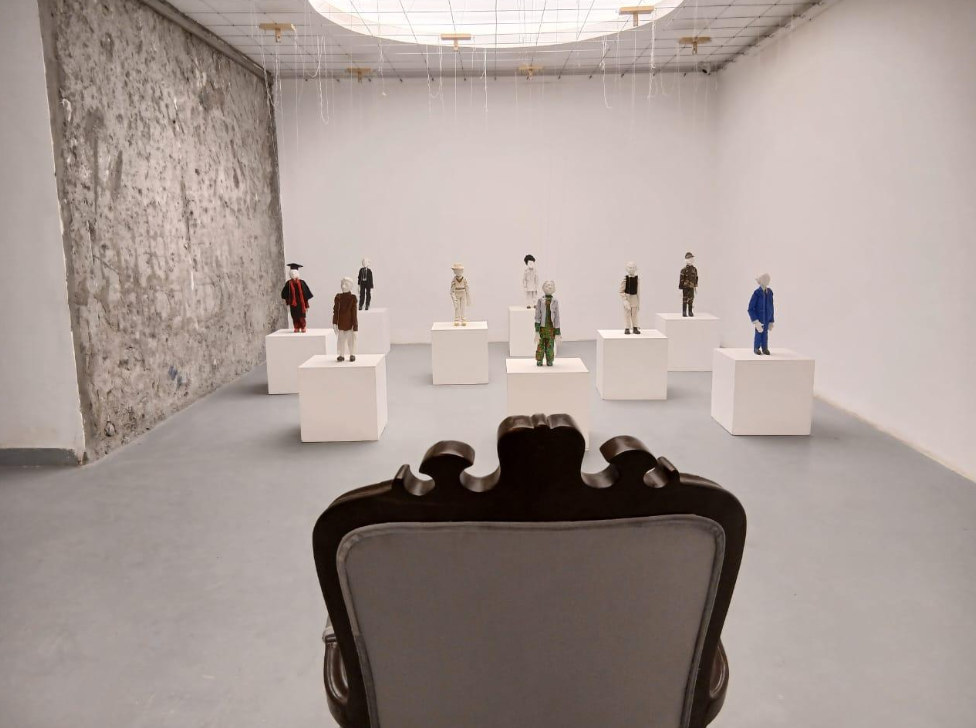
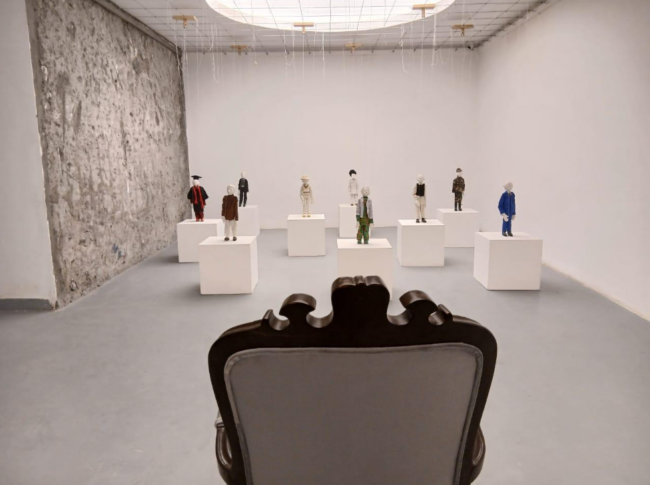
Society placed a grand, elaborately carved chair at the centre of a large white room. Facing it, arranged on nine individual white plinths, stood nine small puppet figures, each distinct: a lawyer in a black suit and tie; a cricketer in Test whites; a professor in academic hood and dupatta; a mullah in traditional dress; a soldier in fatigues; a doctor in a white coat; a CEO in corporate attire; a journalist with a cloth bag over one shoulder; and a Pakistani politician.
Every profession, every social pillar of the republic, assembled and waiting.
An intricate system of pulleys linked the carved chair to each figure. When a visitor sat and shifted their weight, all nine raised their right hands in salute.
What makes this gesture so arresting is the recognition that it is not learned in adulthood. It is learned in primary school, where the first lesson in power is delivered not through a textbook but through physical choreography: stand when the teacher enters, sit when permitted, raise your hand before speaking, face the front. The classroom is the original Society, the space where children first learn that authority occupies a fixed position, that the correct response to it is the upright body, and that the consequences of remaining seated when you should stand are swift and memorable.
By the time the lawyer and the soldier and the politician have found their places on Jokhio’s plinths, they have been rehearsing this salute for decades. The pulleys are just making visible what the schoolroom made automatic.
In a country where the judiciary has swung between defiance and deference depending on which way the political wind was blowing, where journalists have found their cloth bags considerably lighter after writing certain stories, and where the relationship between civilian government and military authority has rarely been what it appears on paper, Jokhio’s nine figures felt less like caricature than portraiture.
And no face was visible in the seat. None was needed.
The work did not ask who the powerful person was; it asked what the chair itself produces in everyone around it. The pulleys were already installed. The salute was already rehearsed. All that was required was for someone to sit down.
In Pakistan, the chair has never been merely furniture. It is the first and last instrument of humiliation, and every citizen, sooner or later, has stood before one and felt the distance between those who sit and those who are made to wait. Jokhio did not need to explain any of this to a Pakistani audience. In this country, the distance between the man in the chair and the man standing before it is the oldest story.
Three Chairs by Ayaz Jokhio was on view at The Barracks Art Museum, Nasir Bagh, Lahore, from August 27 to October 12, 2025.