
In Greek myth, Bellerophon is the hero who tamed the impossible. With a golden bridle given by Athena, he mounted the winged Pegasus and slew the Chimera, and his triumphs made him bold. Eventually he tried to ride his horse to Olympus itself, to take a place among the gods. Zeus sent a gadfly to sting Pegasus, the horse bucked, and the rider fell to earth, to wander, according to most tellings, lame, blind and alone. Pegasus flew on without him, was stabled on Olympus, and ended among the stars. The story’s quiet cruelty is that the hero’s ambition is what undoes him, while the horse simply ascends.
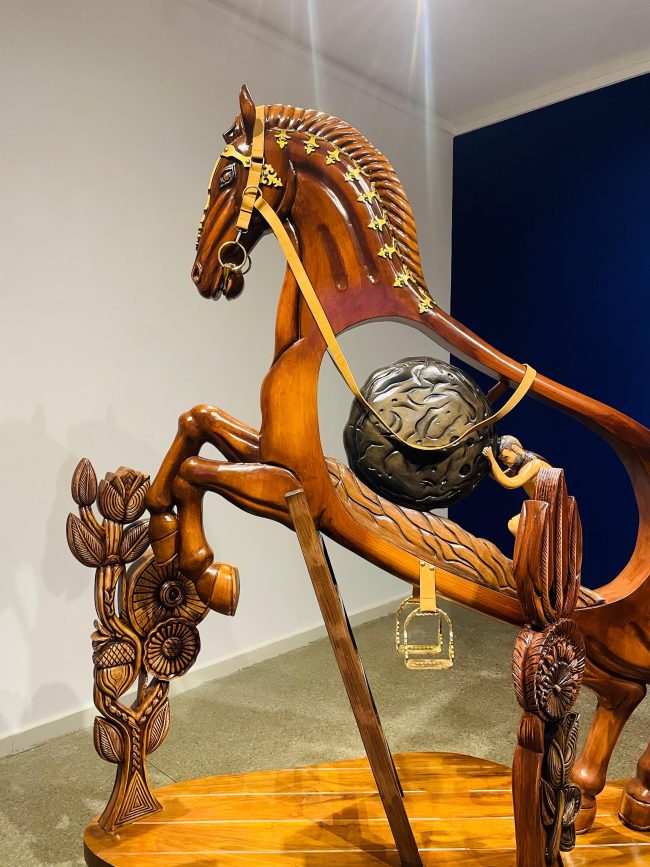
That divergence, between the fallen rider and the horse that rises, is the territory of Adeela Suleman’s solo show at Canvas Gallery. Her title borrows Richard III’s despairing cry on Bosworth Field, as his horse falls beneath him, but she reads it as a threshold rather than a defeat: the instant sovereignty dissolves and something other than power must carry us forward.
The show has six works. Four are horses carved from rosewood. The other two, Pegasus Unseated (72 x 48 inches) and Celestial Quintet (72 x 46 inches), hang on the wall, hand-painted on galvanized iron sheet. In nearly all of them the rider is absent, and that absence is the point. In Pegasus Unseated, however, Bellerophon appears at the horse’s feet, falling or already fallen. It is the only place in the exhibition where the human figure survives, and Suleman uses him as a hinge. He is the cautionary figure, the ambitious one, and his presence makes the emptiness elsewhere legible. We see what the other horses have been freed from.
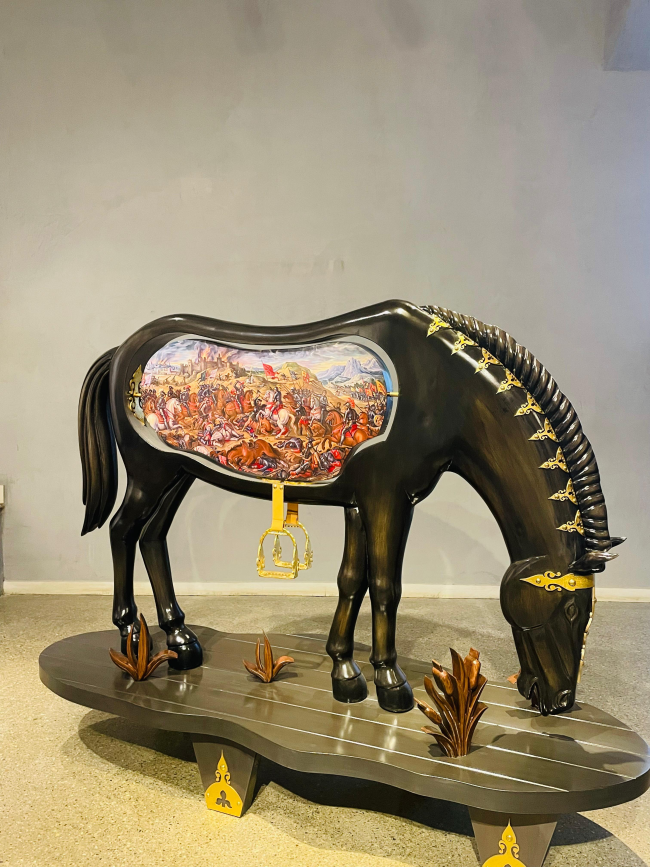
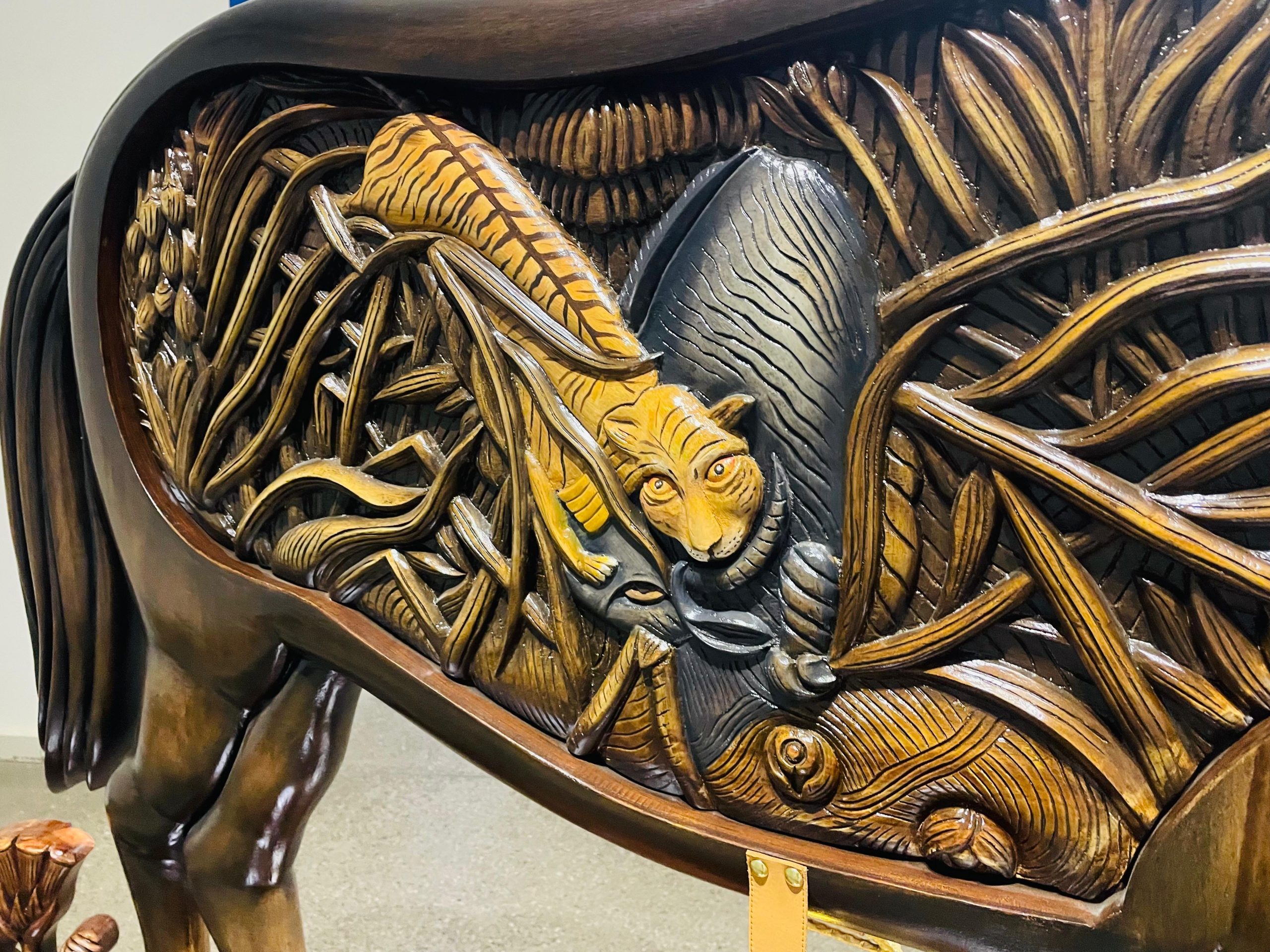
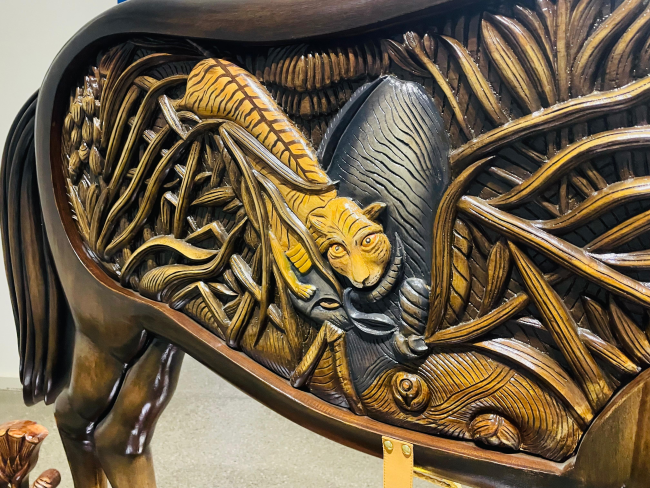
The materials deepen the tension. Rosewood is warm and organic, associated with craft and domestic permanence. Galvanized iron is cold and industrial, the stuff of shutters and hoardings, though Suleman has always coaxed the ornate from the utilitarian. Between them, the horse feels both flesh and artefact. The carved horses are the heart of the show. Each has its abdomen opened to elaborate detail, painted in some, sculpturally carved in others. It is a stunning decision. The belly is the body’s most vulnerable region, and here it becomes the site of the work’s richest invention, as though what the horse once carried has been absorbed into it. Suleman’s meticulous hand, familiar from her work in steel and found materials, is at full stretch.
Her statement gathers a wider lineage: the Ashvamedha, the Vedic horse sacrifice that inaugurated a king’s reign; Buraq, the winged mount of the Night Journey; Zuljannah, the riderless horse that returned from Karbala; Ferdowsi’s Rakhsh; and Alexander’s Bucephalus, whose name survives in cities such as Bucephala near the Jhelum. In a city where Karbala is lived memory rather than distant history, Zuljannah gives the show its emotional undertow. It sits against the Ashvamedha, in which the same animal founds temporal power. Suleman lets the contradiction stand: the horse is both the origin of dominion and what survives its end. The wings hold these horses in the interval between collapse and ascension, and her claim is that stripping away the rider leaves release rather than defeat.
Viewers familiar with Suleman’s practice will recognise its signatures: the preoccupation with sovereignty and violence, the ornamental precision, the transformation of unlikely materials into memorials. This is a new body of work but not a surprising one. It extends her language rather than breaking with it, and the reduction to six works and a single animal feels like distillation rather than repetition.
What lingers is how stunning and strange the objects are in the room, and how they invite reflection rather than demanding it. It is an intriguing, assured show from an artist who knows exactly what she is doing.
“My Kingdom for a Horse” is on view at Canvas Gallery, Karachi, until 15 October.