
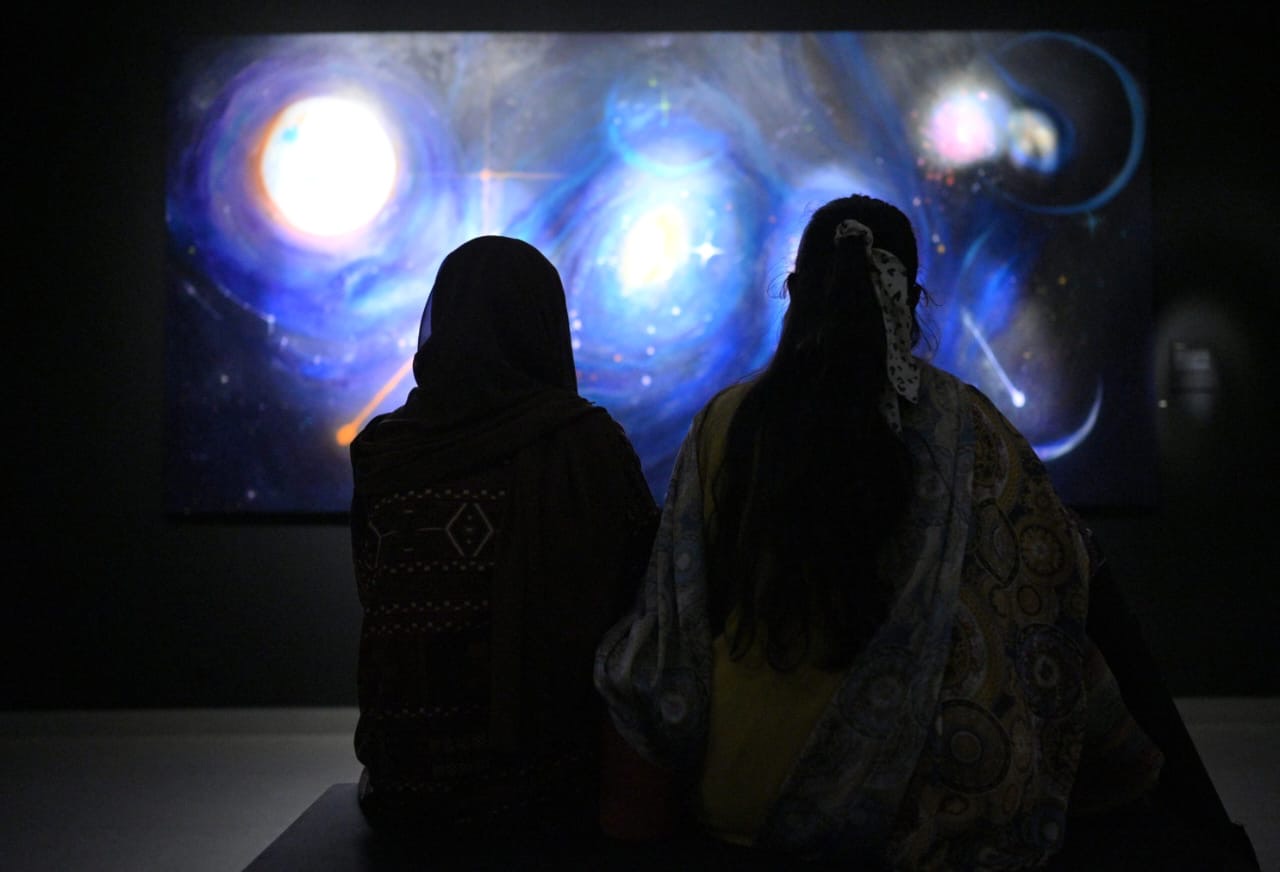
Karachi doesn’t possess a dedicated, state-funded art museum. In a utilitarian city like Karachi, where civic life is severely compromised, the absence of art museums presents a set of unique challenges. It largely means that artistic production relies on purely commercial aspects, and the cultural life of the city and its people withers. The lives of the citizens are dominated by struggles of the working life, commute, traffic, crowds and the time for beauty, appreciation, presence and community is pushed aside. Once art produced by the city’s talented and sought-after artists is purchased, it leaves the city’s domain and now belongs to the homes of the affluent buyers. Though the specific artworks meet their eternal abode, a purely commercial purpose behind art making and viewing damages the relationship that the public has with art. The citizens remain oblivious to the talents of its emerging and established artists thus, being removed from the city’s heritage. It results in a loss of connection with the city. We can only find these works in rare few books and other publications produced in our country, which is yet another obscure industry and a topic for another article.
The lack of a state-funded art museum is made up for by several renowned private galleries, cultural centers, biennales and alternative spaces. Amongst which VM Gallery has played a crucial role since its inception in 1987, established by the ZVMG Rangoonwala Trust under the vision of philanthropist Mohammad Aly Rangoonwala. The gallery is located in Dhoraji, Karachi, alongside Rangoonwala Community Centre and VM Center for Traditional Arts and counters the transactional purpose of art through its community-oriented sensibility.
An important feature of an art museum is the integration of community learning through public programming. VM Gallery combines the morales of the Rangoonwala Community Centre that is focused on vocational training and public education and VM Center for Traditional Arts which is focused on heritage and crafts and offers skill-focused art workshops invited through open calls. Though the gallery lacks in terms of artist talks and discourses, it makes up for it through its scheduled artist workshops that provide hands-on learning and bring fresh, practice-oriented perspectives alongside its regular exhibitions by local as well as international artists.
One of my earliest memories of VM Gallery is “Otto Dix: War and Social Criticism” by the renowned German painter and printmaker Otto Dix (1891-1969) held in collaboration with Goethe Institute. The artist served as an artillery gunner in the trenches during World War I (1914-1918) and the exhibited prints captured the witnessed horrors of combat. The exhibition ran from November 22 to December 19, 2018. It is a testament that the gallery doesn’t only prioritize commercially aesthetic works but rather creates historically rich and educational experiences for the viewers by bringing international narratives to the city which do lean on realistic and destructive angles of society.
The gallery supports Pakistani established artists with the same zeal. It is currently running “We Left an Imprint”, a solo exhibition by Qasim Bugti, that prioritizes humanity’s connection with nature. Qasim Bugti received Bachelor of Fine Arts degree with a specialization in Miniature Painting from the National College of Arts, Lahore, in 2009 and has displayed nationally and internationally, his work belongs to notable collections and he serves as an art educator. The artist brings his mark-making sensibilities from miniature painting to ink and acrylic paintings on canvas. The paintings such as “Nature Under Siege” and “Wounded Earth” are marks of exquisite skill by the artist as much as they are strong political messages for the time we are living in Karachi, displaying chaos and infinite potential. The exhibition asks, as noted in the artist statement, “if nature is the foundation of our existence, how can we continue to progress without losing our connection to it?” The exhibition runs from Oct 3rd to 31st. This exhibition shows that VM Gallery values traditional fine art as well as contemporary political narratives.
VM Gallery places importance of tradition and regularly creates space for traditional crafts. It hosts the yearly VM Center for Traditional Arts graduation show which features work produced through their year-long diploma in collaboration with The King’s Foundation School of Traditional Arts, London. The recent VMCTA Graduation Exhibition 2026 featured works by the fourth graduating batch, curated by Alefiya Abbas Ali and Shahzad Zar. The participating artists included Noureen Chagani, Rafia Shahzad, Sarrah Luvai Zoomkawala, Sidra Tul Muntaha, and Syed Maryam Zameer Meer. The exhibition ran from August 2026 to September 2026 and included works done in marquetry, ceramics, textiles, geometry, biomorphic designs, manuscript illumination paintings combined with contemporary design. The shared images show furniture by Noureen Chagani, “Whisper of Heaven in Wood” shows her skills in marquetry and “Echoes of Thatta Tiles” consists of Kashi Kari tiles and “Teal Petal Star”, a mosaic tile created by Rafia Shahzad. These exhibitions are vital because they preserve heritage by bridging artisanal skills with contemporary design. This ensures traditional identity remains relevant and isn’t lost to the rapidly expanding and evolving city.
Along with safeguarding traditional crafts and supporting their own graduates, the gallery creates an avenue for freshly graduated artists from across art institutes in their yearly exhibition, VM Gallery Emerging Talent Exhibition, currently welcoming applications for it 22nd iteration scheduled for early 2027. Such opportunities allow artists the space to exhibit and connect with the industry especially those who have not yet made a name for themselves in the commercial market. This is a big risk that VM Gallery takes to support fresh talent which is admirable because such risks are avoided in the industrial or commercial state of operation.
The gallery further solidifies its community-ethos through experimental making. Recently, VM Gallery hosted a residency program, “Always From The Heart Vol. II” whose motive was to foster connection from the heart. Free from the constraints of producing purely decorative, retail-ready works, the residents Ahmed Ibn Sakeena and Nabita Zafar created immersive installations that elevated public participation. Ahmed Khan is a visual artist and the ¬first Kathak dancer from Balochistan, under the guidance of Ma’am Zareen Panna and Guru Nahid Siddiqui in Lahore. His residency outcome was a cross between painting and performance, where he danced across the canvas, his movements guiding the painting. Nabita Zafar explored the shared relationship with the sky. Her work was socially engaged involving the public’s narratives combined to produce a moving image of the sky. Such a residency format effectively transforms the gallery from a mere exhibition space into a living, active site of public involvement in meaning-making and artistic evolution.
Where art museums are an important part of the civic life, VM Gallery proves that a commercial art space can still function as a vital educational and cultural hub for the public. VM Gallery’s lasting success demonstrates that profound public appetite and cultural infrastructure required to sustain a dedicated art museum in Karachi already exists.
Photos courtesy of VM Gallery’s website, the artists and the writer.