
Brothers of the Brush brings together two painters from different artistic characters whose practices nevertheless converge through a shared commitment to the medium of painting. Ali Saad and Asif Hussain approach representation from distinct directions: Saad turns outward, finding meaning in observation, history, portraiture and the material world, while Hussain looks inward, constructing whimsical narratives shaped by memory and myth. The exhibition demonstrates how painting can simultaneously document reality and give form to emotional and psychological states, making the pairing of these two artists intellectually stimulating.
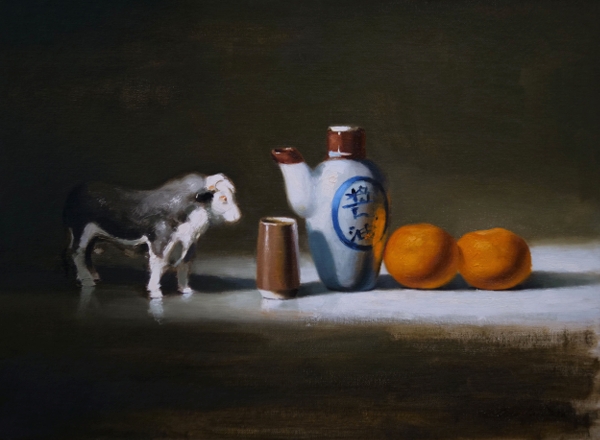
Ali Saad, a graduate of the National College of Arts, Lahore, has established himself as one of Pakistan’s notable contemporary realist painters. Drawing inspiration from the techniques of Dutch Masters such as Rembrandt and Rubens, he uses dramatic contrasts of light and shadow, rich colour harmonies and assertive brushwork to elevate ordinary subjects into moments of thought. His paintings put forward a persistent fascination with observation and the expressive potential of realism. Asif Hussain, considerably younger and trained at the Punjab University College of Art and Design, works within a more symbolic and metaphorical framework. His recent series, The Distance Between Desire, explores themes of yearning, separation and unattainable aspiration through recurring motifs such as the guinea fowl, the moon and the solitary groom. Drawing upon Punjabi folklore and personal mythology, Hussain constructs dreamlike worlds where desire persists despite the certainty of disappointment.
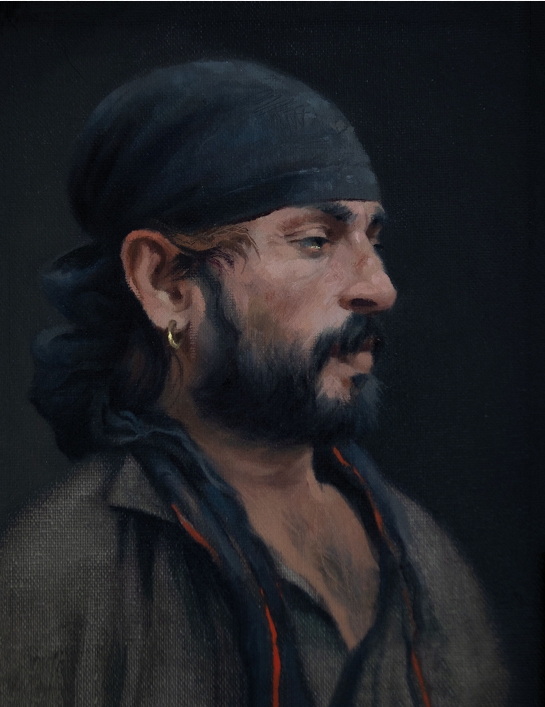
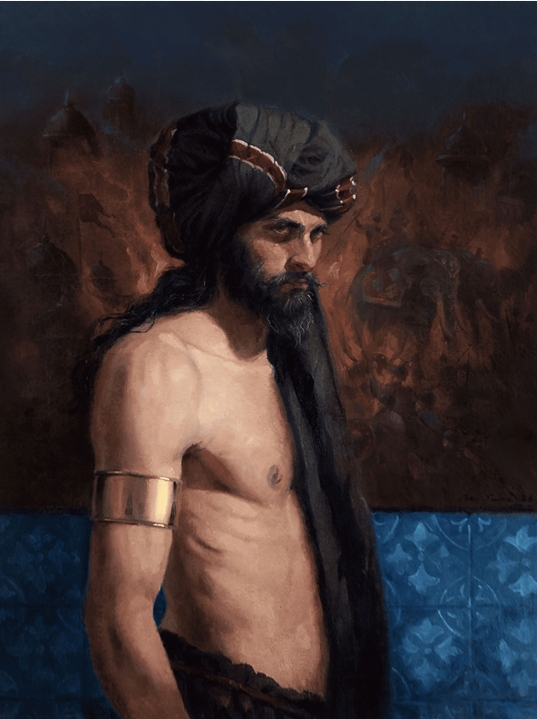
Saad’s work can be understood through two distinct but interconnected groups of works. The first comprises his portraits and figurative studies, including Dara Shukoh, Gypsy II, The Pretender, The Dreamer and Profile of an Oriental Man. These paintings demonstrate his remarkable command over the human figure and his sensitivity to psychological nuance. Despite being portraits, the works highlight inner narratives and emotional states. In The Pretender and The Dreamer, the figures appear absorbed in their own worlds, creating a sense of distance between subject and viewer. Saad’s handling of light is especially significant here; illumination becomes a metaphor for revelation and memory. His subjects seem suspended between presence and absence, embodying the complex interplay of desire and performance.
The second group of Saad’s works focuses on still life and landscape-inspired imagery, including Bull Pot & Oranges, Three Boats, Two Flowers, Thicket, Pigeon and A Pause in Light. These paintings reveal the artist’s ability to find beauty in modest and familiar subjects. While rooted in observational realism, they transcend mere depiction through their careful orchestration of composition and atmosphere. Everyday objects are instilled with a quiet dignity, while landscapes and natural forms become studies in mood and perception. The works testify to Saad’s belief that even the most commonplace subjects possess the capacity to make one wonder when filtered through the artist’s attentive gaze.
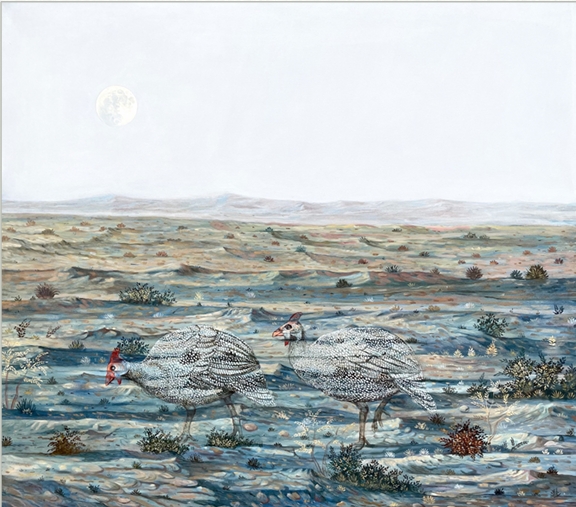
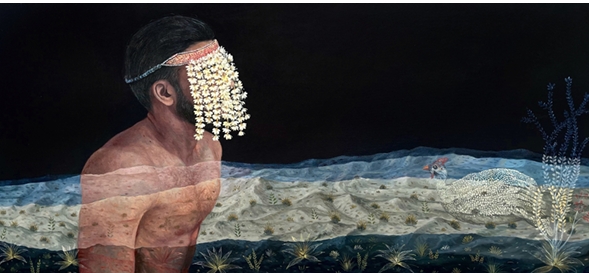
In contrast, Hussain’s untitled paintings are like chapters within a larger visual narrative. Across the series, recurring symbols establish an emotional landscape. The guinea fowl emerges as a surrogate for the human condition; a symbol of yearning towards an unattainable object represented by the moon. The groom appears isolated and suspended within sparse environments, transforming what is conventionally a symbol of union into one of absence and deferred fulfilment.
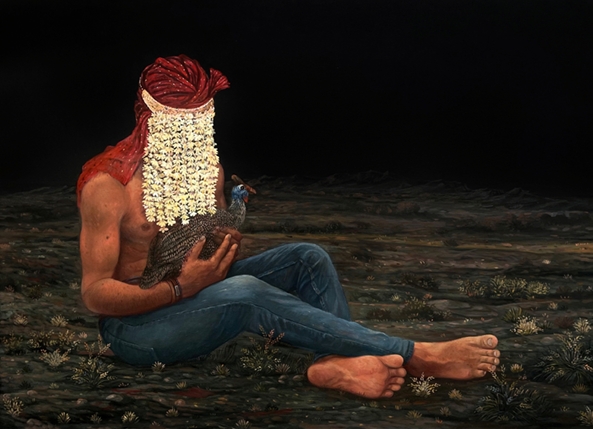
What makes Hussain’s work so fascinating is his ability to transform folklore into a contemporary meditation on desire. He extracts emotional truths from Punjabi love legends and reconfigures them within a personal symbolic language. His paintings do not require literal interpretation, but allow the viewers to inhabit a space between dream and reality. The muted landscapes, enigmatic figures and recurring celestial imagery create an atmosphere that lingers long after the viewing experience.
From the curatorial perspective, with Brothers of the Brush, Aasim Akhtar recognizes the subtle similarities between these seemingly disparate practices. Saad’s realist paintings and Hussain’s symbolic narratives may appear to occupy different artistic territories but both artists are fundamentally concerned with the emotional and psychological dimensions of human experience. Saad approaches these concerns through close observation and painterly realism, while Hussain delivers them through metaphor and myth. And interestingly, both consider painting as a medium capable of conveying expressions of memory and imagination.
The exhibition tells us that realism need not be confined to the visible world; in the hands of these artists, it becomes a gateway to the surreal, enlightening emotional and psychological truths that lie beyond appearances.