
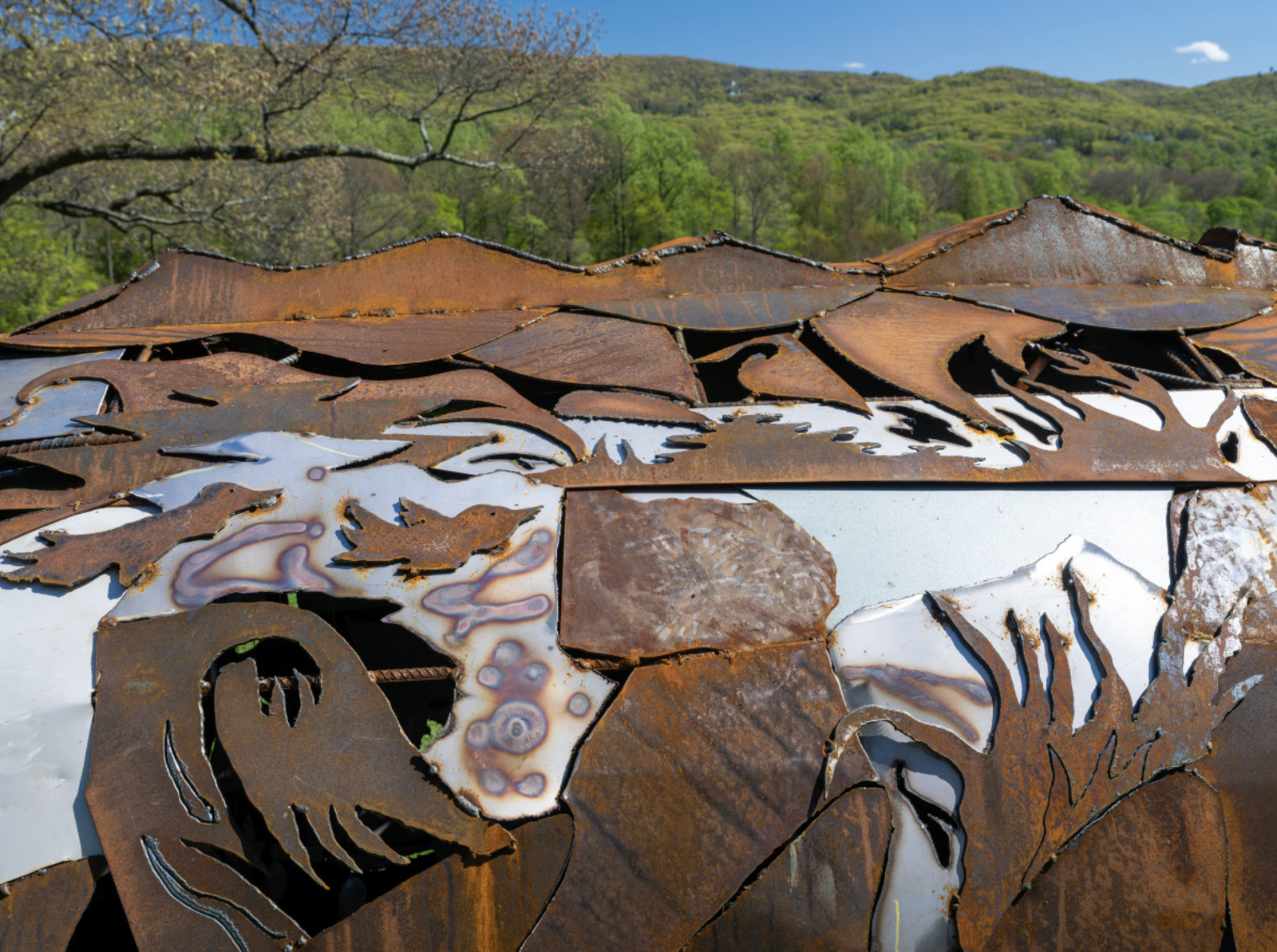
For his first large-scale outdoor public art commission, artist Saif Azzuz presents weych-pues / tàkhòne (where the rivers meet), a monumental sculpture currently on view at Storm King Art Center. Taking the form of a giant sturgeon, the work is both an environmental landmark and a powerful meditation on Indigenous memory, survival, and interconnected histories.
Constructed from steel, aluminum, salvaged car parts sourced from New York’s Hudson Valley, and natural materials gathered from California’s San Francisco Bay Area, the sculpture physically bridges two distant geographies. The project emerged during Azzuz’s 2024 residency at Storm King, where he noticed local signs depicting a sturgeon—a fish that immediately connected him to the Klamath River, which runs through the ancestral homeland of the Yurok people in Northern California.
For many Indigenous communities across North America, the sturgeon represents far more than a species of fish. It is a source of sustenance, cultural knowledge, and continuity. Although sturgeon populations have declined dramatically due to pollution, habitat destruction, and overfishing, the species persists. Azzuz draws upon this resilience to explore the concept of “survivance,” a term coined by Native American scholar Gerald Vizenor to describe Indigenous survival as an active process of resistance, adaptation, and cultural continuation rather than mere endurance.
The sculpture’s surface is engraved with drawings of native plants, Yurok imagery, and texts developed in collaboration with members of the artist’s family and staff at Storm King Art Center. Within the sturgeon’s body hang carved hardwood forms, beads, steel elements, and abalone shells that gently sway with the wind. These details encourage viewers to move around the work slowly, discovering layers of meaning embedded within its structure.
The title, weych-pues / tàkhòne (where the rivers meet), is written in both Yurok and Lenape languages. This linguistic pairing creates a symbolic connection between the ancestral lands of the Yurok people in Humboldt County, California, and Lenapehoking, the homeland of the Lenape people who were forcibly displaced from the Hudson Valley. By bringing these histories together, Azzuz highlights shared experiences of dispossession, resilience, and enduring relationships to land.
Born in 1987 and of Libyan and Yurok heritage, Azzuz has built a practice that combines abstraction, surrealism, and references to the natural world. His paintings and installations frequently examine questions of identity, ecology, memory, and belonging. Drawing upon both his Indigenous and Arab roots, he develops a visual language that challenges viewers to reconsider humanity’s relationship with the environment—not as a resource to be exploited, but as a living network of interconnected beings.
Over the past decade, Azzuz’s work has gained significant recognition. He was a finalist for the 2022 SFMOMA SECA Award and has participated in numerous residency and public art programs, including the Clarion Alley Mural Project and artist residencies with Storm King and Facebook. His works are held in prominent collections including the de Young Museum, KADIST, the North Carolina Museum of Art, the Rennie Museum, and the UBS Art Collection.
With weych-pues / tàkhòne (where the rivers meet), Azzuz expands his practice into the realm of monumental public sculpture while remaining deeply rooted in the themes that have long defined his work. The giant sturgeon stands not only as a tribute to Indigenous histories and ecological knowledge but also as a reminder that survival, like rivers themselves, is sustained through connection, movement, and continuity.
This version reads more like an editorial artist spotlight rather than a press release, making it suitable for publication in an art magazine.