
Last month I visited a fisherman community in Karachi. My friends were engaged with local community workshops at the Rehri Goth school and I merely tagged along, not knowing the great day that awaited me: the conversations, boat ride, and eating locally caught and cooked fish curry and prawn biryani. I met an elderly, kind woman who made jewelry sitting on her takhat. As I searched through the collection to pick something for myself to purchase, a very recurring piece was a beaded cord for glasses. I was told this was quite a hit when these jewelry pieces are sold at local festivals.
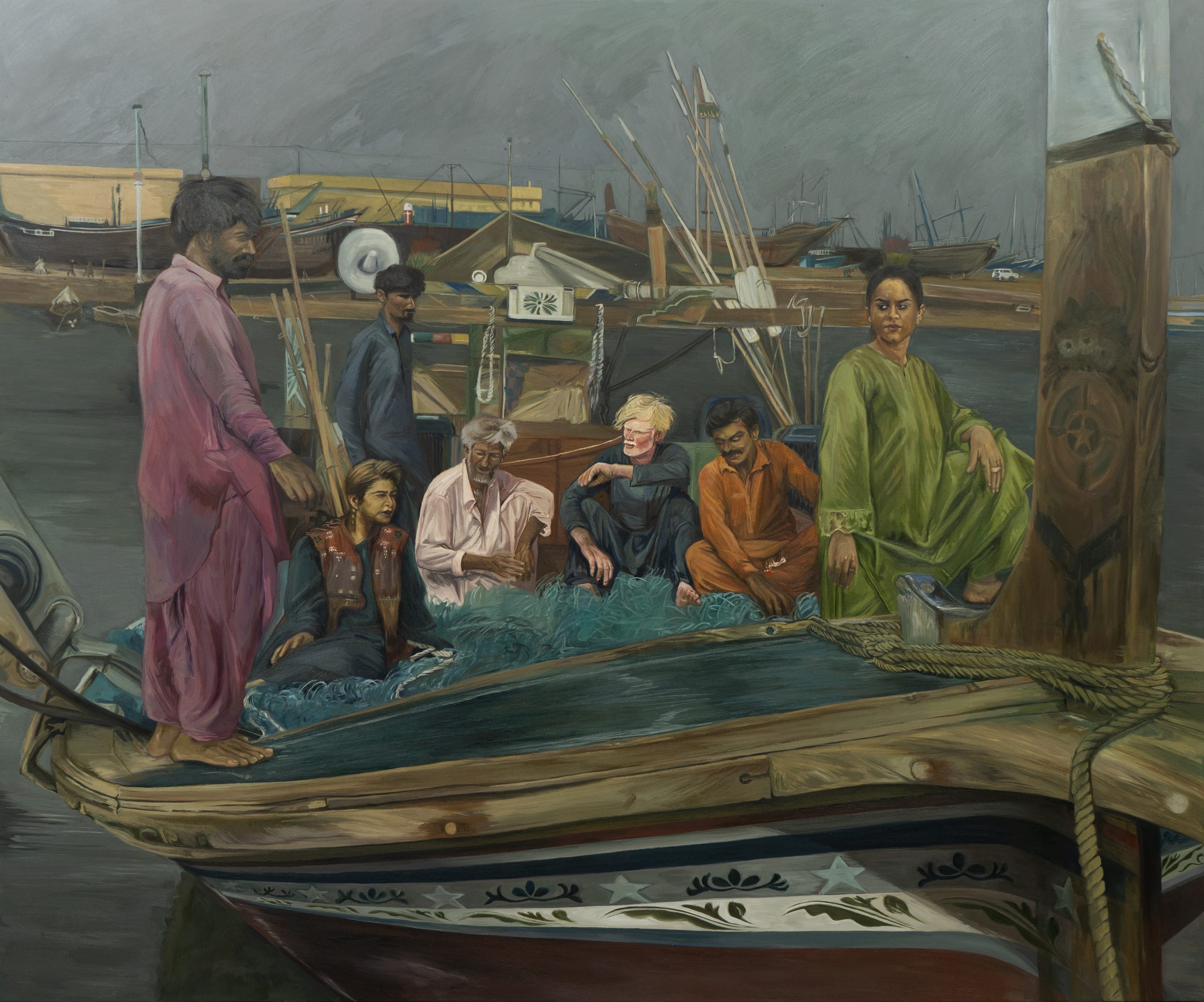
After having this very up-close visit with the fishing community, seeing Amna Rahman’s exhibition, I can’t help but feel a grave sense of disconnection. The artist shares that she has intentionally tried to convey a sense of discomfort from the placement of an out-of-context situation. She has done so remarkably, as when one looks at these images, they think, “This is not how women behave in these situations”. The set of paintings showcases women and their placement amidst power, surveillance and male-centric environments. According to her statement, the artist has expanded her practice through community-based engagement with fishermen and boat-dwelling communities in Ibrahim Hyderi, Sindh. The oil painting “She Takes the Helm I (series)” sets the stage for the series with two women seated on a fishing boat with men. In one of the works, “The Unfamiliar Driver,” she has situated a female inside a water tanker, taking the place of a male driver, whilst in “The Unscripted Scene,” two women join men in a dhaba watching an Indian film, making them self-conscious.
Currently, many stories are surfacing related to artists such as Paul Gauguin, who created paintings inspired by the local women and their practice was laced with appropriation and colonial power. I like that Amna hasn’t revealed the identity of the local women and there’s a kindness in this perspective. However, this raises questions about the women who are painted. According to the artist, these women are inserted into these settings to embody ideas of surveillance and power. The outfits and accessories painted and the staged postures evoke glamour and urban clothing aesthetic, often sold in outlets as unisex or artistic clothing. Some of the paintings could easily be mistaken for editorial work for a fashion campaign.
In fact, in 2003, the music band Strings released a music video “Dhaani”, where women are shown wearing men’s clothes, engaged in jobs traditionally associated with men, like driving a bus. In 2015, feminist collective “Girls at Dhabas” advocated for female agency in public spaces and sitting at dhabas and photographing a casual tea-time in places where men exist socially was their repertoire. This extended into cycling and street cricket. In 2018, the first protests by Aurah March took shape across Lahore, Karachi and Islamabad. The movement has challenged long-standing assumptions regarding where women belong and how they should appear within society. Amna Rahman’s paintings seem to operate within a similar visual and political territory.
But do they offer something different? Do they provide answers to the critique of feminine radicals? Or do they simply illustrate for us what the protestors have advocated for already in 2015? When Amna removes the original women from the community, whose story is ultimately being told? The artist has captured the male gaze with astonishing skill. However, the attire and postures of the female figures take the focus away as they represent aesthetic appeal and don’t highlight the realities of coastal labour. If the male gaze and power in public spaces were the subject matter, it could have been anywhere, any street or any public park. Women and men both are subject to the gaze in any public or private place. Hence, the disconnect I feel from the paintings results from a meek use of place. The setting of coastal life is only a background if not fully activated through the language of painting and insight.
The artist has previously engaged in realistic female figurative painting, in which the subject looks directly at the viewer in a confrontational stance. These figures are positioned in interior and exterior locations that are generic and non-identifiable. I observed that the artist has taken a sharp detour from her practice, where now she has referred to the specific fisherman community of Ibrahim Hyderi. This drastic shift has resulted in her seeing the community from the perspective of an outsider. They are a mere subject matter because the paintings lack empathy and an understanding of the community from the inside. This results in a portrayal from the eyes of an urban woman who is trying to highlight what is wrong with this place that I have visited, projecting opinions on the site rather than the other way around. A work of art forcing community and fieldwork is much less convincing than openly personal work that acknowledges subjectivity. Because the reality is that women are very involved in the fishing community!
As a separate note, apart from the subject, the colors are deep and murky, in continuation with the artist’s figure-painting practice that eludes emotional weight. However, for this set of work, the colour palette is quite the opposite of the lively and fresh environment of the place. I wish the usage of colour were either realistic or the darkness remained the focal point with lesser usage of figures and setting, just like how Amna paints her figures in interior spaces; very focused and impactful. Maybe if Amna had painted herself positioned in these spaces, she would have produced works more intimate and less removed. These paintings could be an early step, a research process before Amna or any other artist takes a deeper dive utilizing the language of painting.
Wouldn’t it be a breath of fresh air to see paintings capturing the reality of local fisherwomen or the wives of chai dhaba owners. I’m curious to know their lives and collaborative efforts. A few weeks ago, I witnessed a young man with his wife and small kid setting up a mango stall together to begin their work day. It was a very humbling experience to see this very real collaboration between the couple in a public setting. I have written this before and I’ll write it again: in contemporary art why is there a need to trigger and disrupt? Here the triggering of a community, showing women without dupattas with fisherman, etc, may result in more harm then it does good in the representation of the community.
It is also important to consider that the subject painted is next to never going to visit the art gallery where they are mentioned and presented. Is it not, then, a matter of inclusion only for the sake of serving the artist and the gallery? For ages, the elites have relied on rural and lesser privileged
communities for aesthetic benefits, idealizing them, and sensationalizing them. These communities are seen as the other; they spend their entire lives in places where the elites might never engage in person. Hence, there is a sense of exoticism associated with underprivileged communities and their lifestyles. Now, when post-colonial practice is the talk of the hour when it comes to art practices, it is imperative to rethink community as well as the feminine as mere exotic subject matter and unlayer and uncover kind and humanist perspectives in painting.
Amna Rahman’s solo exhibition, titled “Locus: Where Eyes Settle,” was on display at Chawkandi Art Gallery, Karachi, from April 21st to 30th, 2026.
Images provided courtesy of Chawkandi Gallery
References
1. Nayha Jehangir, Art Review: Amna Rahman Solo Show at O Art Space: https://www.youlinmagazine.com/article/art-review-amna-rahman-solo-show-at-o-art-space/MjIxNg==
2. Hira Azmat, 5 Years of Pakistan’s Aurat March: The Young Feminist Movement Shocked the Nation Into Paying Attention. But Where Is It Headed?: https://no-niin.com/issue-14/5-years-of-pakistans-aurat-march-the-young-feminist-movement-shocked-the-nation-into-paying-attention-but-where-is-it-headed/index.html 3. Natasha Ansari, Girls at Dhabas: https://www.opendemocracy.net/girls-at-dhabas-safety-respectability-urban-pakistan/
4. Ayesha Mir, A fishing town where women overshadow men: https://tribune.com.pk/story/1072891/making-a-mark-a-fishing-town-where-women-overshadow-men