
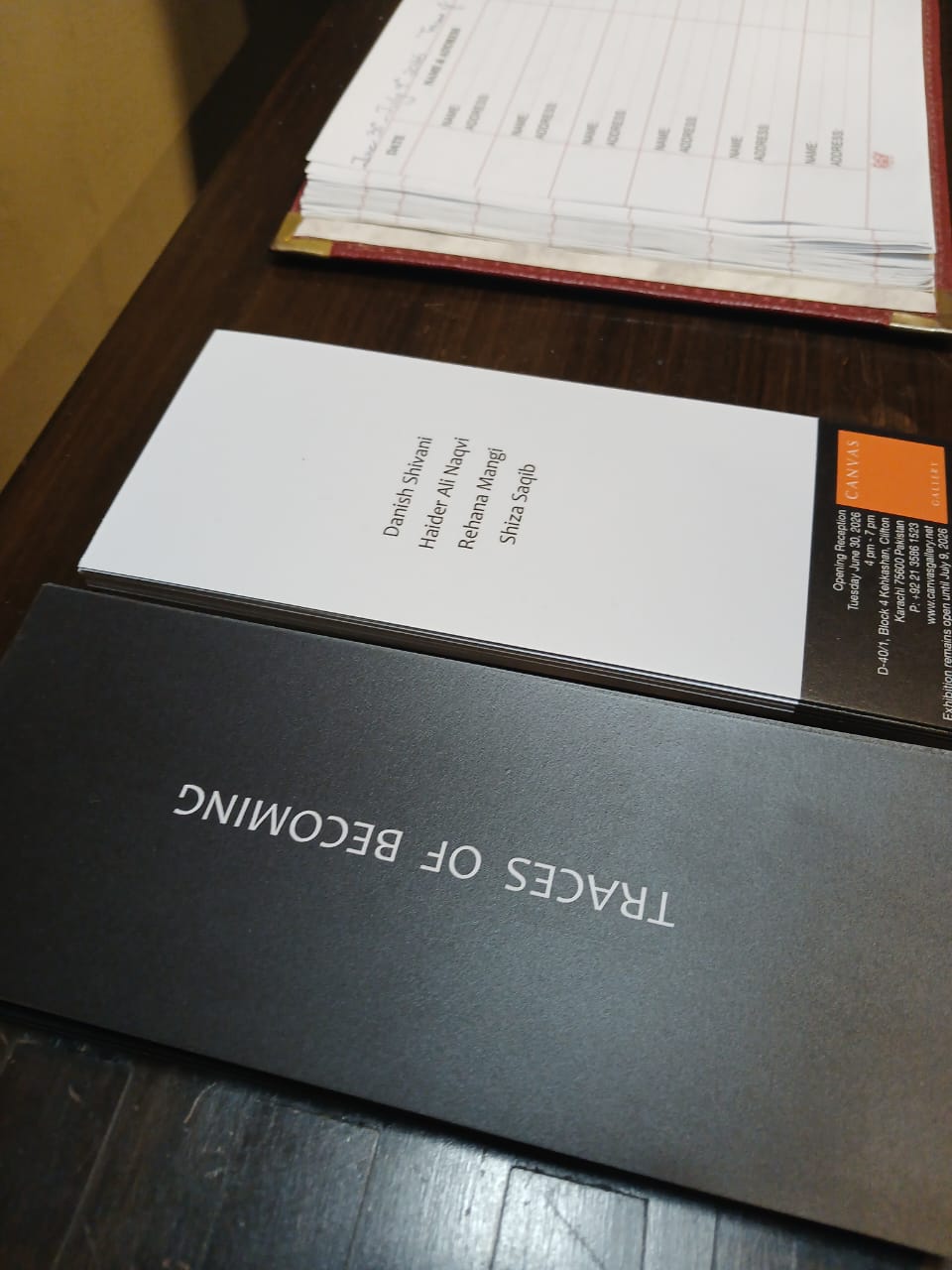
Traces of becoming currently on view at Canvas Gallery, brings together the work of four artists from different academic backgrounds and generations. Featuring Danish Shivani, Haider Ali Naqvi, Rehana Mangi, and Shiza Saqib, the exhibition is united less by a shared visual language than by a common set of artistic concerns. Across drawing, engraving, embroidery, and text-based abstraction, the artists reflect on memory, labor, observation, resistance, contemplation, and the slow formation of identity. While each practice remains distinct, the exhibition demonstrates how these themes can be approached through vastly different materials and processes.
The title suggests that becoming is never complete. It is an ongoing condition shaped by experience, place, repetition, and time. This idea quietly runs through the exhibition, where every work asks viewers to slow down and look beyond immediate appearances.
Among the most visually engaging works in the exhibition are those of Shiza Saqib. From a distance, her drawings appear almost abstract, composed of delicate rhythmic patterns that seem to pulse across the surface of the paper. Only on closer inspection does the viewer discover that these forms are constructed from repeated Urdu words. The act of looking becomes central to the work itself. As hidden text gradually reveals itself, the drawings shift between language and image, between reading and seeing. This movement mirrors Saqib’s own interest in endurance, meditation, and repetition as pathways towards deeper states of awareness. Rather than functioning as written language alone, the repeated words accumulate into meditative landscapes where breath, gesture, and bodily rhythm become inseparable from the image.
Haider Ali Naqvi’s contribution offers a different form of contemplation through his sustained engagement with Karachi. Working from photographs taken during his daily commute, Naqvi translates familiar fragments of the city into meticulously rendered graphite drawings. Their quiet precision slows the pace of urban life, allowing viewers to linger over roads, buildings, and dense architectural forms that are often passed without notice. Alongside these drawings, engraved plexiglass works introduce another layer to his exploration. Although the two bodies of work differ in material, they remain equally compelling, presenting complementary ways of thinking about Karachi. The graphite drawings emphasize patience and observation, while the engraved plexiglass references the city’s commercial visual culture through a material embedded within its streetscape. Together they offer a portrait of a city that is constantly changing while remaining deeply personal to the artist.
Rehana Mangi’s works also reward close viewing, though through an altogether different encounter with material. At first glance, the delicate stitched images resemble finely executed drawings. Only after spending time with the work does the viewer realise that the embroidery has been produced using human hair. This revelation fundamentally alters one’s relationship with the image. Hair, carrying intimate associations with identity, memory, and the body, transforms the works into objects that are simultaneously fragile and deeply personal. Mangi’s labor-intensive process recalls traditions of embroidery and domestic craftsmanship while drawing attention to forms of care and skill that have often remained invisible within histories of art. The discovery of the material becomes an essential part of the viewing experience, encouraging a slower and more attentive form of looking.
Danish Shivani approaches questions of identity and collective endurance through abstraction. His carefully constructed grids of freehand lines evoke systems of confinement while deliberately resisting mechanical precision. The slight irregularities within each mark become reminders of individual presence within larger social structures. Drawing from the experiences of the Kasbi community, Shivani creates works that quietly speak of resilience rather than spectacle. The abstract compositions refuse direct illustration, instead allowing accumulation, repetition, and imperfection to suggest histories that have too often remained undocumented.One of the exhibition’s greatest strengths lies in its refusal to impose a singular aesthetic or narrative upon its participants. The four artists graduated from different institutions and have developed practices that are materially and conceptually distinct. Yet meaningful conversations emerge between them through their shared investment in process. Whether through the repetitive writing of words, the patient rendering of urban landscapes, the painstaking stitching of human hair, or the accumulation of hand-drawn lines, each artist embraces slowness as both method and meaning.
In an age dominated by speed and instant consumption, Traces of Becoming asks for something increasingly rare: sustained attention. These are works that unfold gradually. They encourage viewers to move closer, to spend time with materials, and to recognize that the deepest meanings often emerge only through careful observation. The exhibition succeeds not because it presents four similar practices, but because it demonstrates how different artistic languages can converge around shared questions of memory, place, labor, and the quiet processes through which we continually become.