
I went into “Layer | Impression | Memory” not expecting the title to actually mean anything, group shows often pick a title that sounds nice and then hang whatever fits in the space. But this one stuck with me, mostly because by the time I left, I realized I’d been looking at six very different artists (Achala Gunawardhana, Atif Khan, Choy Khye Fatt, Iram Wani, Stephen Menon, and Sudath Abeysekara) who all seem, in their own ways, obsessed with the same question: what happens to an image, or a memory, once something else gets placed on top of it.
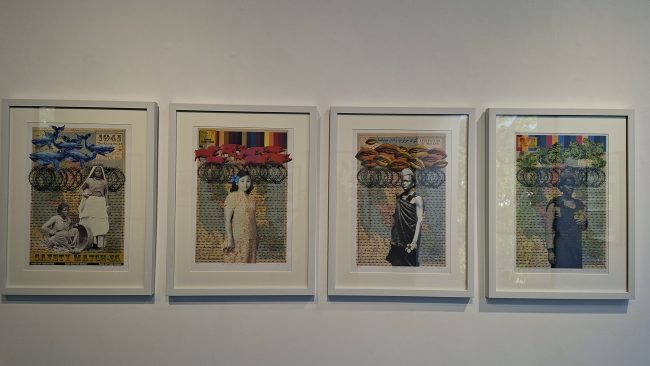
The pieces that grabbed me first were Stephen Menon’s collages. He’s working with old colonial maps of Malaya, the kind with place names in English and Arabic script, borders drawn by people who’d probably never set foot there, and onto these maps he layers black-and-white archival photos of workers and strikers. So far, fairly serious. But then on top of that he adds these strange, almost cartoon-like elements: a school of blue whales, a row of bright pink pigs, a cluster of oversized lips in mustard yellow and orange, frogs sitting on coils of barbed wire. It sounds like it shouldn’t work, and honestly the first time I looked at it I wasn’t sure it did. But it grew on me. The maps already carry a kind of violence, borders as a form of control, and the people in the photos look like they’re trapped inside that control, boxed in by the wire motifs literally drawn around them. The whimsical animals floating above almost feel like a joke that isn’t funny, or maybe a distraction from what’s actually happening underneath.
There’s one piece with “FEDERATION OF MALAYA” printed across the top where the woman in the photo is looking straight at you, while all this visual noise, the wire, the lips, the map lines, presses down from above. I kept coming back to that one.
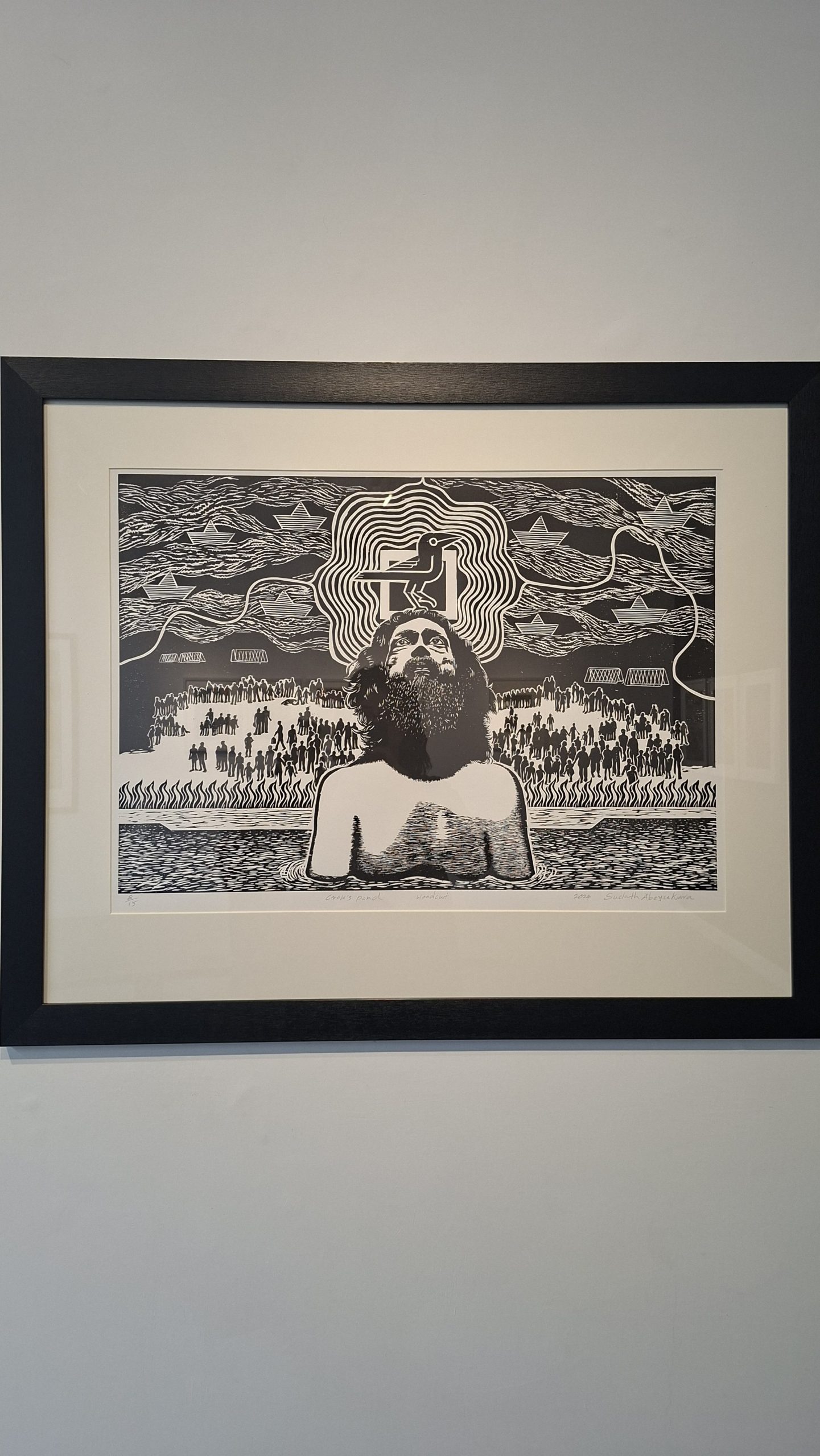
Then there’s Sudath Abeysekara’s woodcut, “Crow’s Pond,” which is a completely different mood, black and white, dense, almost like an old folk illustration. A bearded man stands chest-deep in water, head tilted back, staring up at a crow that’s drawn inside these rippling concentric lines, like the bird is causing some kind of disturbance just by existing. Behind him there’s a crowd, hundreds of tiny figures along the shore, and the sky above is full of paper boats and stars. It has this biblical quality to it, one person and water and a crowd, except the crow refuses to be a tidy symbol. Is it a warning? Is it just a bird he happens to be looking at? I don’t think the print wants you to answer that. What got me more than the imagery, actually, was just thinking about the making of it, every single line in that piece had to be carved out by hand, and there’s something about that level of repetitive, careful work that becomes its own kind of memory, almost like a record of time spent.
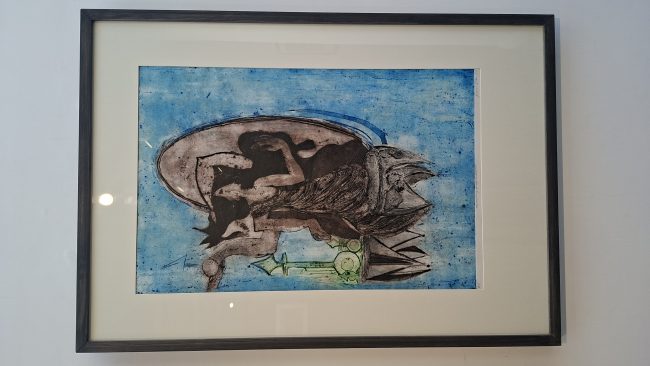
Iram Wani’s etching was quieter and took me longer to sit with. A woman has her back to us, facing an oval mirror, except the mirror doesn’t really reflect her, it shows a slightly different version of her, repositioned. Next to her is some pale green glassware, the kind you’d associate with old chemistry sets or alchemy. The whole thing sits on a mottled blue background that almost feels underwater. Out of everything in the show, this felt like the most literal take on “impression”, not a mirror as vanity, but as this strange, partial encounter with yourself that never quite lines up.
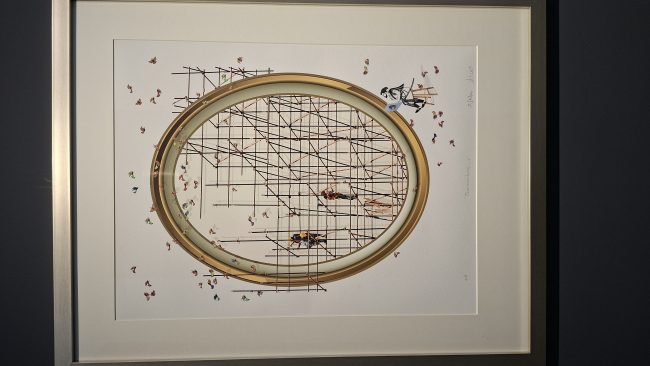
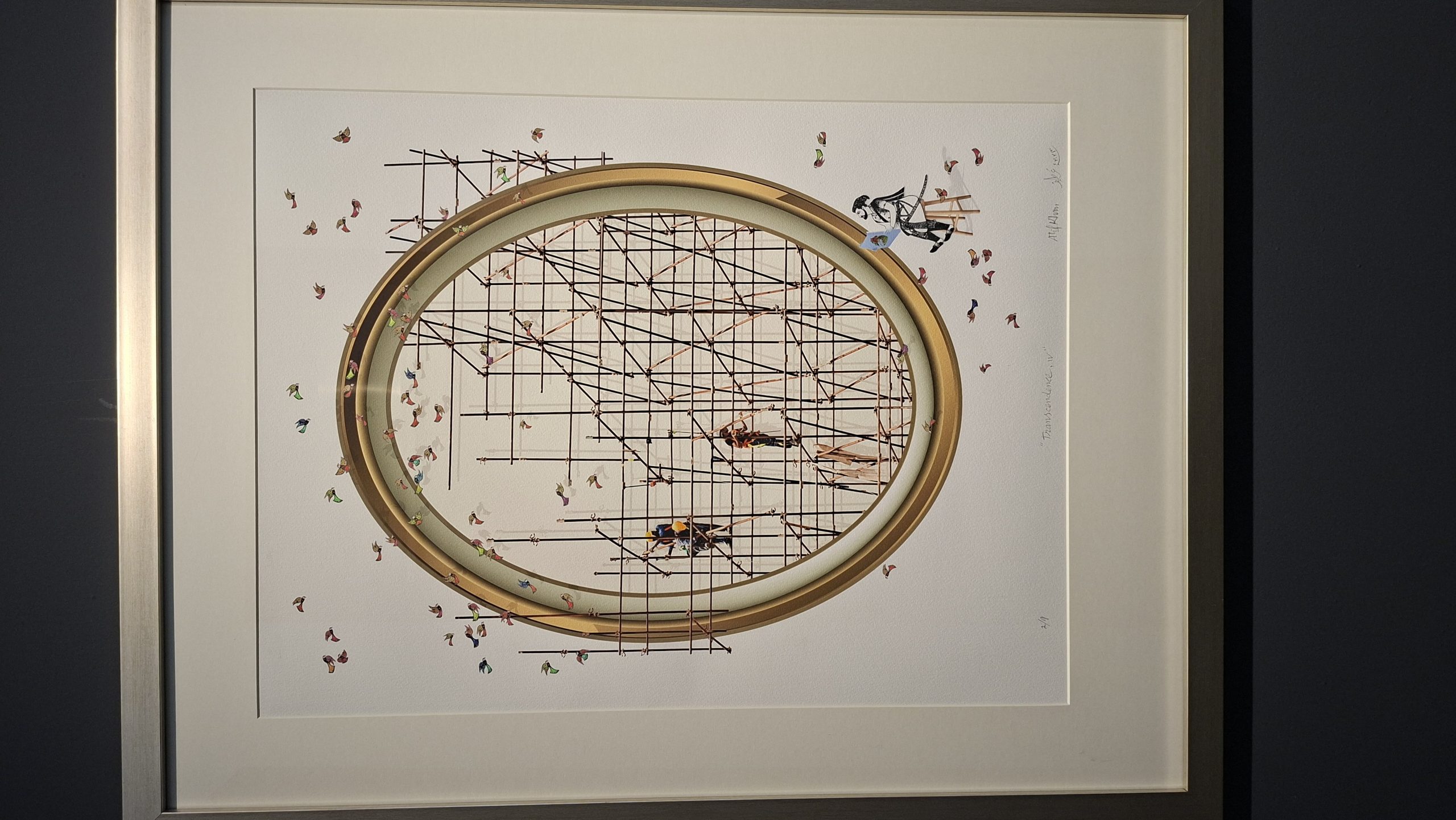
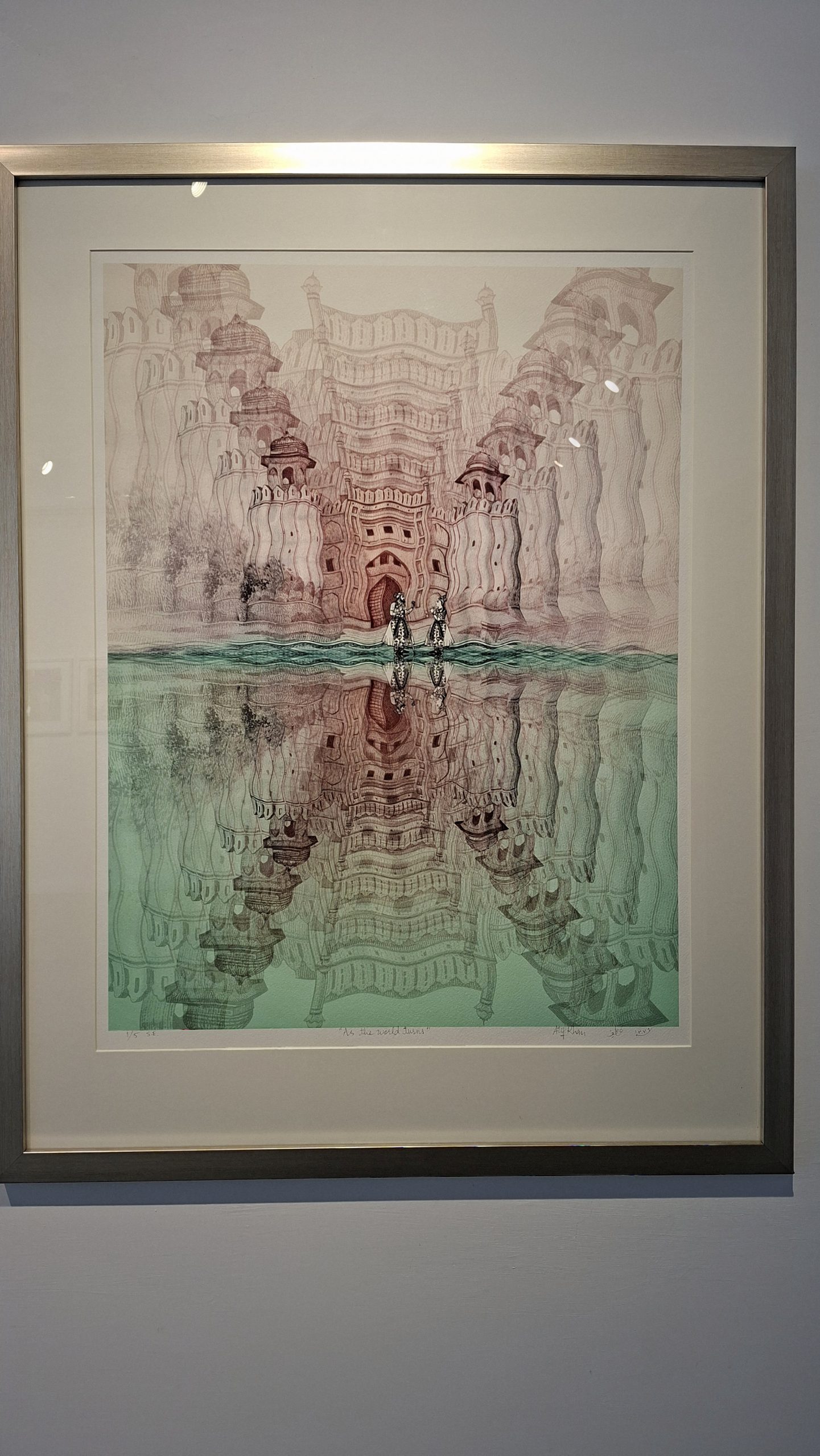
Atif Khan had two large prints, and they took a more architectural route. “Transcendence, IV” has this huge gold oval frame, multiple frames, actually, nested inside each other, completely empty, hovering over a mess of construction scaffolding. Through the gaps in the scaffolding you can just make out tiny figures, workers, almost easy to miss. Small painted birds drift across the whole image, and off in the corner there’s a miniature seated figure in traditional dress, maybe sketching the scene, maybe just watching. I couldn’t stop thinking about the contrast, this elaborate, museum-worthy frame around literally nothing, versus the scaffolding and the workers who don’t get a frame at all. What gets preserved and what doesn’t. His other piece, “As the World Turns,” is gentler, a Mughal fort drawn in delicate red-brown ink, mirrored across a green waterline so the reflection doubles the whole structure. Two small figures stand right at the edge, between the real version and the reflected one. The “layering” here is almost too literal, but it works.
Achala Gunawardhana’s work, a woodcut called “Galle Port,” felt like the most grounded piece in the room after all that symbolism, no mirrors, no maps, no empty gilded frames, just a harbor full of fishing boats at dusk, rendered in dense black-and-white linework. The water takes up most of the composition, all these short, repeated strokes that catch the last light, and a lighthouse sits on the far shore among palm trees, watching over the boats the way it presumably has for decades. It’s the one piece in the show that doesn’t seem to be reaching for a metaphor about memory, it just is a memory, or close to one, a specific place rendered with the kind of patient, line-by-line attention that, again, the act of woodcutting itself demands. Next to all the layered, doubled, reflected imagery elsewhere in the show, its straightforwardness could be noticed.
If I’m honest, I don’t think the show is trying to make one single point about memory. Menon and Khan are doing something more literal, physically layering images on top of each other. Wani and Abeysekara are working more with doubling and reflection, the self-seen from a slightly wrong angle. And the photographs are almost geological, showing what time does to a surface whether anyone’s paying attention or not.But there is something that ties it together, I think. None of these artists present memory as something clean or stored away neatly. It’s always mediated by something, a map, a mirror, a frame, a weathered wall, and that thing in between always leaves its own fingerprints. Walking out, what stayed with me wasn’t any single image, but that idea: an impression is never just received. It’s shaped by whatever it happens to land on.