
The recent Indus Valley School of Art and Architecture (IVS) MPhil Thesis show highlighted the distinct creative practices of two graduates, Mehrin Haseeb and Xindagi Zahra. Through their respective investigations, both artists approach the concepts of time, loss, and memory. Yet, they do so from completely different scales: Haseeb fixes her gaze on the vast, transforming expanse of a regional landscape, while Zahra looks inward, using the microscopic debris of the human body to map personal and familial histories. Together, their works show how exploring unique materials can challenge standard historical and cultural stories.
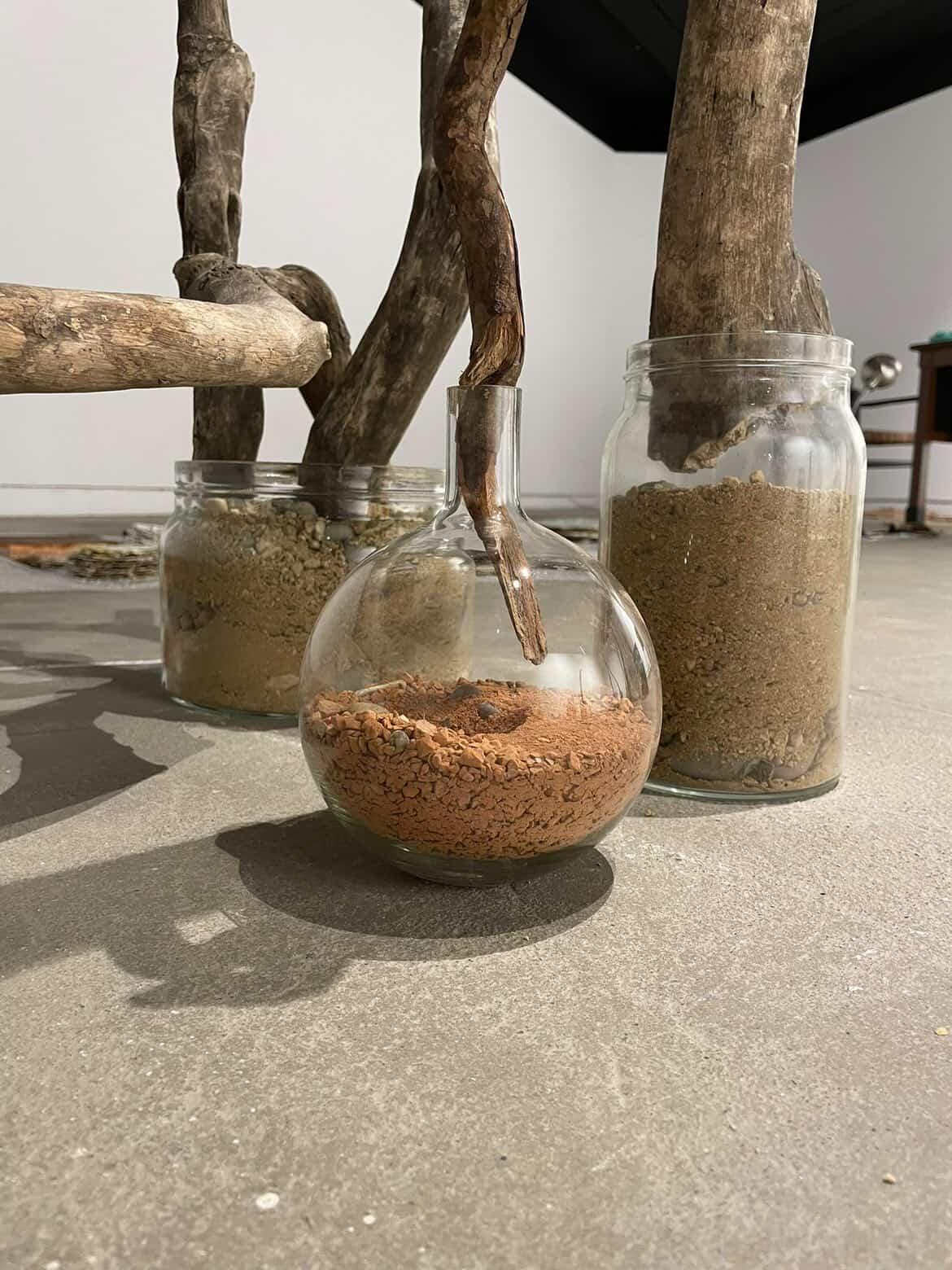
Mehrin Haseeb’s work focuses on how a landscape changes over time, using a specific place—Topi Rakh, an old forest reserve in Rawalpindi now known as Ayub Park—as her primary subject. Born and raised on its edges, Haseeb views the land as a space filled with personal memories, ancient myths, and local history. Her project acts as a direct response to the commercialization and erasure of this childhood playground. Her process combines deep historical research—spanning Sufi poetry, royal memoirs, and colonial accounts—with direct physical contact with the land. Her creative practice is grounded in foraging, where collected bark and leaves serve as both her medium and inspiration. Moving away from traditional paintings, Haseeb developed a layered series titled Kapra (cloth) and Kaghaz (paper). In the Kapra pieces, foraged materials are embedded directly into fabric to hide and reveal nature. The Kaghaz works use recycled paper mixed with forest debris, drawing inspiration from the mythic tales her father read to her as a child. Through these materials, Haseeb constructs a physical archive that addresses ecological and historical loss.In contrast, Xindagi Zahra’s project, Compost, positions the human body as an archival site, focusing on a deeply intimate, domestic scale. Zahra investigates the tangible markers of time by collecting discarded, shed hair from brushes, vacuum cleaners, and drains. For Zahra, each strand functions as a genetic record and a physical sign of the aging process. Her practice untangles these physical remnants alongside the spoken stories of her mother, who describes her own experience of accelerated aging driven by social and cultural expectations. By utilizing her own shed hair as an embroidery thread, Zahra engaged in a demanding studio process to create delicate embroidered forms that challenge the negative cultural views of women aging.
Linking her practice to the concept of compost—inspired by her mother’s love for gardening—Zahra treats the physical decline of the body not as a process of being thrown away, but as a necessary site for renewal, regrowth, and gentleness toward oneself.When viewed together, Haseeb and Zahra present a compelling contrast between large environmental shifts and small bodily transformations. Haseeb investigates the outer landscape, tracing how an ancient forest turns into a place of business, while Zahra examines the inner landscape of the home, charting how cultural pressures change our internal sense of aging. Despite these differences in scale, their practices share strong conceptual foundations. Both artists rely on their parents to anchor their work in family memory, using childhood stories and maternal conversations to interpret the passage of time. Furthermore, both reject static preservation; Haseeb uses layers to show that history is built in overlapping strata, while Zahra uses the metaphor of compost to emphasize that decay is part of a cyclical change. Both artists ultimately use non-traditional, gathered materials to fight against the erasure of identity.
The significance of these works lies in how they elevate personal vulnerabilities into broader social critiques. Haseeb’s defense of Topi Rakh addresses the urgent realities of urban development and environmental degradation. By documenting the commercialization of an ancient forest reserve, her work critiques a mindset that prioritizes commercial real estate over ecological heritage and community memory. Her pieces mourn an environmental loss while asserting that a community’s sense of belonging is tied directly to the preservation of its natural spaces. On the other hand, Zahra’s Compost addresses the gendered pressures surrounding the aging female body. In a culture where a woman’s value is frequently linked to youth, public conversations about physical decline are often avoided or framed negatively. Zahra brings these themes into focus by documenting her mother’s experiences and using her own genetic material to confront them. By translating the debris of hair into delicate embroidery, she reframes aging from a process of decay into an act of rewriting personal narratives, offering a strategy for self-reconciliation and cultural resistance.
Ultimately, the works presented in the thesis show underscore the vital role of the IVS MPhil program in fostering rigorous, research-driven creative practices. By framing artistic practice as a form of research, the program provides the institutional support and critical framework necessary for artists to push beyond conventional boundaries. Haseeb’s transition from traditional painting to tactile, material-embedded paper and cloth works, along with Zahra’s discovery of human hair as a viable embroidery medium, demonstrate the fruits of sustained studio experimentation. The program’s focus on exploring issues through a critical lens encourages graduates to engage deeply with fields like critical ecology and socio-cultural theory. This approach ensures that the resulting artwork moves beyond a simple aesthetic exercise, contributing fresh discourse and alternative mediums to the contemporary art landscape.