
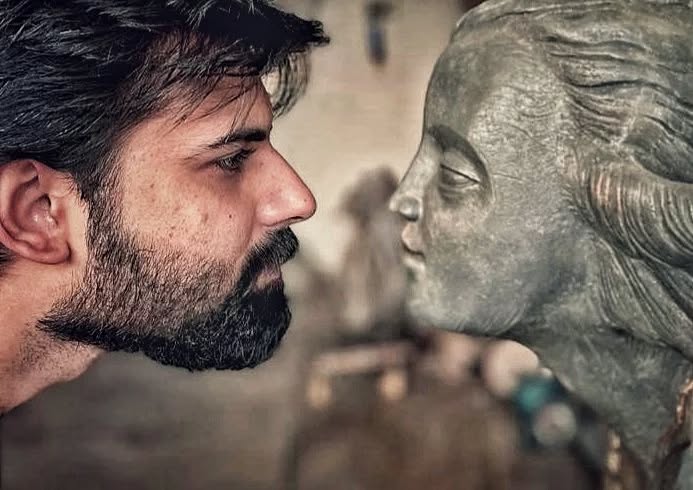
The dualistic landscape of the twin cities, comprising the sterile, meticulously planned grid of Islamabad and the storied, palimpsestic sprawl of Rawalpindi, has undergone a profound tectonic shift in recent years. For decades, this region was dismissed as a mere enclave for bureaucratic formality, garrison bareness, and the polite diplomatic art. Yet, beneath the surface of this joined-at-the-hip urbanity, a new contemporary identity is being forged by a defiant new generation of practitioners determined to transcend the twin cities’ long-lingering, infamous, creatively sterile boundaries.
For years, Islamabad and Rawalpindi’s art scene was defined by traditional aesthetics and a reliance on the National Art Gallery, a monument intended to exhibit national art but that remained largely underutilized. While the twin cities may not offer the immediate grit and commercial buzz synonymous with Lahore or Karachi, they continue to offer a noiseless atmosphere that allows the luxury of creation for those seeking deliberate isolation. A new breed of artists from the Twin Cities is slowly but insistently carving out its own niche within the national art discourse. The establishment of the National College of Arts campus in Rawalpindi has served as a catalyst. Coupled with the planned expansiveness of the less-jostling Islamabad, the twin cities are cultivating an inherent art culture and temperament of their own.
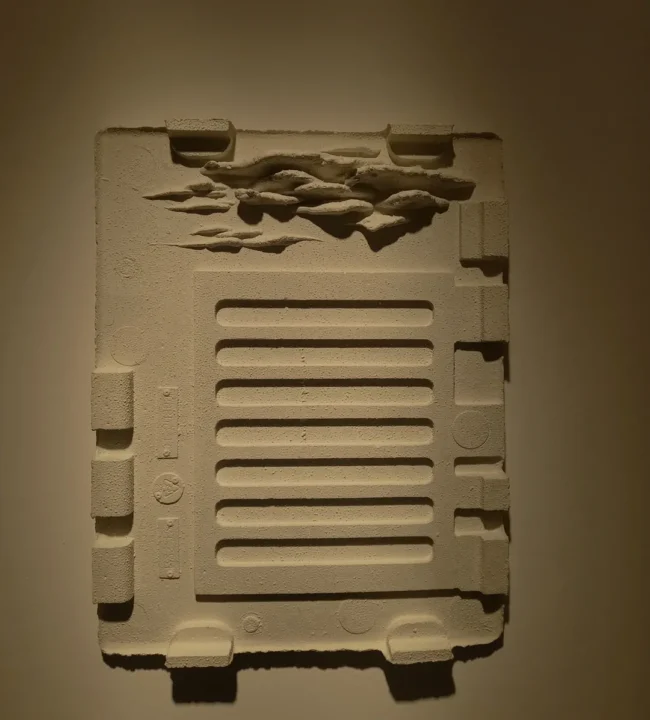
Husband and wife duo, Nazeer Hunzai and Fatin Suleman, reside in Islamabad. Graduates of Rawalpindi NCA from the batch of 2012, they are the prefect representatives of this vanguard. While their individual practices range from the deconstruction of classical form to the friction between the organic and the industrial, they are bound by a commitment to redefine personal expression within a global aesthetic.
Nazeer, known as Maggie by his friends, hails from Hunza. He discovered his knack for art in Karachi, but established it in Islamabad. He processes the curse of evolution through a poignant commentary on the mechanized world. “I see it as a dangerous trend that young artists are depending on artificial intelligence to generate ideas. In contrast, I always craved experimentation during my formative years and that is perhaps why I selected sculpture as my primary medium. I never fixed my language and continued to evolve with time and continue to explore new dimensions. I get triggered by nature as an artist, and Islamabad helped me a lot. When I started living here, my studio was next to a green belt. I observed the squirrels, the mongoose, and the insects, and how there was a constant encroachment battle between man and nature. I found it very fascinating.” Nazeer recollects. Unsurprisingly his sculptures and drawings continue to explore the miraculous nature that surrounds the raw human existence. Away from the fad-istic trends, Nazeer divides his time between teaching at his alma mater and his studio practice.
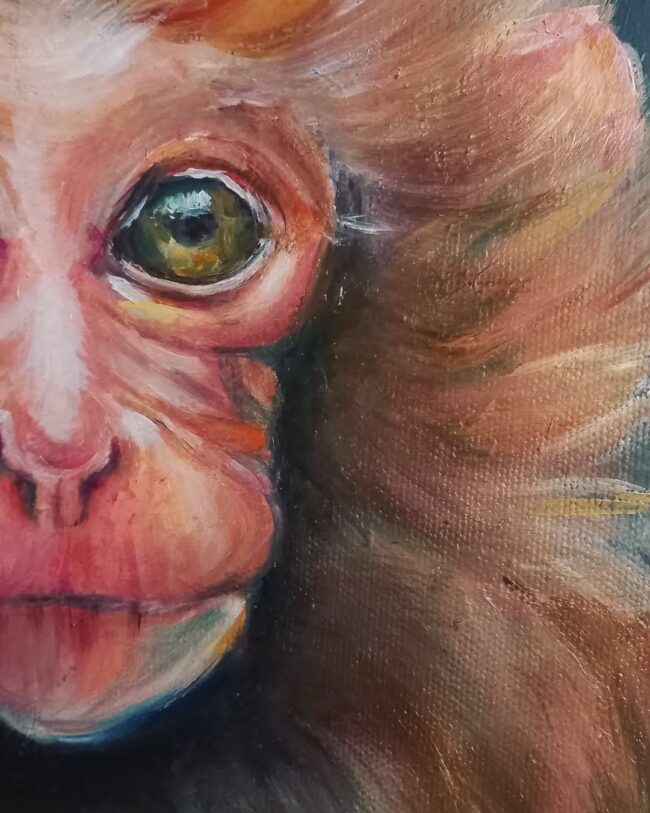
Fatin Suleman’s practice also benefits from the quiet isolation of the Islamabad grid. If Nazeer’s work explores the external, Fatin excavates a profound internal, domestic landscape. Her paintings and mixed-media pieces are a visual journal, documenting realities of motherhood that are rarely afforded such unvarnished honesty. “I used to paint from a young age and my parents encouraged me a lot. I painted on doors and even an old television set that I had in my room. When I came to NCA, I learnt about the figure, particularly the female figure. I think my work has mostly taken its direction from personal traumas or changes in my life. My work can be described as a visual diary. When I became a mother, I suffered from post-partum depression. I painted the joy of motherhood, juxtaposed with frustration as I lost control over my own life.”
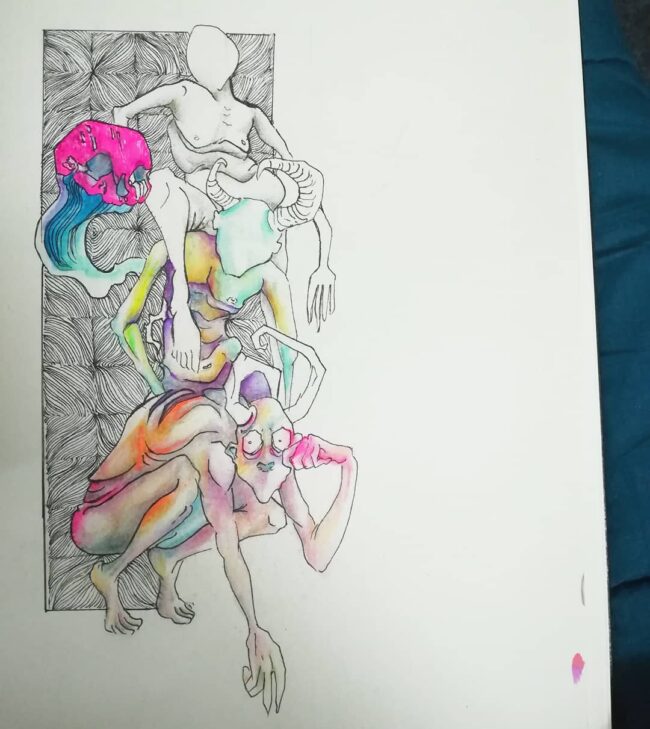
In her canvases, the maternal experience is stripped of its romanticized tropes and replaced with a visceral intensity. This tension is most vividly captured in her recurring use of monkeys as a metaphorical stand-in for children. By using these primates, a frequent sight in Islamabad, Fatin highlights the untamed, often exhausting nature of nurturing, while simultaneously celebrating the fierce, instinctive bond that defines it. Islamabad provides Fatin a silent, rhythmic pulse, proving that the most intense grit actually exists within the confines of the home and the self. While they are bound by their shared history at NCA Rawalpindi, Nazeer and Fatin’s voices remain distinct in how they process their surroundings and what is happening in them.
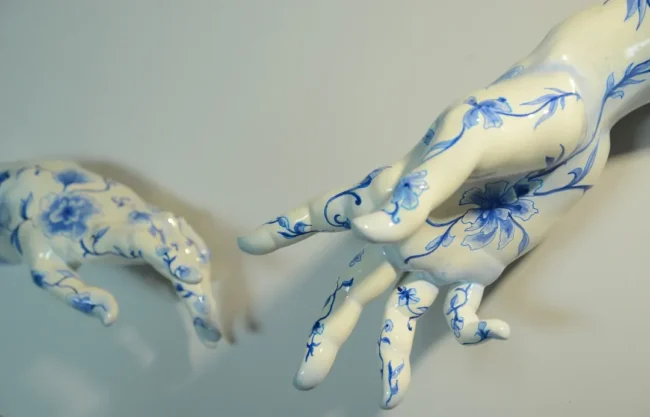
Jibran Shahid’s work is characterized by an almost clinical approach to form. Specializing in large-scale oil paintings, sculpture, and ceramics, most notably porcelain, Jibran navigates the delicate boundary between tradition and hybridity. For Jibran, it has been a constant journey of discovery. From oil to acrylic to sculpture, he has experimented with many mediums and themes. “Most recently, I have started to get inspired by climate, change and environmental degradation around us. You will see gas masks have started appearing in my work. Earlier, I used to depict otherworldly and mythological themes but now even my themes are finding new directions – those that are more physical and immediate.” As his work transitions to the next phase, Jibran is perhaps also chronicling the transformation of the cities he calls home.
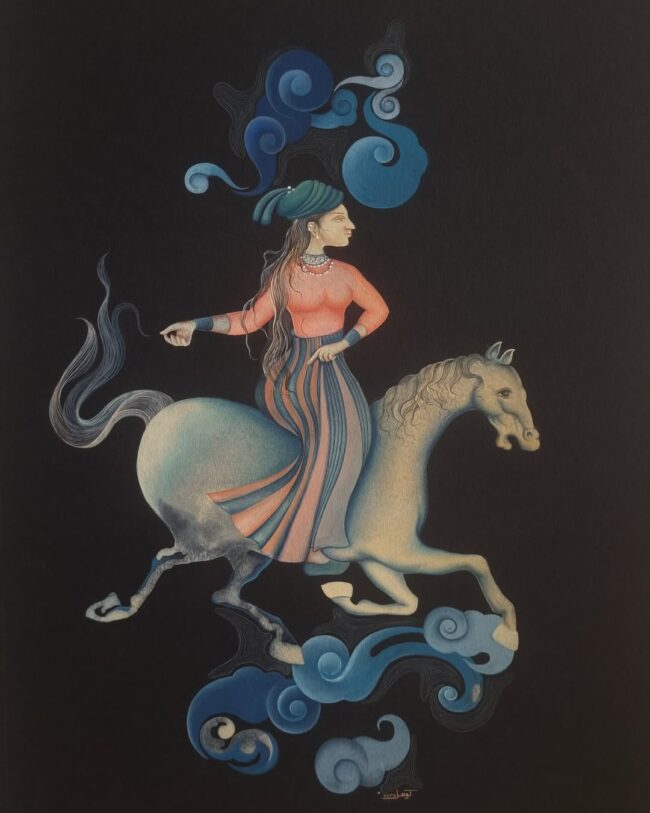
Komal Shahid graduated from the University of Punjab in 2012, majoring in Fine Arts, followed by a Master’s in Fine Arts from Fatima Jinnah Women’s University Rawalpindi. An adherent of the Pahari miniature tradition, she enjoys experimenting with both the subtle washes of neem rang and the opaque richness of gad rang. In her own words, she describes her works as a continuous unraveling of themes: the sharp sting of mockery, the unsettling dance of human puppetry, the fleeting spectacle of the circus and its tricks, and the relentless pull of mortal desires. Her technical hand has journeyed from a controlled illustrative style towards one that is luxuriantly ornamental. “Islamabad has been very limited in resources, fewer galleries, not many art critics, and fewer art collectors than Karachi or Lahore. I exhibited in Karachi and Lahore at the start of my career, so I never felt disconnected that way. I also had the fellowship experience with the South Asian Institute at Harvard, so I never felt disadvantaged while practicing my art in Islamabad.” While staying connected with the more mainstream art scene at the national and international level, her work remains deeply personal, pulling together a dream world where tradition gives way to fantasy, and every detail carries a quiet confidence of someone rooted in the old, but dreaming ahead.
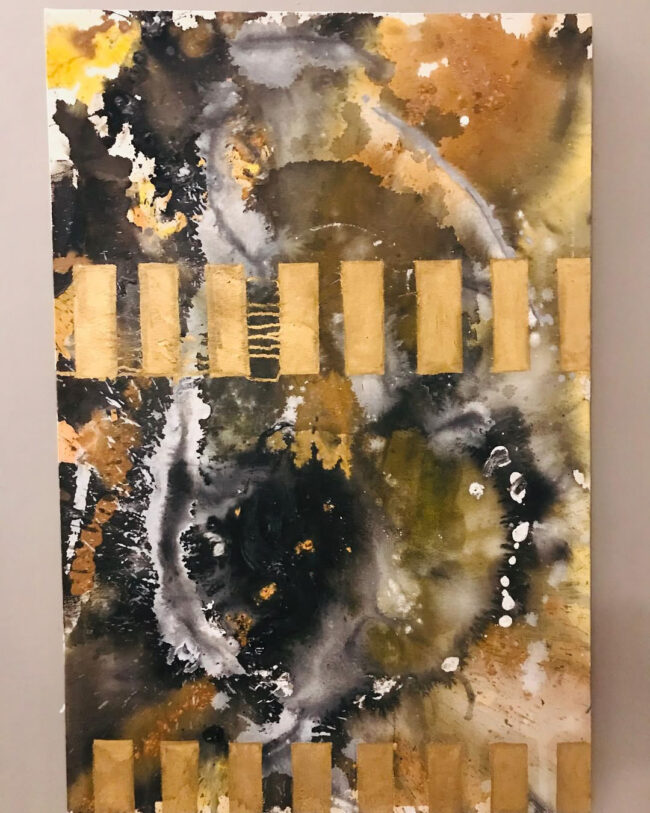
Noor Fatima is a visual artist, curator, and cultural practitioner whose work bridges artistic practice with curatorial research and cultural programming. With a Bachelor’s in sculpture from NCA Lahore, completed in 2016, Noor also serves as a curator at the Pakistan National Council of the Arts. Her artistic practice explores the relationship between emotion, memory, and imagination, drawing from personal experiences and reflections. Through sculpture and painting, she constructs layered visual narratives that move beyond the ordinary. According to Noor, the spread of creative studio practices in the capital has made the younger generation of artists less dependent on the ‘traditional gallery’. “The audience is also developing. It’s not as large or commercially active as Lahore or Karachi, but there’s definitely more curiosity now than before. The studio culture is more cross-disciplinary and builds a different kind of practice which is more inward looking, more research driven, and less influenced by market pressures.”
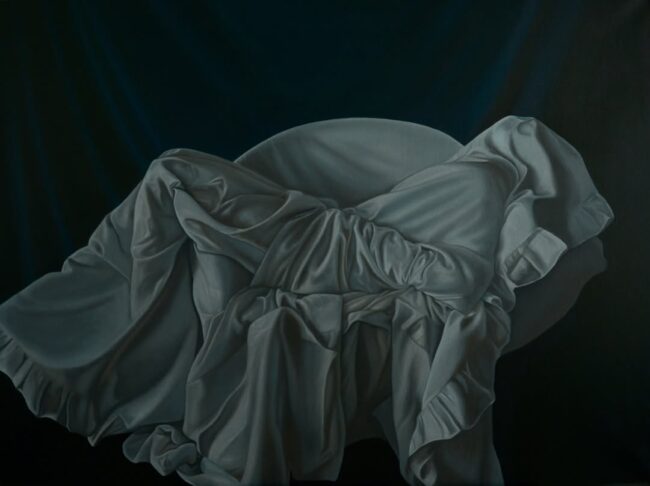
Specializing in oil painting, Ammama Malik graduated with a degree in painting from NCA Rawalpindi. She has also carried a classical approach to art, influenced by Renaissance and Baroque traditions and yet very independent. She describes her work as “painting for the sake of painting,” emphasizing the fundamental value of the medium itself. Her art revives classical aesthetics, focusing on emotive brushwork, dramatic lighting, and precise realism. She often portrays subjects in dreamlike states, using drapery not only as a visual element but also as a symbol of concealment and protection, creating a dialogue between historical art forms and contemporary themes. Protecting her independence unapologetically, Ammama deliberately pushes language and conceptual framing to the periphery, allowing the act of painting itself to lead.
Just as a traveler navigates the two cities that are joined at the hip yet hold on to their unique characteristics with quiet protectiveness, Islamabad and Rawalpindi find their voice in these artists, who translate universal inquiries into their personal creative journeys.