
History often survives through what it chooses to remember. The Mughal Empire (1526–1857), one of South Asia’s most extensively documented dynasties, left behind an extraordinary archive of chronicles, court records, manuscripts, and miniature paintings. From Babur to Aurangzeb, imperial historians meticulously recorded battles, courtly rituals, political alliances, and the lives of rulers. Yet these records are far from complete. They privilege emperors, nobles, military victories, and monumental architecture, often relegating women and other non-elite figures to the margins. The result is a deeply gendered historical record in which male authority occupies the centre while countless women survive only in fragments and footnotes.
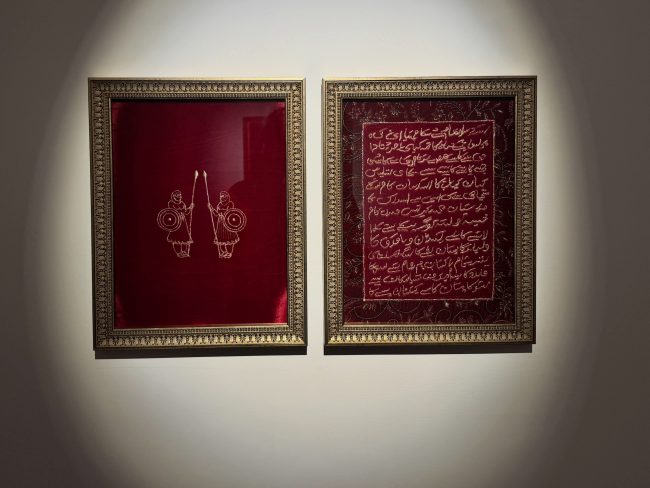
Behram Farooqui’s Begi-Nama, presented as part of Vasl Artists’ Association’s fifth Museum Series edition, Museum of Unseen, engages directly with these omissions. Through a body of works inspired by the little-known Urdubegis of the Mughal Empire, Farooqui examines the limits of historical memory and the structures that determine whose stories are preserved.The exhibition takes as its starting point the historical references to the Urdubegis, female guards tasked with protecting the imperial zenana and, at times, the emperor himself. References to these women appear as early as the reigns of Babur and Humayun and continue into the later Mughal period, particularly after Akbar formalised the administration of the imperial harem. Trained in archery, lance combat, and palace security, they occupied positions of considerable trust within the court. Yet despite their proximity to power, very little is known about them. No confirmed visual depictions survive, and historical accounts mention them only briefly. Their lives remain overshadowed by the emperors they served and by the male-centred narratives that have long shaped Mughal historiography. The fact that the only Urdubegi known by name today is Bibi Fatima, whose story survives largely through the writings of Gulbadan Begum rather than official court histories, highlights how women’s histories often endure through scattered references rather than sustained documentation.
Rather than attempting to reconstruct these women, Farooqui embraces uncertainty. Begi-Nama functions less as an act of recovery and more as a speculative archive. The works acknowledge the impossibility of fully knowing these figures while resisting their complete disappearance. In doing so, the exhibition occupies a space between history and imagination.
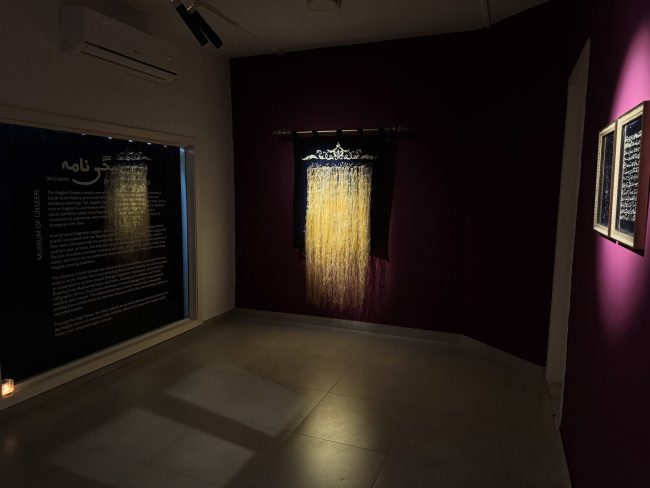
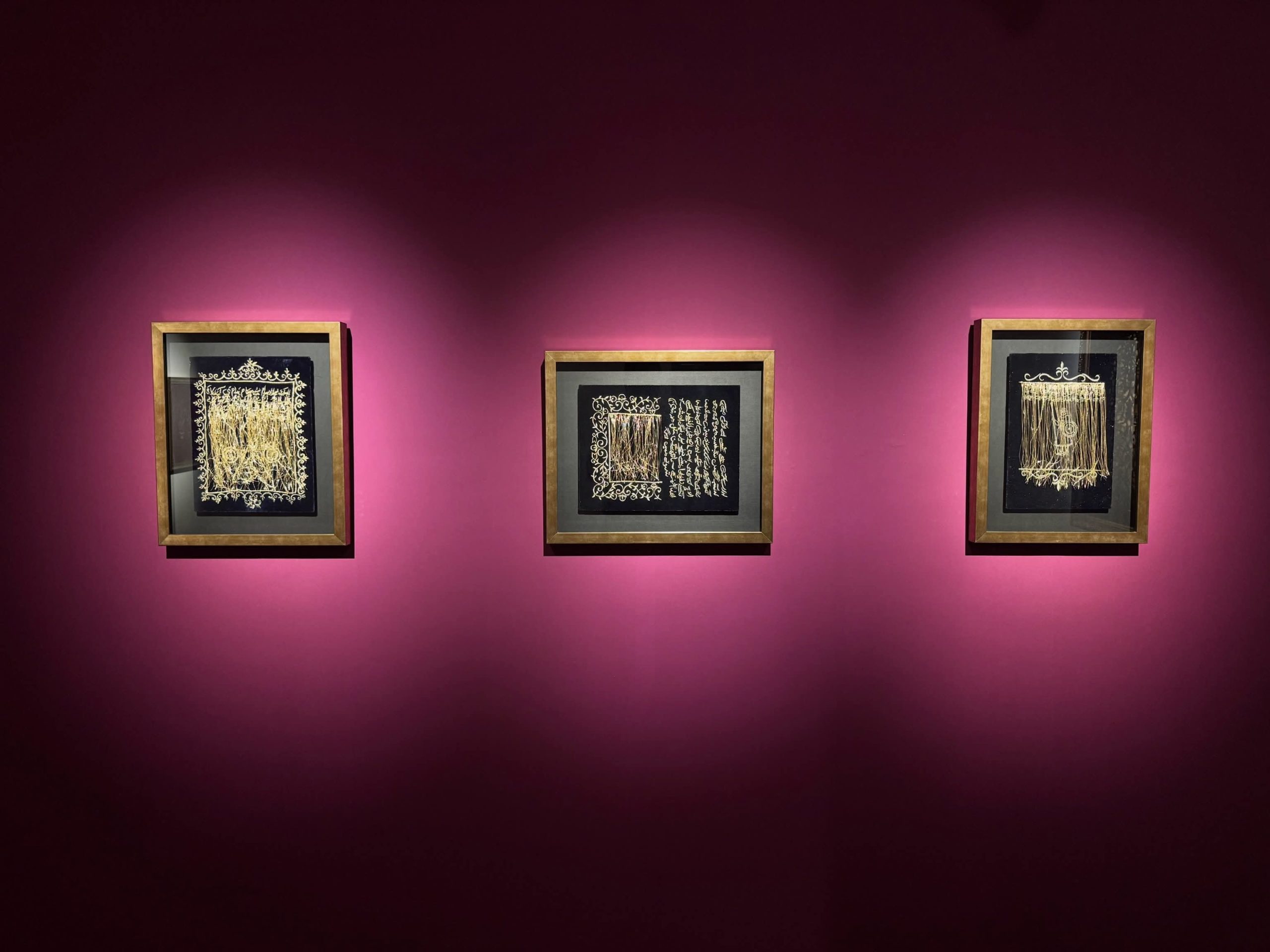
Visually, the exhibition draws heavily from Mughal miniature painting traditions, manuscript culture, and Persian calligraphic practices. At first glance, the works evoke the aesthetic language of imperial archives and courtly documentation. Yet this familiarity quickly gives way to ambiguity. Figures emerge only partially, forms dissolve into decorative surfaces, and texts remain illegible. The viewer is repeatedly confronted with imagery that appears archival but resists interpretation. Particularly compelling is Farooqui’s use of embroidered text. Across the exhibition, script is not used for communication but as an object to be viewed. The embroidered passages recall manuscripts and official records, yet remain unreadable. This transforms language into a visual form rather than a textual one. Evidence appears to be present, but its meaning remains out of reach. The viewer encounters a challenge similar to that faced by historians working with incomplete records, where fragments suggest stories that can no longer be fully reconstructed.The choice of embroidery is equally significant. Traditionally associated with domestic labour and feminine craft practices, it introduces a tactile dimension that contrasts with the authority typically associated with written histories and official records. Through this material choice, Farooqui creates a dialogue between institutional forms of documentation and the quieter forms of memory that often exist outside them.The exhibition’s greatest strength lies in its refusal to offer certainty. The works neither claim authenticity nor present themselves as recovered truths. Instead, they foreground speculation as a valid artistic strategy. This approach encourages viewers to think not only about the Urdubegis themselves but also about the broader processes through which historical knowledge is produced.
This concern resonates strongly within South Asia, where colonial, imperial, and nationalist histories have often privileged rulers, military achievements, and monuments over the lives of ordinary individuals. By focusing on figures who exist at the edges of documentation, Begi-Nama shifts attention away from dominant narratives and toward those who have remained largely invisible within them.As part of Museum of Unseen, the exhibition feels particularly apt. It does not seek to resolve historical silences or offer definitive answers. Instead, it asks viewers to reflect on what remains unknown and why. Through a careful engagement with Mughal visual traditions, material processes, and historical fragments, Farooqui draws attention to lives that have long existed at the margins of the historical record.Ultimately, Begi-Nama asks viewers to consider why figures such as the Urdubegis remain largely absent from history despite their proximity to power. By focusing on these omissions, the exhibition reveals how historical narratives are shaped not only by what is preserved, but also by what is forgotten. In doing so, it gives presence to histories that have long remained unseen.