
A three-person show, ‘Bayaan’ exhibited at NumaishGah Gallery, is a visual narration of possibilities embedded in Urdu script.
In a time when language is increasingly commodified, abbreviated and digitized, the latest exhibition at NumaishGah Gallery in Lahore titled ‘Bayaan’, offered a deeply reflective counterpoint. Bringing together the works of Faizan Reindiger, Imran Baloch, and Zakir Baloch, the show explores the visual, emotional, and political possibilities embedded in Urdu script, not as mere text, but as material, memory, and metaphor. Each artist, working across distinct mediums and conceptual registers, uses the letterform not for its linguistic function but for its aesthetic presence and symbolic weight.
Faizan Reindiger’s work unfolds like a visual mantra; quiet, methodical, and spiritually charged. In this exhibition, his canvases present a dense yet soothing field of motion, crafted entirely from painstaking repetitions of Urdu and Arabic letterforms. His technique, using an architect’s pen to render micro calligraphic strokes, bridges the sacred and the scientific, resembling both scripture and cellular formations.
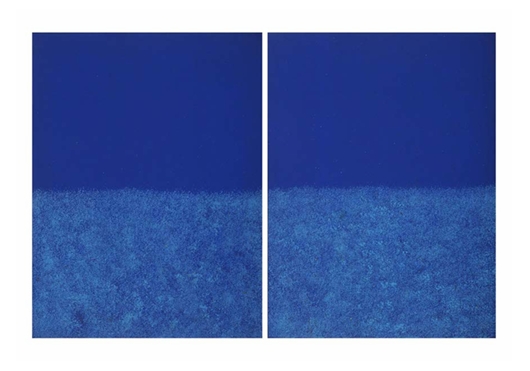
At first glance, pieces may appear as minimalist color fields, but upon closer inspection, they reveal a meticulous world of rhythm and vibration. The forms suggest geological landscapes; undulating dunes, horizons, and submerged terrains, drawn not with brushstrokes but with the looping pulse of script. The letterforms are barely legible, dissolving into abstraction, allowing the viewer to experience language not as text, but as texture and tempo.
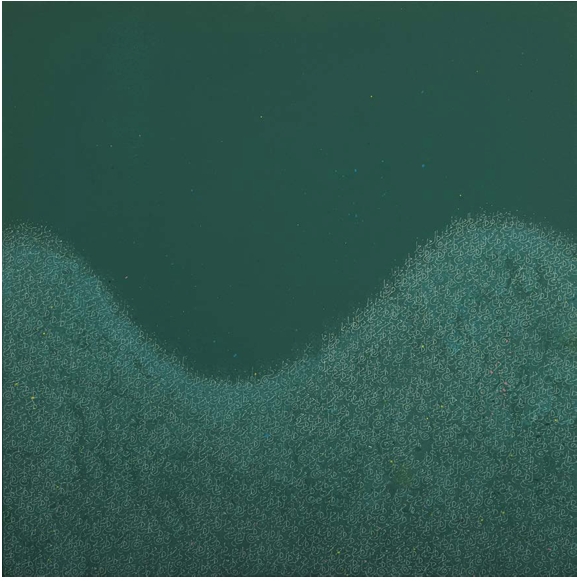
There’s an underlying mysticism in Reindiger’s language of repetition, a quiet homage to the Sufi tradition of remembrance and the generative energy of scripture. Yet his practice is also grounded in contemporary abstraction, drawing subtle influence from minimalism, systems art, and organic geometry. He invites the viewer into a space of stillness where script becomes breath, and visual density opens into a meditative clarity.
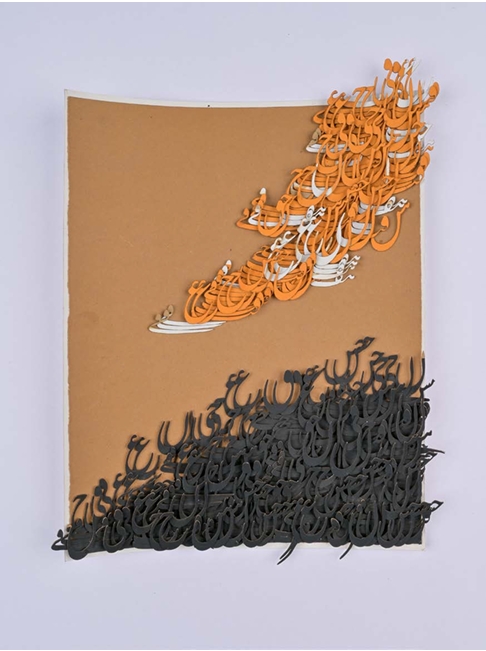
Moving on, Imran Baloch’s practice is anchored in the urgency of linguistic preservation. His visual language critiques the systematic abandonment of Urdu and other regional tongues in favor of hegemonic languages such as English. By choosing clay, a medium inseparably tied to the land, Baloch makes a statement: language, like earth, holds memory, labor, and identity. The shaping of letters in clay mimics the slow evolution of dialects and scripts across centuries, while their erosion or suppression is mirrored in the way forms tumble or collapse in his compositions. In his artworks, Imran Baloch molds language, literally. Using clay as his primary medium, he shapes calligraphic Urdu forms into sculptural reliefs that erupt and sink within the plane of the canvas. The tactility of the work is remarkable: thickly layered letters are compressed, crowded, almost suffocating. The context is not merely aesthetic; it is deeply political.
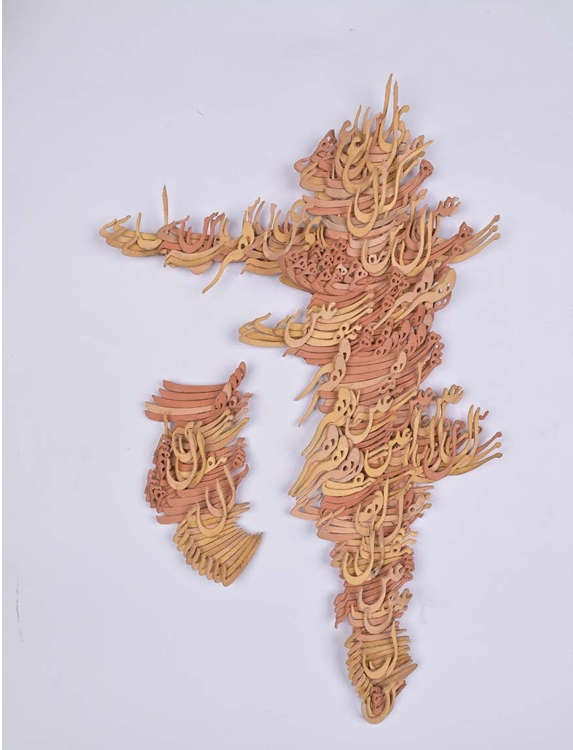
The use of Nastaliq script in Imran Baloch’s work is deliberate and symbolic. It recalls a once-glorified national aesthetic now rendered precarious. Baloch’s layering creates a visual metaphor for how languages die, not abruptly, but under the weight of imposed priorities, social hierarchies, and erasure. The work doesn’t offer simple nostalgia, but an embodied critique of linguistic marginalization, especially within the postcolonial context of Pakistan, where language politics have long mirrored larger struggles of power and identity. His work stands in tension with modernity’s accelerating detachment from native tongues. Through his process, a slow, deliberate formation of letterforms in a fragile, organic material, he resurrects language not as digital text but as something lived, handmade, and intimately vulnerable.
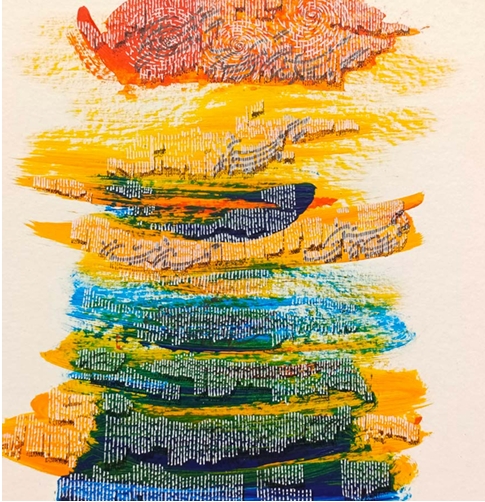
Going further, Zakir Baloch’s Salvation Series emerges as a quiet yet powerful meditation on human resilience and the transformative power of spiritual yearning. Working with painterly strokes layered with dense fields of Urdu script, Baloch’s canvases seem to oscillate between abstraction and the act of writing; suggesting that language, even when unreadable, holds emotional memory.
In the artworks, energetic strokes dominate the composition, their texture disrupted by segments of layered script, some legible, some lost in the buildup of paint. The colors splatter interspersed throughout act almost like punctuation marks, hinting at moments of rupture or emotional climax in an otherwise meditative landscape. The tension between movement and stillness, between chaos and clarity, speaks directly to Baloch’s notion of “a path shaped by transformation.” His color palette expands into a vibrant spectrum; yellows, blues, reds – conveying an almost celebratory quality. The script is rhythmically integrated, suggesting fluidity, perhaps even ascent. The interplay of Urdu text with expressive color hints at a kind of visual a repetition that is not only spiritual but also deeply personal.
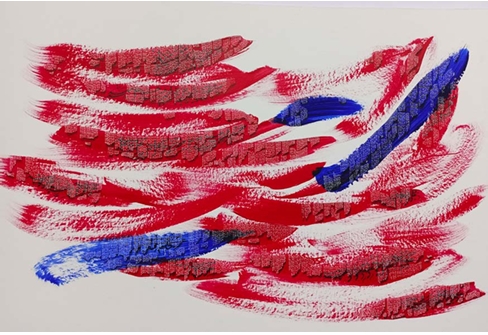
What is particularly compelling in Baloch’s work is how he renders the written word not as semantic content, but as texture, as breath, as heartbeat. His use of Urdu text as an abstract form elevates its visual essence, allowing language to participate in the painting not as narration but as presence. The result is a series that feels both intensely private and universally resonant, a visual poetry of healing.
Together, these three voices form a layered conversation about the role of Urdu in contemporary identity, not just as a language, but as an aesthetic, a memory, a philosophy. The exhibition resists nostalgia while mourning what is at risk: the slow disappearance of script as a cultural code. And yet, it is not a pessimistic show. Rather, it offers a kind of quiet hope, that through mark-making, molding, layering, and repetition, we might reclaim the script not for utility, but for beauty, presence, and continuity.