
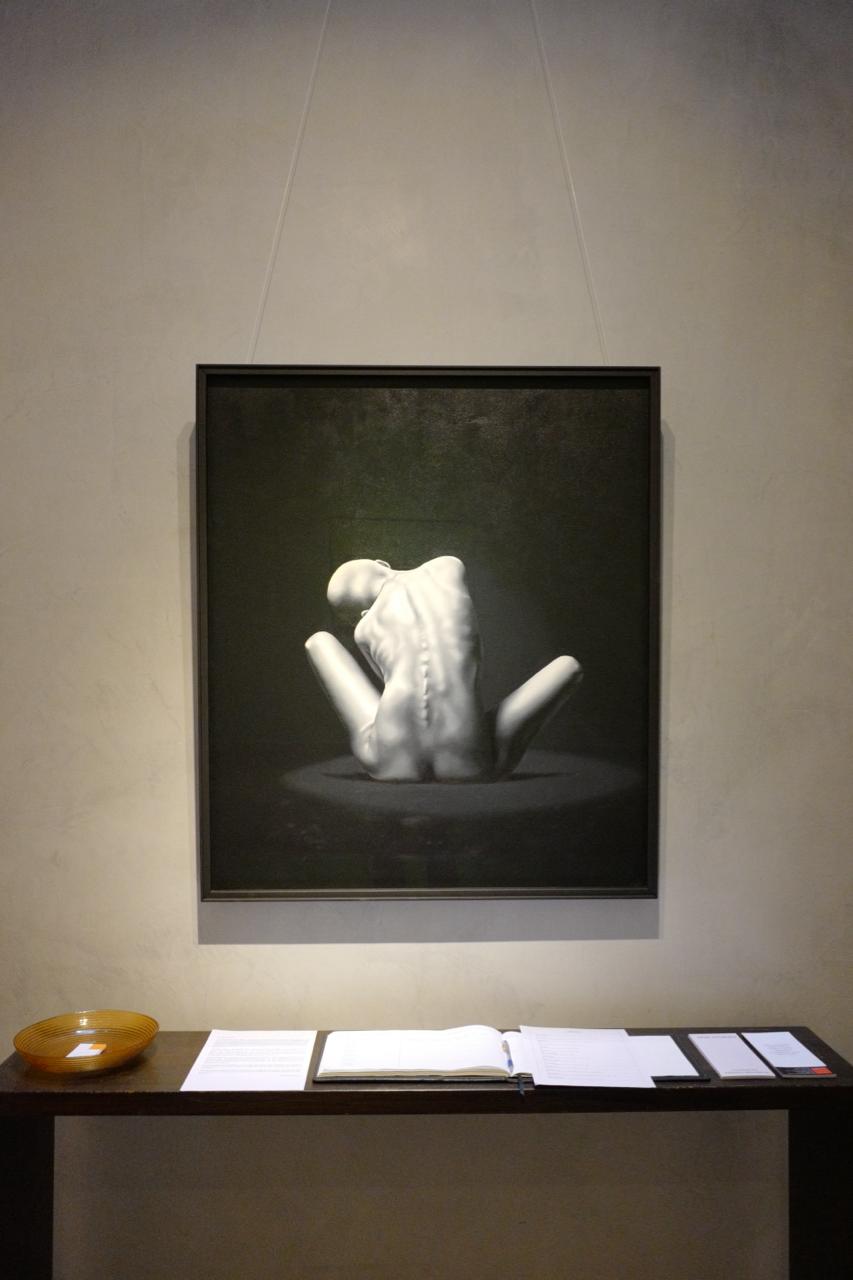
Curated by Emaan Mahmud, the exhibition explores the significance of reinventions in the contemporary art world amid the digital revolution.
In an era increasingly dominated by digital identities and algorithmic governance, Skin Stories, curated by Emaan Mahmud, on display at Canvas Gallery, Karachi from 24th June to 3rd July 2025, arrives as a timely and necessary intervention into the contemporary Pakistani art landscape. The exhibition gathers seven artists—Abdullah Qureshi, Amna Rahman, Khadija S. Akhtar, Natasha Malik, Rabeya Jalil, Scheherezade Junejo, and Yasser Vayani—whose works confront the body not as a passive object, but as a contested terrain of performance, memory, violence, and resistance. The show is unflinching in its inquiries: What defines beauty? Who owns the skin we inhabit? And what violences are obscured beneath its surface?
The curatorial premise frames the body as both a site and a stake in broader systems of gendered oppression, capitalist commodification, and surveillance. Crucially, the exhibition resists flattening its subject matter to globalized feminist tropes. Instead, it foregrounds local context, interrogating constructions of desirability, the historical policing of gender expression, and the resilience of alternative identities such as Khawaja-sira and non-binary embodiments.
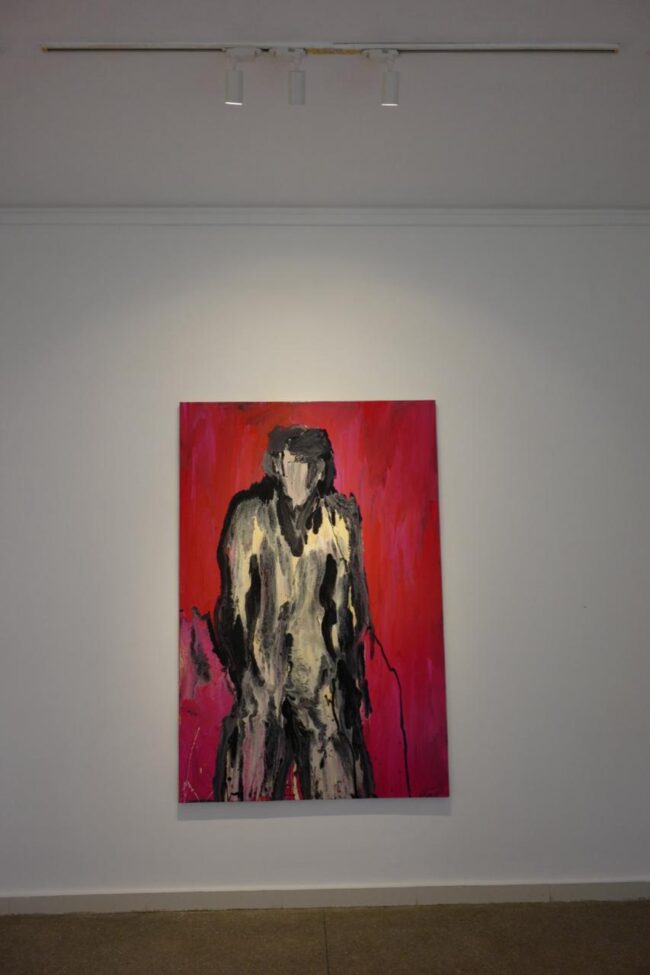
Qureshi’s paintings—Can I Take My Shirt Off, His Jumpsuit Era, and It Has Been a Long Time—throb with emotional urgency. Executed in enamel with violent, melting brushstrokes, his faceless figures hover between intimacy and anonymity. His Abstract Expressionist style gestures to queer desire not through overt iconography but through bodily gesture and painterly texture. The figures appear suspended, yearning, dissolving, subsumed in layers of paint like memories eroded by time. These are not static portraits; they’re performances of longing, mourning, and fragmentation in a culture where queer love is often erased or hidden.
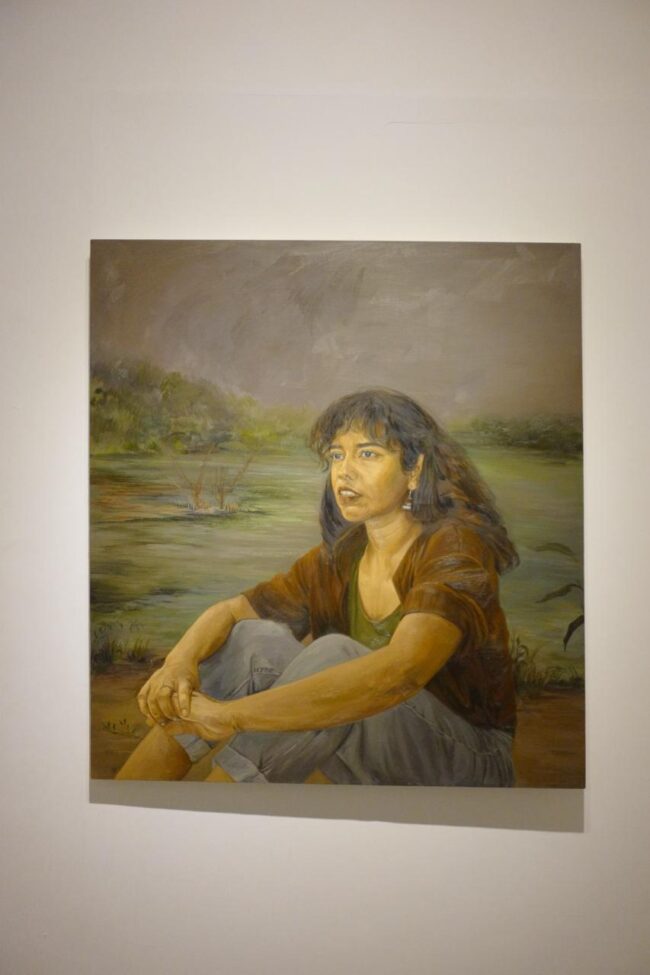
Rahman’s hyper-realist oil portraits—Jovi in the Mangroves, Resting in the Mangroves—are set within Karachi’s threatened mangrove ecology. Her subjects sit unapologetically at ease in a landscape that doubles as a sanctuary and protest site. With their direct gazes and grounded postures, these women demand space—not only in the frame but in the cultural geography itself. The mangroves function metaphorically, as tangled and resilient as the histories of the women within them. Rahman’s practice situates feminine rest and presence as radical acts against a backdrop of ecological and gendered dispossession.
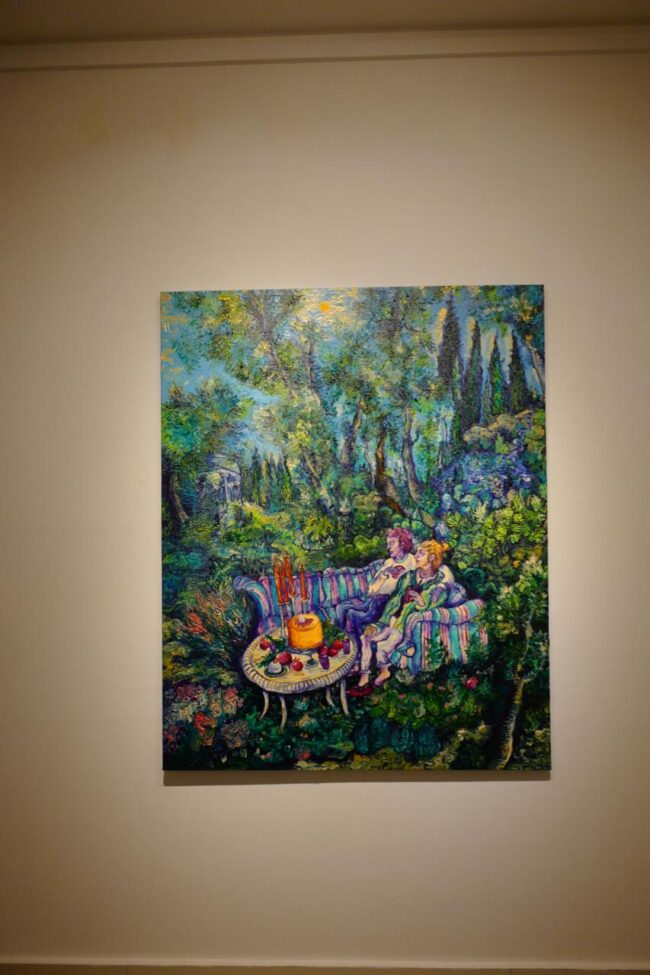
Morning Sun, Akhtar’s richly pigmented, surreal acrylic painting, is both lush and claustrophobic. Drawing from miniature traditions and art historical tableaux, her scene—a cake on a table, dreamlike figures on a striped sofa, and flora teeming around them—conjures dissonance. The domestic becomes psychedelic, nostalgic, yet unstable. Akhtar’s palette intoxicates, but beneath it simmers an emotional vertigo. Her work complicates the visual seduction of memory, asking: what haunts our most beautiful visions?
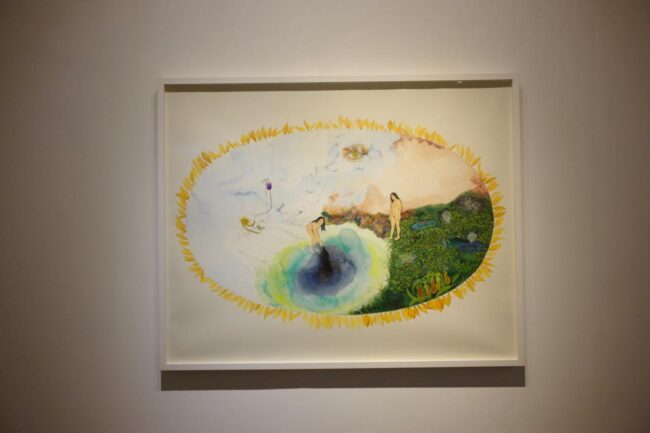
Malik’s A Flowering Utterance II and Melancholia are multi-layered meditations on female embodiment, trauma, and the unconscious. Drawing from Indo-Persian miniature traditions, her compositions swirl with uteruses, eyes, and water-bound flora—symbols that subvert the male gaze and reframe the female body as a vessel of resistance and regeneration. Her nude protagonists confront the viewer, not with eroticism but with interiority. These are women of myth and dream, conjured into being from the sediments of memory and grief. Malik’s practice is interdisciplinary—her painterly forms overlap with psychoanalytic and archival investigations.
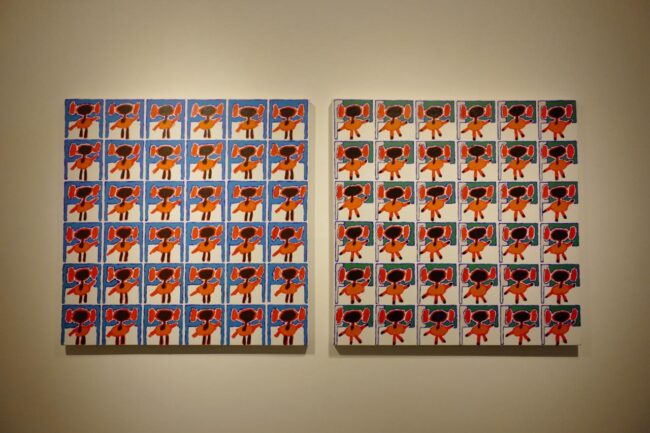
With Aurat March, Female Colleagues, and Green Flag, Jalil constructs a language of repetition that mocks institutional order. Her unsettling heads are simultaneously a bureaucratic archetype and a feminist icon. Through patterned grids and untamed line work, she dismantles notions of academic precision and ‘beauty’. Jalil’s work reads like a protest turned into a pattern—a visual essay on how women are categorized, surveilled, and yet constantly subverting those very frames. Her painterly choices challenge the binaries of high and low, as well as serious and satirical.
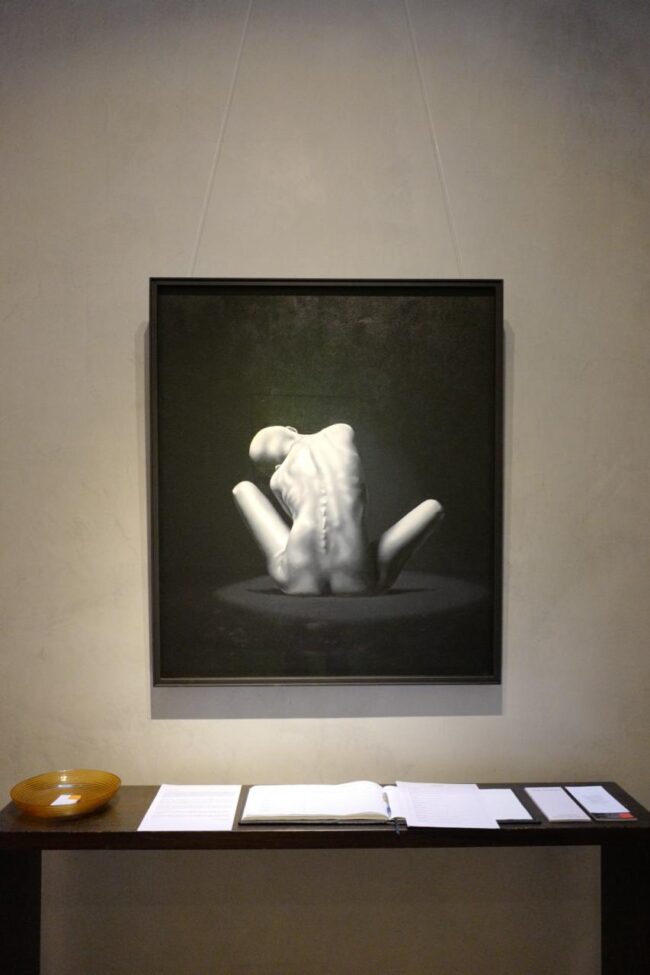
Junejo’s Skin II and Skin III present anonymous hyperreal bodies in submissive poses, rendered in stark monochrome. These are not sensual nudes but dehumanized sculptures—objects of gaze, contorted and polished into silence. Her artist statement, calling herself a “peddler of flesh,” is a biting critique of how even feminist aesthetics can be consumed by capitalist desire. Junejo’s figures whisper of violence through their stillness; they do not resist physically, but their erasure speaks volumes.
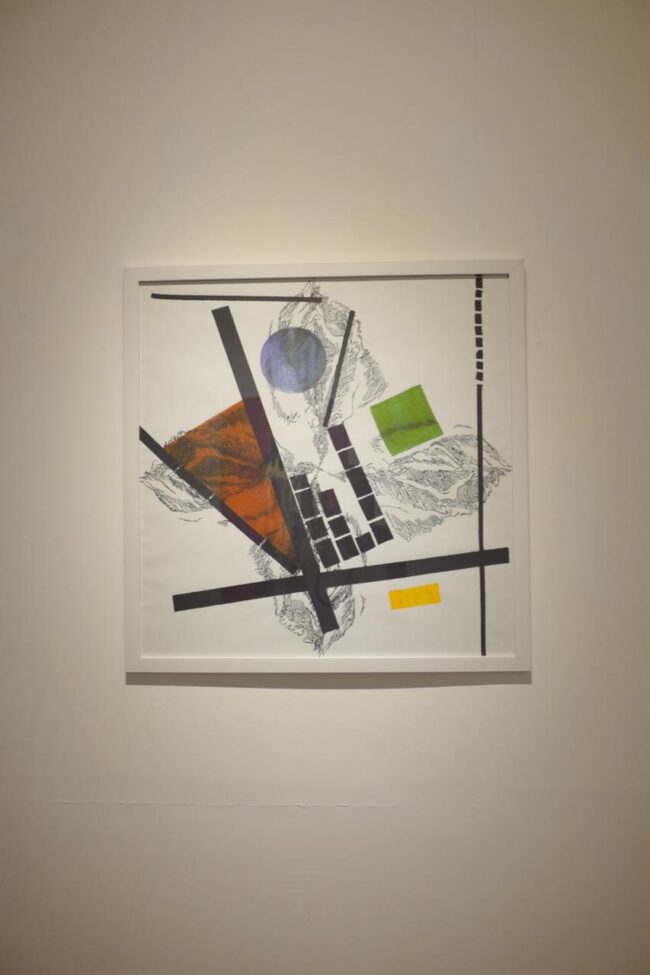
Yasser Vayani : ‘Chicanery III’, Digital Print of drawing with ink, acrylic and duct tape, 30 x 30 Inches, 2025
Vayani’s Chicanery III is a conceptual rupture in the exhibition’s corporeal flow. His ink, acrylic, and duct-tape digital print abstracts the body into grids and interruptions—like CCTV feeds or corrupted data maps. The coloured blocks and linear overlays feel both architectural and invasive. He doesn’t depict bodies; he alludes to how bodies are broken down and tracked across systems. Vayani’s contribution offers a meta-critique, reminding us that skin is not just visible, but digitized, surveilled, and manipulated.
Together, the works in Skin Stories do not offer a unified vision of gender, embodiment, or resistance. Rather, the exhibition’s strength lies in its plurality. Each artist speaks from a distinct visual and political vocabulary, yet the cumulative effect is one of resonance. This is not a show that aestheticizes trauma for spectacle, nor does it rely on didactic moralising. Instead, it allows space for contradiction—for the coexistence of softness and rage, myth and critique, longing and rupture.
In a socio-political context like Pakistan’s—where gendered bodies are under constant scrutiny, and artistic freedoms remain precarious—Skin Stories is not just an exhibition. It is a proposition. A challenge. A refusal. And above all, it is a reminder: the skin remembers.