
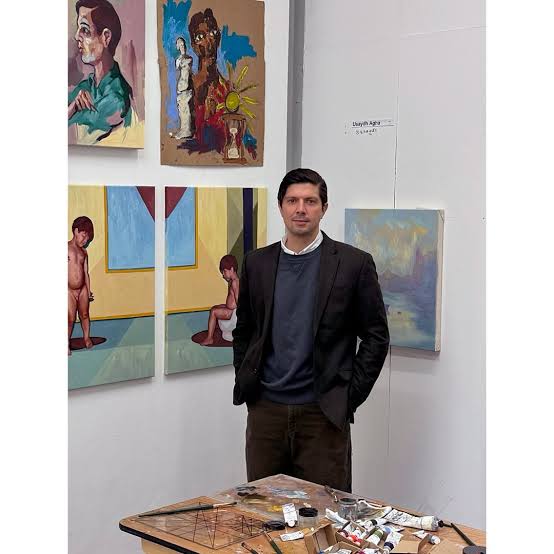
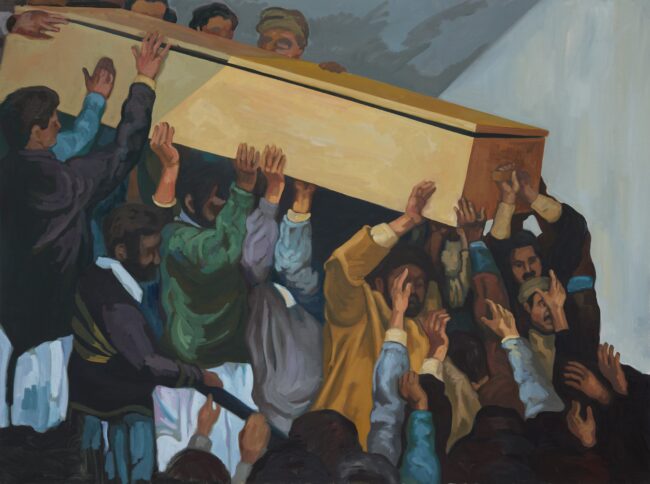
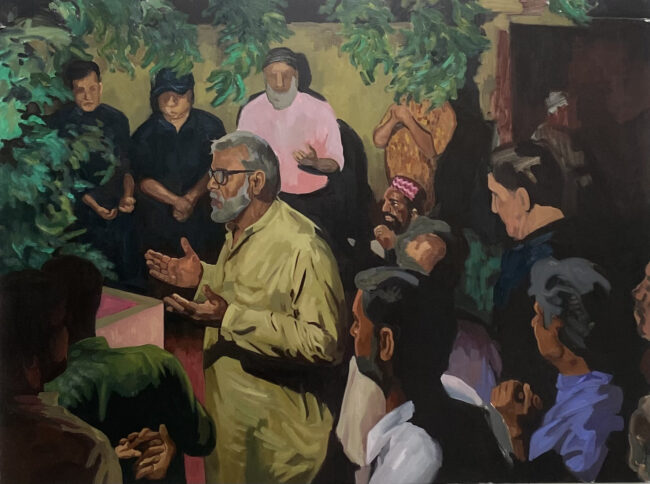
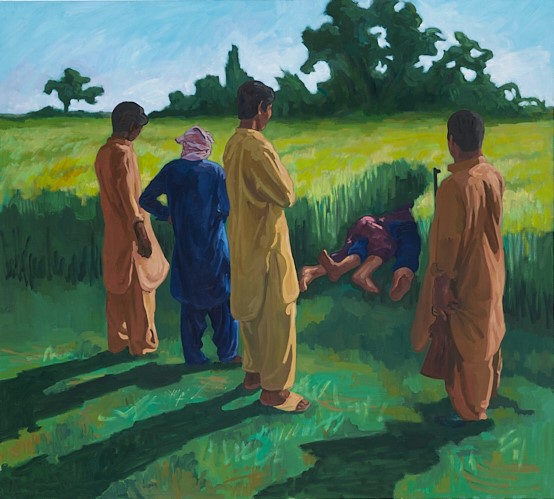
Usaydh Agha recently participated in the four-person show called ‘The Geography of Memory’ at Canvas Gallery. He exhibited three large-sized canvases in oil that were arresting for their dramatic composition and mystifying narratives. The work displayed a mature handling of psychology and ambiguity of moods.
Agha’s compulsion to paint has led him to detour from a career in law to the full-time practice of art. He is among a cohort of Pakistani painters who are bringing classical figurative art featuring the human body back into popularity after the long-running dominance of contemporary miniature painting. It would be fair to say that we are witnessing the resurgence of contemporary classicism in Pakistan.
Agha has a master’s degree in fine arts from the Royal College of Art (RCA) in London and has trained at The Florence Classical Art Academy (Italy). He is thoughtful about the subjects and methods that make his work distinct. In a discursive conversation with Nusrat Khawaja, Usaydh’s insights reveal the complexity with which artists construct the worlds depicted in their art.
Nusrat Khawaja: Usaydh, you are known as a British-Pakistani painter who is currently based in London. Let’s start our conversation by placing you within the context of your studio, where you paint.
Usaydh Agha: I have my studio in Camden in a building that is full of artists. Many of them are also graduates of the Royal College of Art [RCA]. It is a good community, and it is nice to be painting around other artists. I share my studio space with a very talented artist named Connor, who is also an alumnus of RCA. We have a good rapport about painting. We paint in similar but distinct ways. We can bounce ideas off each other and also discuss very important techniques. For a brief time, I was in a different studio where I painted alone, and I found that very restrictive.
NK: Spaces and their connection (or disconnection) with communities no doubt influences artistic energy. What about places? You are a well-travelled artist.
UA: Places significantly affect the color scheme. When I think of Karachi, the colors that come to mind are yellow, beige, and brown surfaces contrasted with a hyper blue sky. That is roughly the dry, dusty Karachi landscape. London, on the other hand, is a very different scheme, especially in winter when it gets dark early and is rainy. The color scheme for me is a neutral purple, along with green. Place is an important inspirational feature, and it drives me to paint in different locations.
NK: Usaydh, you have a very strong grasp of the technical elements of painting, and you very consciously deploy them to develop a painting. Please share something about your Florentine interlude in Italy, as you have the Renaissance sensibility of using chiaroscuro and geometry.
UA: I enjoyed training in Florence for my short tenure there. It had an effect on my technique. The intensity and contrast between the dark and the light, blocking in – these were useful tools, but I wouldn’t say they influenced the way I paint now. I had to unlearn a lot of what I learnt there. Academic training can be quite constraining. The work tends to become repetitive, and the differences between artists’ styles diminish. It is a valuable exercise, but I try to vary styles even when I choose to paint academically.
I learnt from the late Shakil Siddiqui the Dutch/Flemish approach of layering and applying light washes of successive color and working from a realistic color palette. It’s important not to get bogged down in one particular style. Over-academicizing your work traps it into a very narrow box.
NK: How interesting to note the hybrid elements of European and Pakistani training! Your work is strongly figurative with a powerful narrative quality. We saw this in your three paintings that were displayed in ‘The Geography of Memory’ exhibition, namely: A History of Violence, Prayer To, and The Deposition. Please comment on the lure of figuration for you.
UA: To an extent, we must consider figuration and abstraction as two sides of the same coin, because both work on the same fundamental basis, i.e., manipulating the medium in a two-dimensional space, with the intention of creating an ‘affect’ on the viewer. Figuration operates somewhat differently from abstraction as the tools at hand are the visual image – a language or vocabulary of motifs and archetypal symbols, so that a particular object in a particular context will convey a specific sentiment. Our ability to register images in a particular way is supported by human psychology. We have a biological constraint that allows us a limited range of perception to interpret the image.
For example, a woman with an apple is assumed to be Eve in the Garden of Eden, and she invokes notions of temptation, sin, etc. Simpler and more innate symbols include the inward spiral or the wheel, to represent the turning of life, the change of seasons. When you take such an archetypal image and juxtapose it with other images within the same picture plane, you create a more elaborate idea or more elaborate emotion.
Abstraction operates on a slightly different basis. We are conveying emotion not through motif but through color, line, and form. What I would like to underscore is that the dichotomy of figuration and abstraction should not be seen as mutually exclusive. Countless figurative painters throughout history have relied on some degree of abstraction. A good example is Piero della Francesca in the National Gallery, in whose work we see the blurring of the categories. We have to understand that a representational painting will be limited. A painting cannot be the world as we know it. It has to acknowledge the surface of the painting, its two-dimensionality.
In my paintings, I find places where I can abstract to enhance the impact of the painting. The grass may be abstracted; the sky may be a solid plane of color. By doing that, I am trying to achieve a painting that has a greater effect because it acknowledges the medium as a painting and not as reality.
NK: That acknowledgment is a form of honesty to the material elements of a painting. It may not be reality, but the work is heavily impregnated with meaning, which is real.
UA: I like the use of images that can convey complex meanings. I like the use of symbols. I like playing with the interpretations we can pull out from a painting. It’s about pushing that image to its limit, testing what the viewer can see.
In one sense, it is beautiful, and in another sense, it is dark and macabre. It’s playing with the psychology behind imagery. We live in a world that constantly presents us with new and potent images. The assumption is that the image says everything. But what if the image is not revealing everything? What if there is so much more that can be taken from the image that is not presented in the image itself? It has to do with the mystery behind the image.
Let’s connect mystery, memory, and drama, and how they operate within a painting. Take the example of an illustration. It lets you know everything there is about the painting. I dare say it conveys too much too quickly. Norman Rockwell is a great painter, and his painting tells us everything he wants us to know. There is no mystery left. We may even shy away from calling it a painting in favor of ‘illustration’.
A painting has to hold back; it has to push the visual image where something is left out, allowing the viewer to go into their own head and rethink what is happening in the image, as if the story is being told through a veil or in a mirror. It is a poignant absence of over-explanation.
NK: What techniques do you use to develop this mystery?
UA: The mystery of figuration can be achieved through misdirection, juxtapositioning of objects, through lighting and color. These create a potent combination of drama that enables the viewer to experience the power of a painting through their own engagement.
NK: Let’s talk about these creative ingredients such as color and composition.
UA: Color harmony is very important to me, though I prefer not to define my color palette. I like to vary color schemes from one painting to another. I feel more comfortable with the cooler end of the color spectrum and usually gravitate toward neutral colors in the green-blue range rather than the red-orange range. Before I start on a painting, I decide what colors I want to work with. Lately, I prefer a cool red, a cool yellow, and a warm green. I then adjust values within each hue to see the impact. Every so often, I give myself a challenge by working on an entirely different palette. Recently, I was working on a series of landscapes where I wanted a very dominant cobalt green and to pair it with shades of purple. I found myself painting skies that were in green tones and clouds in varying shades of purple. It’s like developing a new color vocabulary with every grouping.
NK: And that brings us to the subject of composition.
UA: This is a really interesting subject because it is the most scientific aspect of a painting. The eye does move in a certain way, and we know how a viewer will start and move their gaze. We artists, work with well-established toolkits for composition. Dynamic symmetry is extremely important, that is, using the intersections of important diagonals to create sub-structures within the painting for the eye to linger within and move from one to another.
I map out the predominant diagonals: the Baroque diagonal that moves from bottom left to top right, and the Sinister diagonal that moves from top left to bottom right. Forty-five degree angles that come out from each corner, the intersections of those, and how that subdivides the painting into quadrants, and then eighths and sixteenths and so on.
There is a book about composition by Henry Rankin Poore [Pictorial Composition and the Critical Judgment of Pictures] that has been very helpful to me.
Some very simple suggestions for composition come from rather unusual places, such as a clip of David Lynch on the placement of the horizon line.
NK: Usaydh, it has been truly illuminating to hear you expound on the method and diligent planning that goes into the creation of a work of art.
All the best for your artistic journey!