
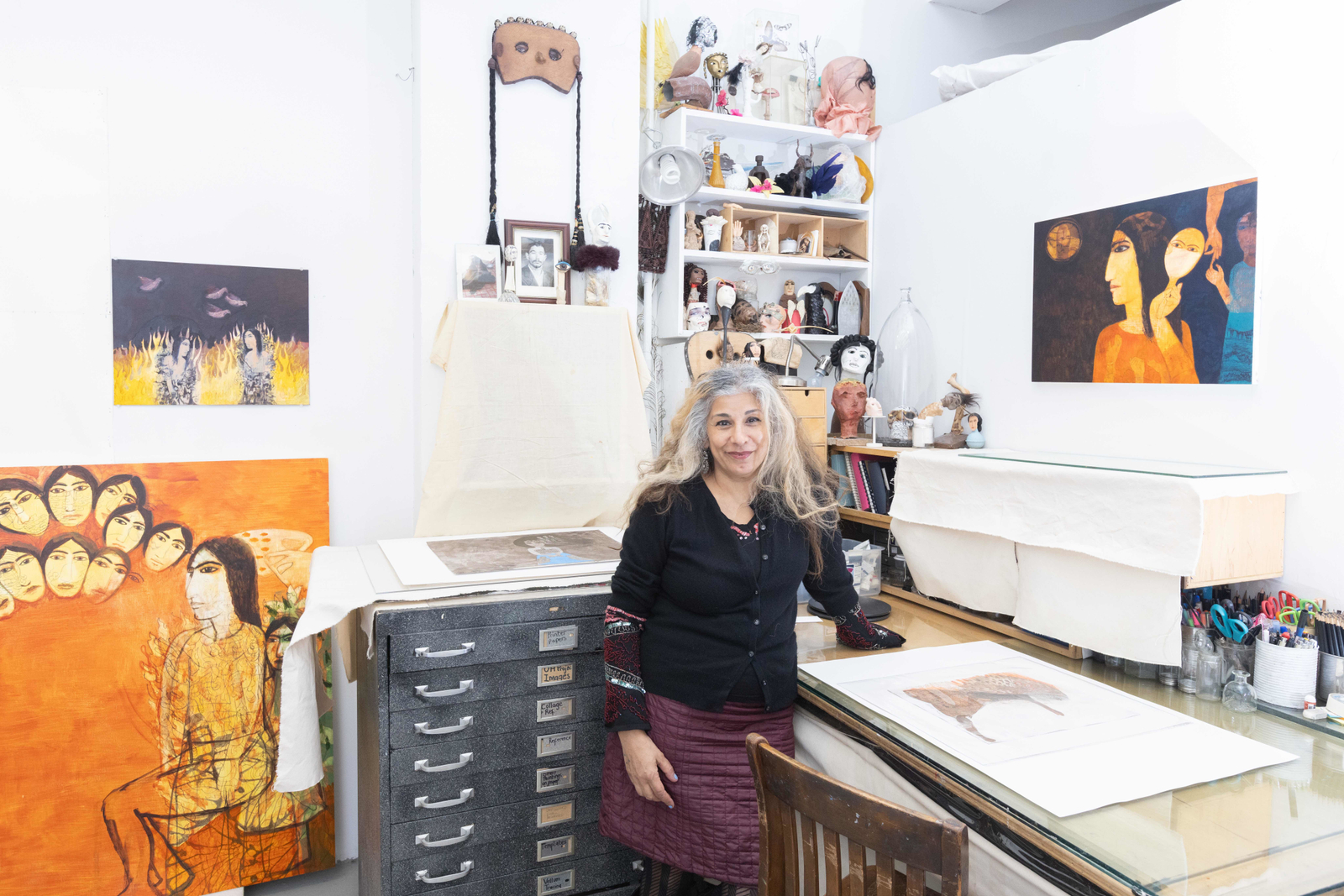
In Of Loss and Redemption, Samira Abbassy turns inward, using the body as a terrain through which to examine identity, memory, grief and transformation. Presented digitally by Taymour Grahne Projects, the exhibition brings together paintings and drawings that resist fixed narratives, instead building a visual language from recurring figures, animals, flowers, fire, fragmented bodies and multiple heads. These motifs do not function as symbols with singular meanings; they shift from one work to another, forming an evolving vocabulary through which Abbassy considers the instability of the self and the ways human beings remake themselves through loss.
Born in Ahwaz, Iran, raised in the UK and now based in New York, Abbassy’s own experience of movement and layered identity informs a practice that moves freely between Persian, Islamic, Christian and Western art-historical references. Yet her work does not attempt to resolve these influences into a single cultural identity. Instead, they coexist, overlap and transform. Her figures often appear hybrid, dismembered or incomplete, suggesting that the body is less a fixed vessel than a site where memory, history and psychological experience accumulate.
At the heart of the exhibition is Abbassy’s fascination with what exists beneath the visible body. Drawing partly from early Arabic and Persian anatomical illustrations, she imagines the body as a landscape of discovery—not simply in search of physical knowledge, but of the elusive soul. Scraped surfaces, flattened perspectives and distorted anatomies make the paintings feel almost archaeological, as though the artist is excavating something buried beneath layers of experience.
Animals, particularly birds, become recurring presences within this world. Rather than serving as straightforward allegories, they emerge as intuitive forms through which Abbassy expresses ideas that language cannot contain. Birds suggest possibility, movement and the soul, while the peacock carries ideas of endurance and transformation. Fire similarly operates on several levels: it can suggest destruction, purification, power or the forces that act upon individuals from beyond their control. In works such as The Water Bearers, these motifs create an unsettling tension between vulnerability and agency.
Women occupy an equally important place in the exhibition. They appear as carriers of water, grief, knowledge and continuity, embodying the quiet labour of surviving catastrophe. Abbassy’s women are neither idealised nor presented as passive victims. Instead, they suggest resilience—the capacity to absorb loss and continue, to hold together what has been fractured and to transform suffering into another form of existence.
This idea of transformation runs throughout Of Loss and Redemption. Abbassy’s repeated heads and fragmented bodies recall Jung’s conception of the self as plural and continually changing. Identity, in this framework, is not something stable that can simply be recovered; it is formed through accumulation, rupture and renewal. Loss therefore becomes more than an ending. It becomes part of the process through which the self is continually remade.
Her treatment of materials reinforces this idea. Many paintings are made on wood, recalling the structure of religious icons, while layers of paint are scraped away to expose the gesso beneath. Rather than simply depicting illumination, Abbassy allows light to emerge from within the surface. Her works on paper are more immediate, retaining erasures, revisions and traces of movement, making the act of thinking visible within the finished image.
What makes Of Loss and Redemption compelling is its refusal to offer a single reading. Abbassy draws from mythology, anatomy, psychology, religion and personal experience without allowing any one system to dominate. Her images remain deliberately open, inviting viewers to sit with ambiguity rather than solve it. In a world increasingly shaped by displacement, fractured identities and collective loss, Abbassy’s work proposes that survival may not mean returning to an original state, but finding ways to transform what has been broken into something newly luminous.
About the Artist
Samira Abbassy (b. 1965, Ahwaz, Iran) is an Arab-Iranian-British artist based in New York. She studied at Canterbury College of Art before moving to New York, where she co-founded the Elizabeth Foundation for the Arts in 1998. Her work has been exhibited internationally, including at the Metropolitan Museum of Art, the British Museum, LACMA and the Venice Biennale. Her work is held in numerous public and private collections, and she has received fellowships and awards including NYFA awards in Drawing and Painting, a Joan Mitchell Award and a Pollock-Krasner Award.