
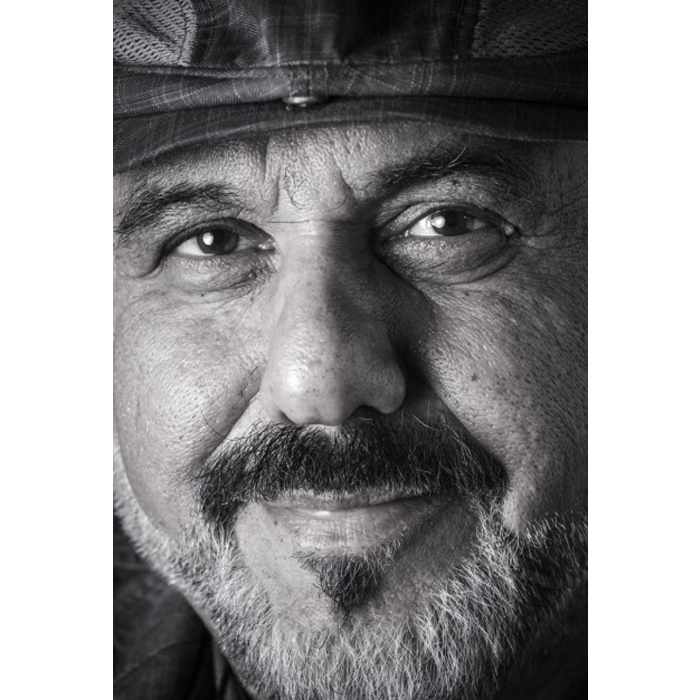
Akram Dost’s Retrospective through the Lens of Kadyrova’s Origami Deer
The story of Kadyrova’s Origami Deer at the now contentious Venice Biennale was reeling through my mind as I made my way to Akram Dost Baloch’s Retrospective show, a collaboration between the Pakistan National Council of the Arts (PNCA) and Nomad Gallery. At Venice, Zhanna Kadyrova’s massive concrete sculpture anchors a poignant narrative of displacement at the Ukraine pavilion. Originally cast onto its pedestal in Pokrovsk public park, the deer was never meant to move until a high-stakes 2024 emergency operation evacuated it from the advancing front lines. In Venice, multiple screens track the sculpture’s flatbed truck journey across Europe, transforming the artwork into a refugee that manifests instability and precarity.
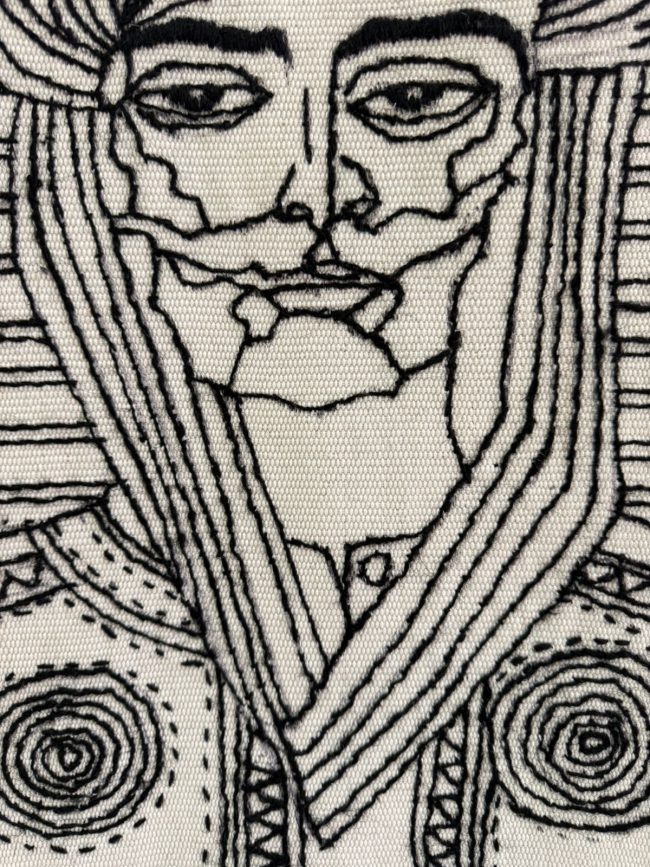
This unsettling journey of a fragment of creativity from a land in disarray mirrors the conceptual weight of Akram’s art practice. His work has long served as a vital repository for the narratives of Balochistan, a land that remains obscure and distant from those who have often decided its fate. Just as Kadyrova’s displaced deer demands global accountability, Akram’s retrospective creates a parallel friction in Islamabad; his haunting Baloch faces stare with wide blank eyes, raw textures, and indigenous motifs reject historical erasure and demand visibility for a people caught in the crosshairs of political and social neglect.
When I sat down with Nageen Hayat, the driving force behind the exhibition, my first inquiry was inevitable: how did she compel Akram Dost Baloch, an artist of notoriously reclusive, almost hermetic habits, to entrust such an extensive body of work to Islamabad? “Akram is a deeply sensitive artist, and the negotiation required immense delicacy,” Hayat shares. “Ultimately, our decades-old friendship afforded me the necessary leverage. Regrettably, due to his declining health of late, he was unable to make the journey to Islamabad to witness the culmination of his own retrospective.”
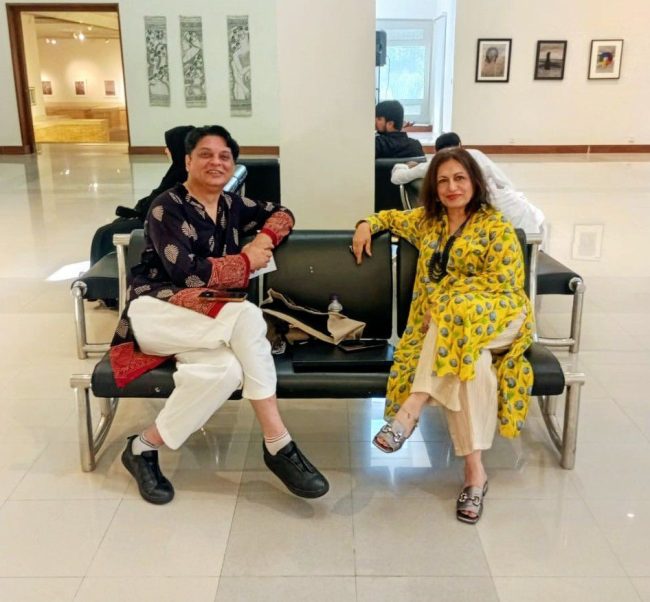
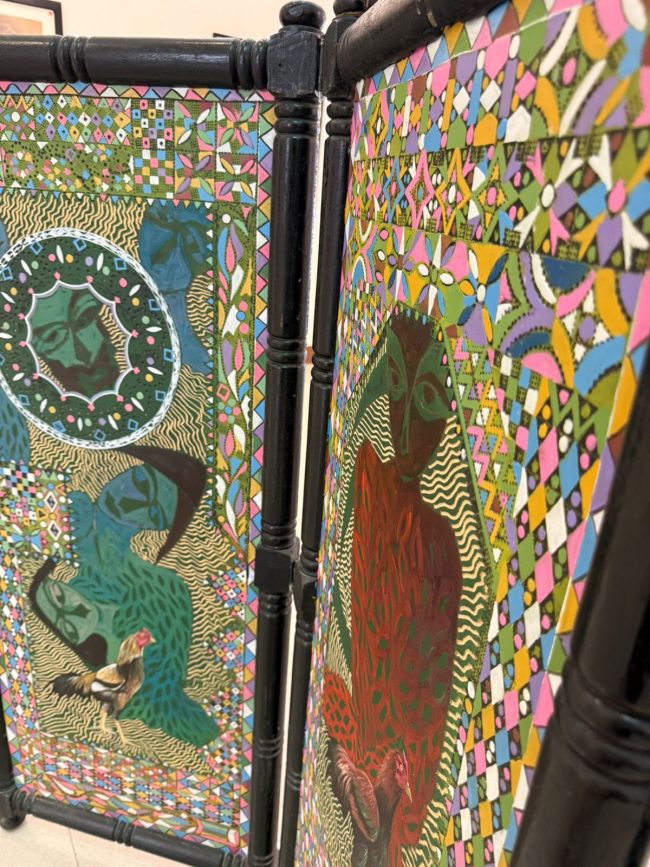
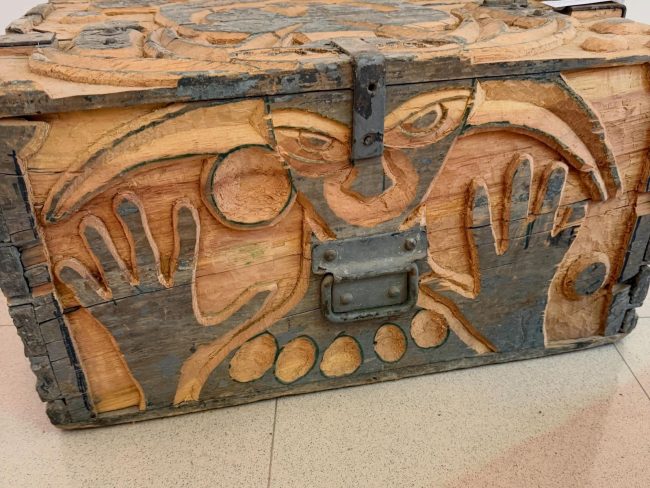
Beyond the initial hurdle of securing the artist’s consent, transporting such an expansive archive to Islamabad represented a formidable logistical feat. The retrospective features around ninety pieces in total, meticulously tracing Akram’s creative evolution over the decades. The display is remarkably comprehensive: early works from his time in Paris sit alongside his iconic doe-eyed profiles with their unmistakable Balochi features and traditional attire. His charcoal visages and delicate scrolls of line art on handwoven fabric share the space with rare pieces of hand embroidery by Balochi women from his personal collection. Most striking, perhaps, are the intricately carved wooden boxes—part of a larger installation of forty pieces that debuted at the Karachi Biennale 2017—and the vividly painted wooden architectural screens, whose rustic yet arresting charm depicts the lives of nomadic Baloch communities, materially sparse yet profoundly rich in spirit.
“The overland transport of these invaluable works from Quetta to Islamabad was fraught with complications,” Nageen recalls. “The truck was stranded in Sukkur for several days due to transit bottlenecks, ultimately arriving in the capital long past its scheduled deadline. Properly curating such an extensive oeuvre within the galleries of the PNCA was a deeply personal imperative for me. It was essential to honor the integrity of both the work and a lifelong friend whose practice I hold in the highest regard.”
The message vibrating through Akram’s work is unmissable. “Art is not for decoration; it is a political statement — a silent weapon screaming for justice through imagery,” he once declared in an interview. This philosophy transforms his retrospective into an arena of resistance, where the recurring motifs of hollowed-out cheeks and glassy, grief-laden eyes offer a devastating commentary on how the modern-day extractive socio-political structures fracture a deeply rooted tribal way of life. Rather than merely occupying space, his figures bear witness from monotone backgrounds, their parched gazes registering the psychological weight of a marginalized people. By deliberately fusing these faces with raw textures of his native soil and the intricate geometry of traditional Balochi embroidery, Akram weaponizes indigenous craftsmanship. This synthesis ensures that his art remains an uncompromising visual archive.
“It is a documentation of memory, resistance, and beauty. Through Akram Dost Baloch’s paintings, sculptures, and drawings, we see Balochistan not as a periphery, but as the center of story, craft, and human dignity. His work weaves together the embroidery, weaving, and wood carving of his people with modern, often monochromatic landscapes that speak of politics, culture, and the quiet resilience of everyday life. His “Identity” series reminds us that art is how a people remember themselves.” Nageen said at the opening of the show.
One cannot help but think again of the Origami Deer and wish that the perilous overland transit of Akram’s archive from the rugged terrain of Balochistan to the sanitized galleries of the federal capital were similarly documented and broadcast. To map the bottlenecks and the structural friction of moving these pieces would be to expose the profound physical and metaphysical distance that separates Balochistan from the rest of the country.
If the Ukrainian Origami Deer manifests a nation uprooted by external aggression, a mapping of the journey of Akram’s work for his retrospective could reveal an internal paradigm of exclusion; it would lay bare how systematically the cultural memory of peripheral communities is sequestered by decades of abandonment. Displaying this logistical struggle could perhaps force us to confront an uncomfortable truth: that for the people of Balochistan, sharing the raw, visceral reality of their existence through art and creativity remains an act of immense defiance against absolute invisibility.