
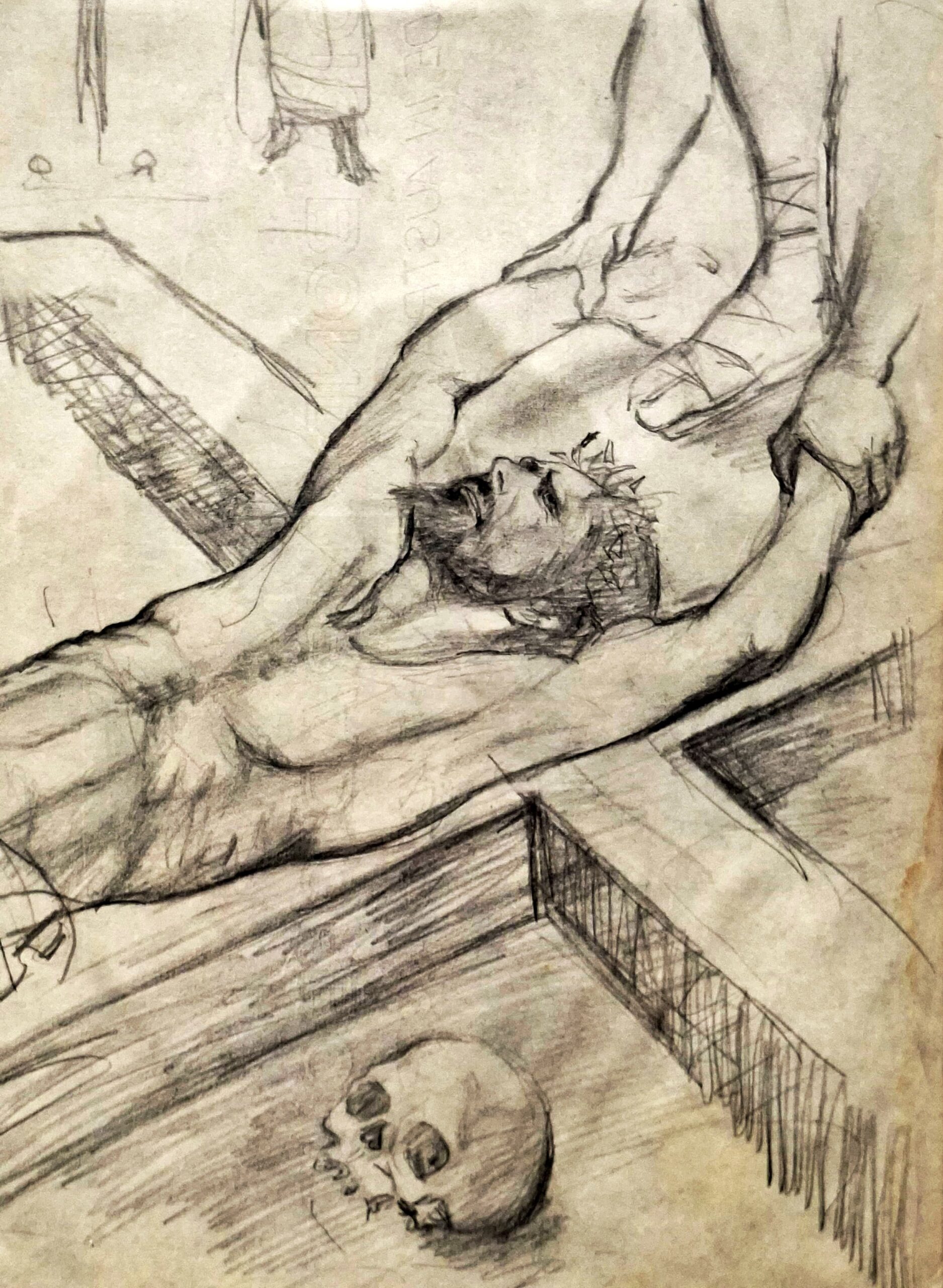
Seeing Colin David’s drawings at O Art Space, which were taken from Ms. Ruksana David’s collection, was more akin to entering an extended moment of attention than it was to visiting an exhibition. These pieces wait rather than announcing themselves. In doing so, they ask the viewer to slow down, to look carefully, and to remain present with what unfolds through line. In an age that rewards immediacy, these works ask us to pause, to inhabit silence, and to recognise that meaning often emerges most clearly when it is allowed to remain unresolved.
David’s practice reminds me of Virginia Woolf’s insistence on noticing “the atoms as they fall upon the mind.” His drawings are created by the accumulation of pauses, glances, and precisely calibrated markings rather than spectacles or excess. His depictions of people frequently seem to be lost in thought or mid-rest. They oppose narrative closure, just as Woolf’s characters. They merely invite us to remain with them without telling us who they are or what they are doing.
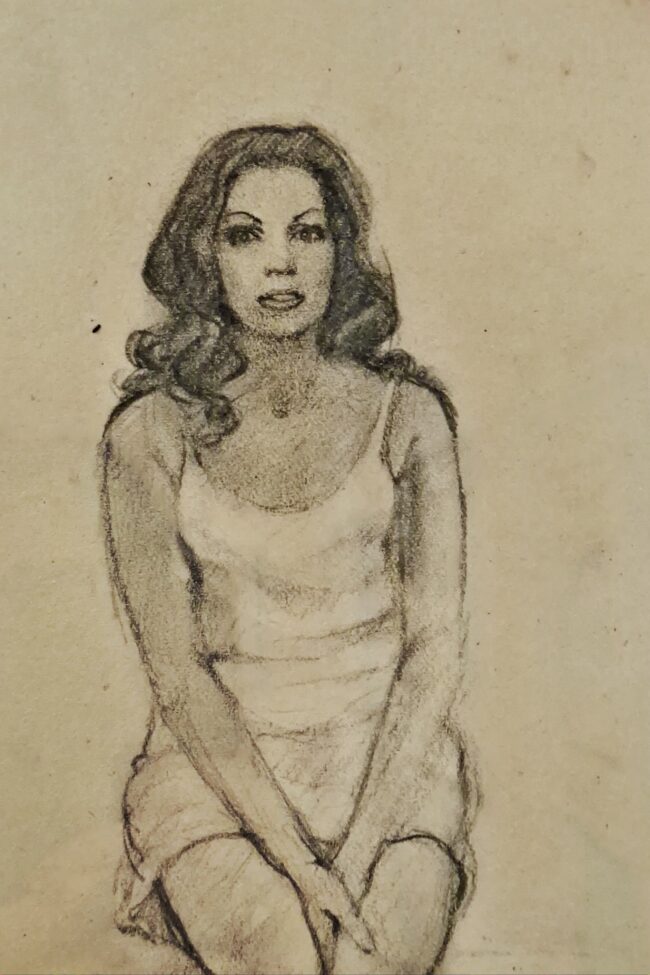
David’s view of restraint as an ethical choice is what most appeals to me about his work. His speech is methodical and frugal; it is never rushed or obtrusive. This moderation is reminiscent of Anton Chekhov’s view that meaning is revealed through silence. David’s portrayal of the female figure is the best example of this. His women live their bodies quietly and deeply, shielded by the spareness of the line itself; they are neither idealised nor exposed. There is dignity in this refusal of spectacle.
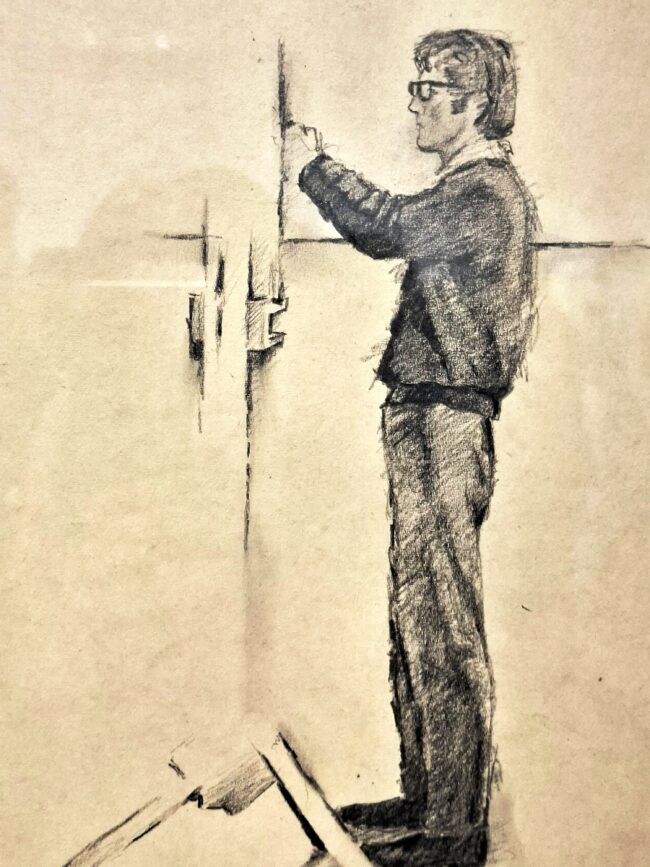
This drawing, which depicts a man standing in profile and engrossed in his work, has an almost metatextual quality. Here, David focuses on the process of creating itself. The figure’s isolated, focused, and patient stance reflects the silent effort and discipline that form the foundation of artistic labour. The idea that art, like mind, is constantly in motion is reinforced by the incomplete lines and architectural fragments surrounding him, which imply process rather than finality. There is also, subtly, a lineage of South Asian modernism at play, the same contemplative seriousness with which Chughtai approached line, discipline, and devotion to craft.
At the same time, these figures resonate subtly with the visual language of Abdur Rahman Chughtai. Like Chughtai’s women, David’s figures are defined less by gesture than by presence. There is lyrical softness to their forms, a melancholy elegance that lingers beyond the immediate image. While David’s work is stripped of the ornamental richness associated with miniature tradition, it carries forward Chughtai’s sensibility, an emphasis on inwardness, grace, and emotional restraint. The connection is not one of imitation, but of shared temperament.
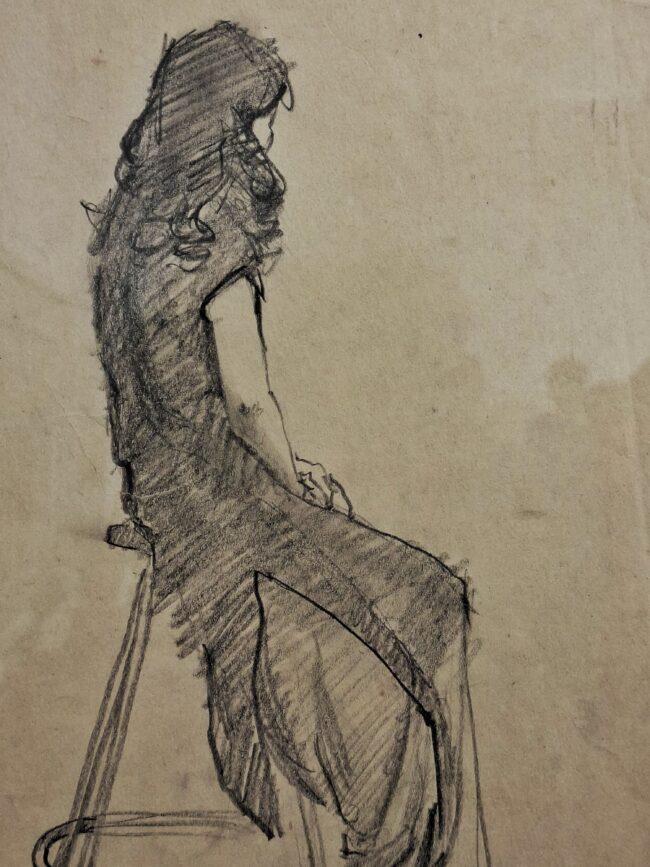
In several drawings, the background recedes almost entirely, leaving the figure suspended in an undefined space. This absence feels intentional. It allows the inner life of the subject to take precedence over setting or context. In this sense, the work aligns with Rainer Maria Rilke’s belief that art should not resolve experience but deepen it. The blankness surrounding the figures functions as silence, a space in which meaning gathers slowly.
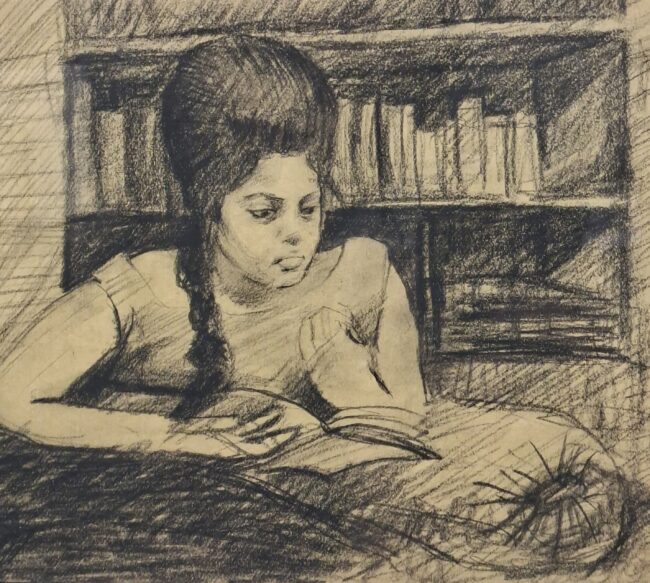
One drawing, depicting a young woman reading before a bookshelf, feels especially resonant. The shelves behind her emerge through dense, repetitive strokes rather than individual detail, reinforcing the idea that knowledge, like drawing, is accumulated patiently over time. Reading here is private, unperformed. I found myself drawn to this image not only for its composition, but for the way it mirrors the artist’s own labour: both reading and drawing demand attention, humility, and trust in slowness.
Even in portrait studies, where the line becomes firmer and more assertive, David resists judgment. Faces are rendered with sharp economy, furrowed brows, compressed mouths, and watchful eyes, suggesting psychological depth rather than caricature.
Seen in Lahore, a city layered with histories of looking, learning, and recording, these drawings feel particularly at home. They allude to a more subdued, older style of engagement that prioritises attentiveness over show and patience over urgency. David’s drawings demand a different perspective in an art world where scale and pace are becoming more and more important.
Colin David’s work does not demand attention; it earns it. Through line alone, he creates a space where the human figure is allowed to exist without urgency, performance, or explanation. Like a sentence that reveals its meaning only upon rereading, these drawings unfold slowly. And in that slowness, they remind us that looking, like reading, is an ethical act.