
It’s not every day that you walk into an art gallery located in the city’s most affluent locality and cultural precinct, and there you witness a sculpture of a donkey; something you least expect art to be. While conversing with the artist and gallery visitors, several referred to the donkey as a horse and I found this little detail very interesting. Why is a donkey uncomfortable to witness in a gallery located in Clifton, Karachi while a horse, an esteemed animal associated with class, royalty and nobility, more appropriate? I believe this itself says a lot about the work and its placement, and more so, exposes the sentiments of elitism in art and the norms around beauty and culture and associated iconography the artistic institutions have established.
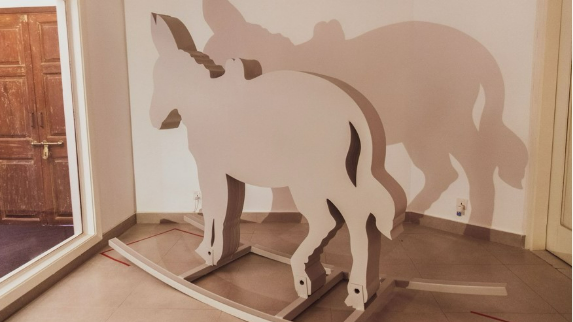
Hamza Rana, 2025, Photo: Vasl Artists’ Association
This sculpture was skillfully created by Hamza Rana, as part of Taaza Tareen 17, a resident artists’ show by Vasl Artists’ Association, Pakistan. This residency, based in the metropolis of Karachi, is an annual arrangement by Vasl, where the outcomes are exploratory, exciting and have some aspect of the cityscape attached. Since its inauguration in 2005, the residency has supported artists from different parts of Pakistan to experience Karachi and produce an interaction with the city. Furthermore, their production aims are grounded in experimentation, away from commercial aesthetics and profit. In a country where commercial galleries often reward finished aesthetics over experimentation, Vasl’s Taaza Tareen residency has become one of the few spaces in the country where artists are encouraged to test unfamiliar ideas, respond to place, and develop work outside market expectations. Karachi is the appropriate city for such a residency for its contradictory nature: a port city, the hub of commerce and religious and cultural diversity, with ecological crisis and political conflicts.
The most recent Taaza Tareen resident artist show included projects by artists Huma Gul, Hamza Rana, Manoj Kumar and Vania Mazhar. It ran from May 13 to May 17 at Vasl Gallery, Karachi, Pakistan. In this 17th rendition, the group show was titled “Milte Hain Dono Waqt Jahan”, a verse from Faiz Ahmed Faiz’s poem “Jab Teri Samandar Aankhon Mein”. The title highlights the transience of time and the stillness of personal moments, themes evident in most works in the group show. Rana expressed that the rocking donkey captures his view of the city, drawing from his childhood memory of visiting Karachi for the first time. Though he focuses on collective memory and rituals in public spaces, there is a strong and explicit symbolism in connection to labour, power and visual hierarchies that continue to shape art institutions.
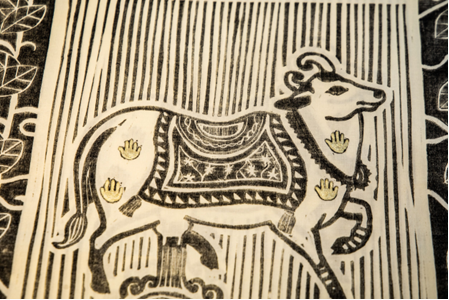
Manoj Kumar, 2025, Photo: Vasl Artists’ Association
I appreciated the use of placement in Rana’s work, as well as in Manoj Kumar’s book. Kumar stated being inspired by his memory of the Shiv Mandir in Umerkot, Sindh, located almost 315 kilometres away from Karachi. The solitary placement instantly evoked a meditative and contemplative atmosphere, highlighting the artist’s very genuine empathy; the sacred and social narrative was not abandoned.
The pages of the book were decorative with symbolic, sacred gestures and free from a forced narrative, enabling me to connect personally. I might add that this is a dangerous territory for an artist, dealing with religious sensitivities, which brings me to Vania Mazhar’s drawings on glass, which were inspired by the sculptures of Gora Qabristan, a cemetery located in the heart of the city.
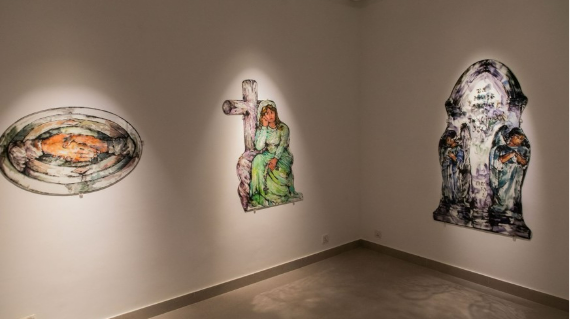
Vania Mazhar, 2025, Photo: Vasl Artists’ Association
Though the artist is, without a doubt, a skilled painter, the whimsical nature of the rendering brings me to wonder: is interfaith inspiration limited to decorative imagery? I wonder if the artist spent enough time on location or considered the colonial history of the cemetery. Maybe a training in field visits and its methodologies was required. An absence can be felt from Vania Mazhar’s drawings on glass; the cemetery’s religious sculptures seem to be used for contemporary commercial aesthetics. While artistic borrowing across traditions is neither unusual nor inherently problematic, meaningful engagement requires historical sensitivity beyond formal resemblance. Vania Mazhar’s drawings expose whether the six-week timeline is enough to produce meaningful work that is inspired by a very important heritage site.
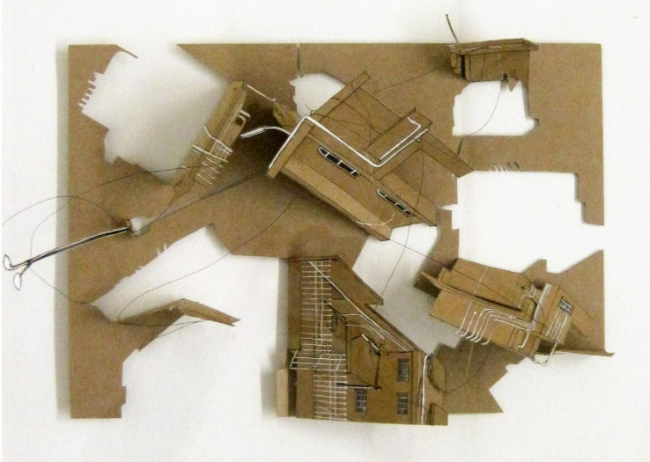
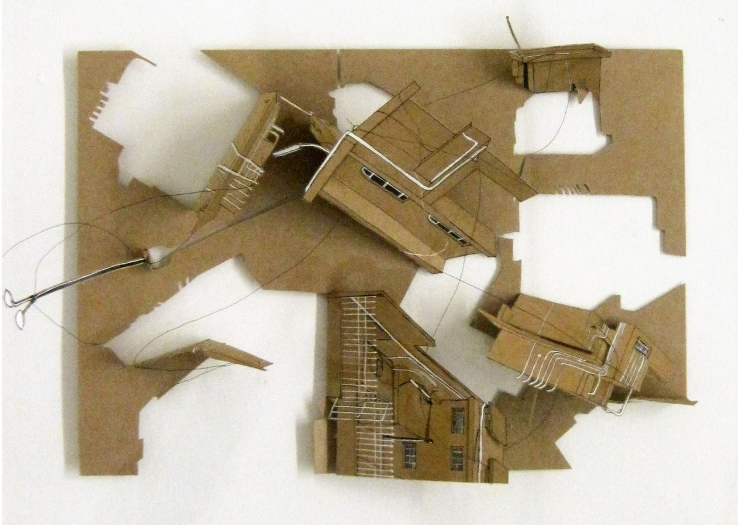
Unum Babar, 2009, Photo: Vasl Artists’ Association
Unum Babar’s reflection during Taza Tareen 5, 2009, “I have realized that even exploring the mood of the city’s architecture within a one-kilometer radius could dictate me to stay on for another year,” asserts authenticity during residencies and also reveals a productive tension within the residency model. The programme excels at initiating conversations between artists and the city, yet the exhibition also demonstrates how compressed timelines shape the depth of those encounters. Maybe not all artists need to execute final, polished works , as they might induce superficiality. Field notes, artist talks, documentaries or alternative ways to display process should be encouraged.
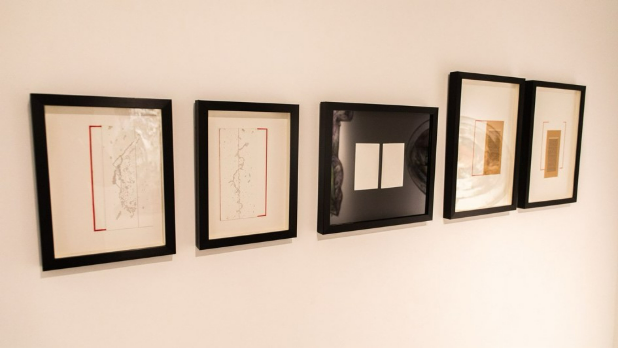
Huma Gul, 2025, Photo: Vasl Artists’ Association
Huma Gul’s drawing series, on the other hand, was more implicit, though it was informed by field research to inflicted areas and online databases. She used the letters from the Urdu language for mark-making, mapping the areas in the city with water bodies and associated obstructions, absence, conflicts, and tensions. She used language and typography stylistically and spatially, visualizing data as well as producing a unique visual language. I enjoyed this use of the national language to critique a grave political issue of the port city; a language adopted as a symbol of national unity now revealing a shared crisis. This is quite a powerful visual tension! In this sense, her practice reflects one of Taaza Tareen’s greatest strengths: providing artists with the opportunity to immerse themselves in Karachi’s social, political and environmental realities and exploring these facets collectively.
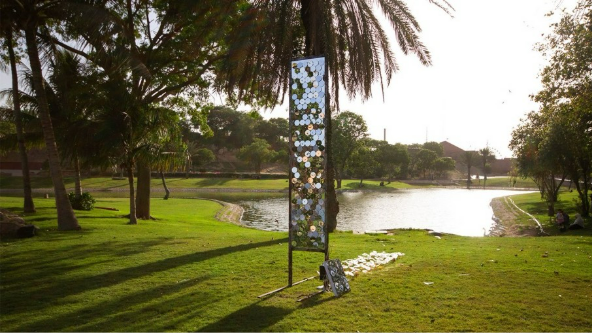
Asad Nizamani, 2024, Photo: Vasl Artists’ Association
Scarcity of resources has been a growing concern in Karachi. The previous residency and exhibition, Taza Tareen 16 “Vertical Garden: Green Spaces in Urban Environment,” was centered around the absence of green spaces in Karachi and their implications. The artists involved in the residency, Fayaz Baloch, from Kalat, Balochistan, and Asad Nizamani, from Hyderabad, Sindh, both engaged in making site-specific ecological works. The exhibition opened at the Aga Khan University Hospital, Karachi, on April 29, 2024, fully engaging the public and the environment through the language of artistic interventions.
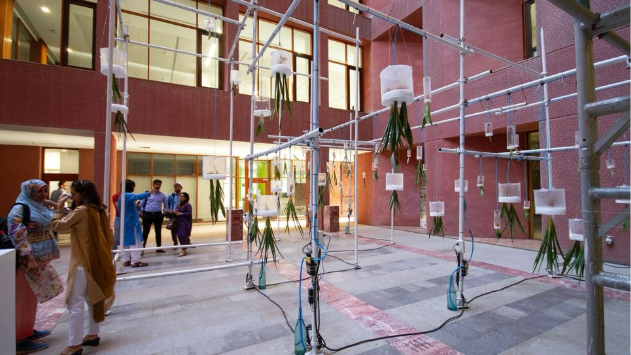
Fayaz Baloch, 2024, Photo: Vasl Artists’ Association
While Vertical Garden (2024) prioritized ecological making practices, the recent edition, Milte Hain Dono Waqt Jahan, expands the conversation of lived realities through memory, ritual, labour and language. It highlights the residency’s broader commitment to treating Karachi not merely as a backdrop but as active
A residency, publication, or a grant is not only mere monetary funding for artists , but it’s an acceptance of a worldview. Residencies like Taaza Tareen, that are based on asking questions and uncovering new insights from community, ecology, public space and life, maintain a sense of accountability in the art institution. Without such thinking spaces, contemporary art risks becoming detached from the places and public it seeks to address.