
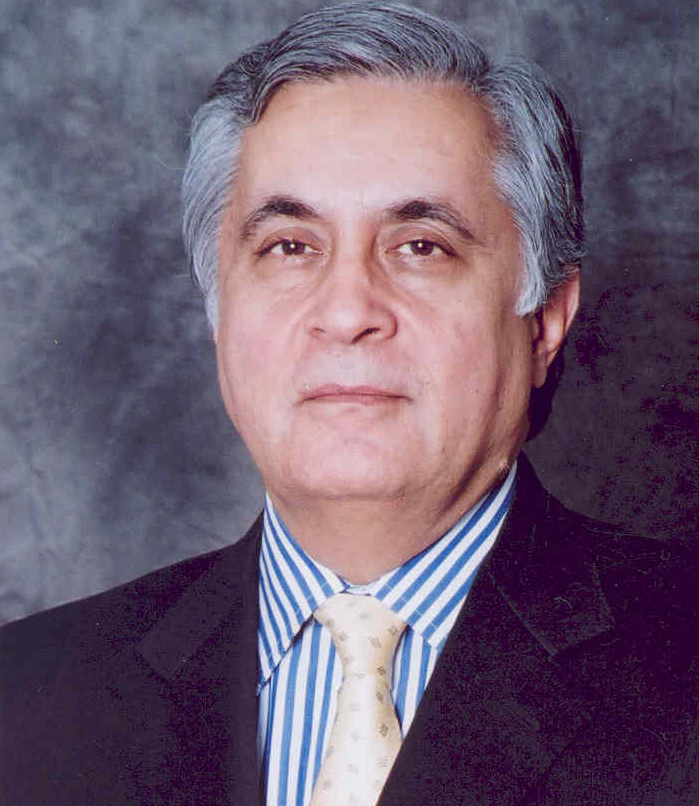
In this video interview headed by Fawzia Naqvi, Chief Editor of ArtNow Pakistan, Zubyr Soomro, the Director of Indus Valley School of Art & Architecture (IVS), shares his views on the changing dynamics of creative learning in Pakistan. He presents his insights on how art and design can serve as tools of positive transformation in a society, as well as the ways in which art education should engage itself in creative learning despite the challenging circumstances of modern society.
Fawzia Naqvi: Knowing your illustrious career, I would like to ask: as Chair of IVS, how would you describe your vision and mission for the institution?
Zubyr Soomro: If I reflect back to about ten years ago, when I first came onto the board, it was really because of Dr. Ishrat Hussain. He was—and still is—a mentor. At that time, I had just taken on the chairmanship of National Bank, and after I retired, I was serving on at least ten boards simultaneously.
About a year later, I was asked to rejoin IVS. Meanwhile, I was on the boards of Aitchison College, LUMS, and the National Education Foundation set up by Mr. Babar Ali, and I greatly enjoyed that exposure. Indus Valley, however, focuses on art and architecture, and initially I was unsure how I could add value.
Over time, though, I grew into the role. What truly attracted me was the potential of IVS itself. Over 80 percent of the students at IVS are women. The idea of educating women—particularly in the arts—is powerful, because when you educate women, you educate families, communities, societies, and generations. That was deeply compelling.
Currently, we are engaged in a visioning project at IVS led by one of the founders, Noorjehan Bilgrami. The idea is to reflect on where IVS is headed after more than 30 years since its inception—especially since the founders are still actively involved—and to understand how the world around us is changing.
Frankly, in the past, we largely followed Western models. What worked in the West, we tried to replicate here. Now, however, we must rethink that approach and ask how we can incorporate local solutions in response to global changes. Countries are increasingly looking inward. The world has, in many ways, closed in. If we can create more opportunities within our own education system, strengthen local institutions, and upgrade them, we can retain and nurture talent instead of losing it abroad. These were some of the key factors that drew me toward IVS.
There are two aspects to this. First, growth and investment are essential—especially investment in technology and expansion. To hire and retain the best talent, institutions must be financially sustainable. We focused on strengthening governance structures. While we had many distinguished individuals on the board, the real question was whether they could give sufficient time and bring relevant expertise. Today, specialization matters.
We decided that no one should join the board unless they had first served on an IVS committee. This allowed us to assess their commitment, expertise, and contribution. Through this process, we strengthened the board and built a pipeline for the future.
Many non-profits in Pakistan operate with boards that are largely ceremonial, meeting only a few times a year. While that provides oversight, it is rarely effective. We felt this structure needed reform.
We established specialized board committees—for example, a technology committee to stay connected with developments in art and technology globally; an HR committee to professionalize faculty and staff management; and a resource mobilization committee. When this board began its work, IVS raised around 13 million rupees annually. The following year, we set a target of 52 million rupees and exceeded it. Today, we raise over 100 million rupees annually, which has allowed us to expand and become financially sustainable through a disciplined, structured approach.
We have also introduced performance-driven systems. Previously, there was no formal performance management for staff or faculty. Now there is. For faculty, evaluation includes student feedback and supervisory input, creating a comprehensive assessment. This allows us to support development, recognize strong performers, and assist those who need improvement.
Fawzia Naqvi: Would you like to talk more about innovations and new directions?
Zubyr Soomro: There is a great deal to discuss. One major priority is expanding our outreach. We are the Indus Valley School, not the Karachi School. We must attract students from across the Indus Valley, particularly Sindh. This raises practical questions, such as accommodation. Years ago, we requested land from the government for this purpose, but we lacked the resources to develop it.
While our current expansion allows us to admit more students, further outreach will require significant investment. Another critical aspect is social outreach. Historically, IVS has been perceived as catering mainly to students from affluent areas such as Clifton and Defence. We have made a conscious effort to change this through financial assistance and scholarships.
Our fee structure covers basic operations but does not allow investment in scholarships, technology, or expansion. Therefore, our fundraising has two components: financial assistance for students and capital expenditure for technology and infrastructure. We have also begun engaging our alumni more actively. While alumni engagement has often been more symbolic than substantive, we are working to change that.
We reached out to Pakistani-Americans, particularly those in the IT sector in Chicago, who helped us upgrade our entire network. Locally, INFAQ Foundation—set up by Agha Hasan Abidi—assisted us in completely replacing and upgrading our computer labs. Today, we have 34 new monitors, servers, and other technological upgrades through these collaborations.
We graduate around 200 students annually, with a total student population of about 800. Over 30 years, that amounts to roughly 6,000 alumni. Institutions abroad use alumni contributions very effectively, and we need to strengthen this area significantly.
There is also growing research—such as work done by Johns Hopkins—on the connection between art and mental health. Art therapy has measurable positive impacts. Whether it is painting, sculpture, creative writing, dance, or music, engagement with art improves mental well-being. Research on dance, for example, shows positive effects on Parkinson’s disease by improving brain-body coordination.
IVS has traditionally focused on young people, but we need to expand beyond that. Through future expansion, we could establish departments that engage older populations concerned about mental health and aging. This would add immense value for both the institution and society.
Fawzia Naqvi: What is your view of art and design education in Pakistan today?
Zubyr Soomro: I have seen excellent examples at IVS. Before joining, I did not fully understand the importance of design. People often associate design only with fashion or building exteriors. But design thinking applies to almost everything we do.
At IVS, we have departments such as interior design, communication design, and textile design. When I reviewed recent thesis projects, I was struck by how many addressed pressing local issues. One project reimagined parking lots—typically dead spaces—as community centers. Another explored how abandoned urban sites could be transformed to bring communities together.
If we can consistently apply design thinking to local problems, it would be a significant contribution.
Fawzia Naqvi: How does IVS ensure the curriculum remains responsive to global changes in art, architecture, and technology?
Zubyr Soomro: This is a major challenge and central to our vision project. There is a saying: “Vision is the art of seeing the invisible.” Once you articulate where you want to go—even if you are not there yet—you must align your curriculum and teaching methods accordingly.
This requires reviewing curricula department by department and reassessing how students are taught and evaluated. For a vision to be meaningful, it must be reflected in what and how we teach.
Fawzia Naqvi: Many students worry about career viability in creative fields. How is IVS preparing graduates for real-world opportunities?
Zubyr Soomro: This is an important question. With the rise of artificial intelligence, traditional professions that focus heavily on technical skills—such as law or medicine—are increasingly disrupted. Creative skills, however, are far less replaceable.
IVS nurtures creativity, critical thinking, and adaptability. Our graduates are not limited to narrow career paths. In architecture, for example, students can focus on climate-responsive design using local knowledge and forgotten techniques. In textiles, I saw a project where a student revived an old technique—silk on the outside, cotton on the inside—used centuries ago to adapt to hot climates. The student modernized this concept, adding real contemporary value.
Fawzia Naqvi: Does IVS offer any master’s programs?
Zubyr Soomro: Yes, we do. IVS offers graduate, master’s, and MPhil programs. However, enrollment is currently very small—often in single digits—which limits our ability to expand the Master’s and MPhil programs. As we grow, we are exploring ways to make them financially viable while preserving their academic value.
Fawzia Naqvi: How do you plan to engage alumni and strengthen mentorship at IVS?
Zubyr Soomro: We engage alumni through two platforms: the IVS alumni office and the Alumni Association, which is a separate legal entity. We are working on using both more effectively. Alumni are represented on boards, and founders—who are now aging—still bring invaluable wisdom.
We are exploring ways to identify alumni who have achieved distinction beyond IVS and bring them into leadership and mentorship roles, gradually taking on responsibilities once held by the founders. This continuity will strengthen alumni engagement and sustain the legacy of art and architecture at IVS.
Do not forget our competitors in Karachi University, Habib University and the capacity of Agha Khan University and their whole focus on the arts. These are the people who have community resources or enormous private family resources and IVS does not have that.
So we have to grow the means for the people to be trained and educated in these areas. And hopefully, through some of the things that I have suggested
Fawzia Naqvi: How would you ensure transparent governance while keeping the IVS identity as an independent non-profit organization?
ZS: Through our governance structure. Through having an effective board as opposed to our ceremonial board, we set up the concept within IVS that we have sub-committees covering key areas and we have the executive committee, which is chaired by senior members from the board.
The chairs of these committees we have put together into a group, which is the IVS Core group and this group consists of the chairs of the subcommittees and of the board. We would meet typically at least once a month to see if all the different areas are synchronized and coordinated. We have also updated the operating menu of IVS. Now we track our performance both through performance management of individuals, and we have committee policies for each of these areas as well. And then we highlight the implementation of these policies in each board meeting and issues are brought to the board.
Fawzia Naqvi: What message would you like to give to the students and artists in Pakistan?
ZS: There will always be people who will not be able to afford a full four-year degree or five year degree. It is now about 7 lacs per year per student, while we look into increasing the monetary amount to offer funding support, but at the moment, 40 students a year, which makes 20 percent of those we take on. We want to build that to at least 50 percent. However, there will be many students across Sindh who have talent and interest who can not afford these 4 years courses. Then we have to have shorter and specialised courses, which are lower courses that take less time, so these students can take shorter breaks. This comes into our continuing education program. We are self-sustaining now, but we are still not using it to its potential. The whole mental health aspect, art therapy is one way to do it, but it’s for older people.
We should have outreach going to a level where we can also deliver programs to other places through alliances with other institutions. Maybe an alliance with Sukkur IBA or other universities, where we can use their premises and have a partnership to reach these students, so we can design the type of courses that we can deliver there as well.
So there is a lot of work to do…