
The Fine Art Graduating Class of 2025 presented a wide range of projects, pushing boundaries of medium and storytelling. The 2D section of the show in particular, displayed an expansive interest in media interwoven with their theoretical concerns. Their works are informed by their lived experiences of Karachi, of private spaces, of social structures and hierarchies. With sensitivity, these students have created installations that draw the eye in with a resounding emotionality.
Hufsa Schabaz deals with the fragility of the city in relation to the body in her work, The Winter Garden. She cleverly uses tracing paper cutouts to create silhouettes that reference public infrastructure with history, such as the two gates of Kharadar and Mithadar, to more private acts of prayer and gathering. The cutouts, sandwiched between plexiglass plates, appear as floating spectres of Schahbaz’s experience in the city as a woman. In her work, she moves in and out of the autobiographical and the political sphere of Karachi, presenting a precise and spectral array of scenes. The medium of tracing paper itself is encased within layers of glass, with light passing through its body, almost as if it has been pinned down for inspection.
Similarly, Huba Nisar employs another delicate and ephemeral medium: Guddi paper. In Gumnaam Jagah, she uses Guddi paper to map her childhood houses and fragmented memories of those spaces. Suggestions of staircases, corridors and verandas move throughout her work, sensitively rendered with layers of Guddi paper. Using wasli making techniques, Nisar constructs a hazy landscape of private memory that evades the mind.
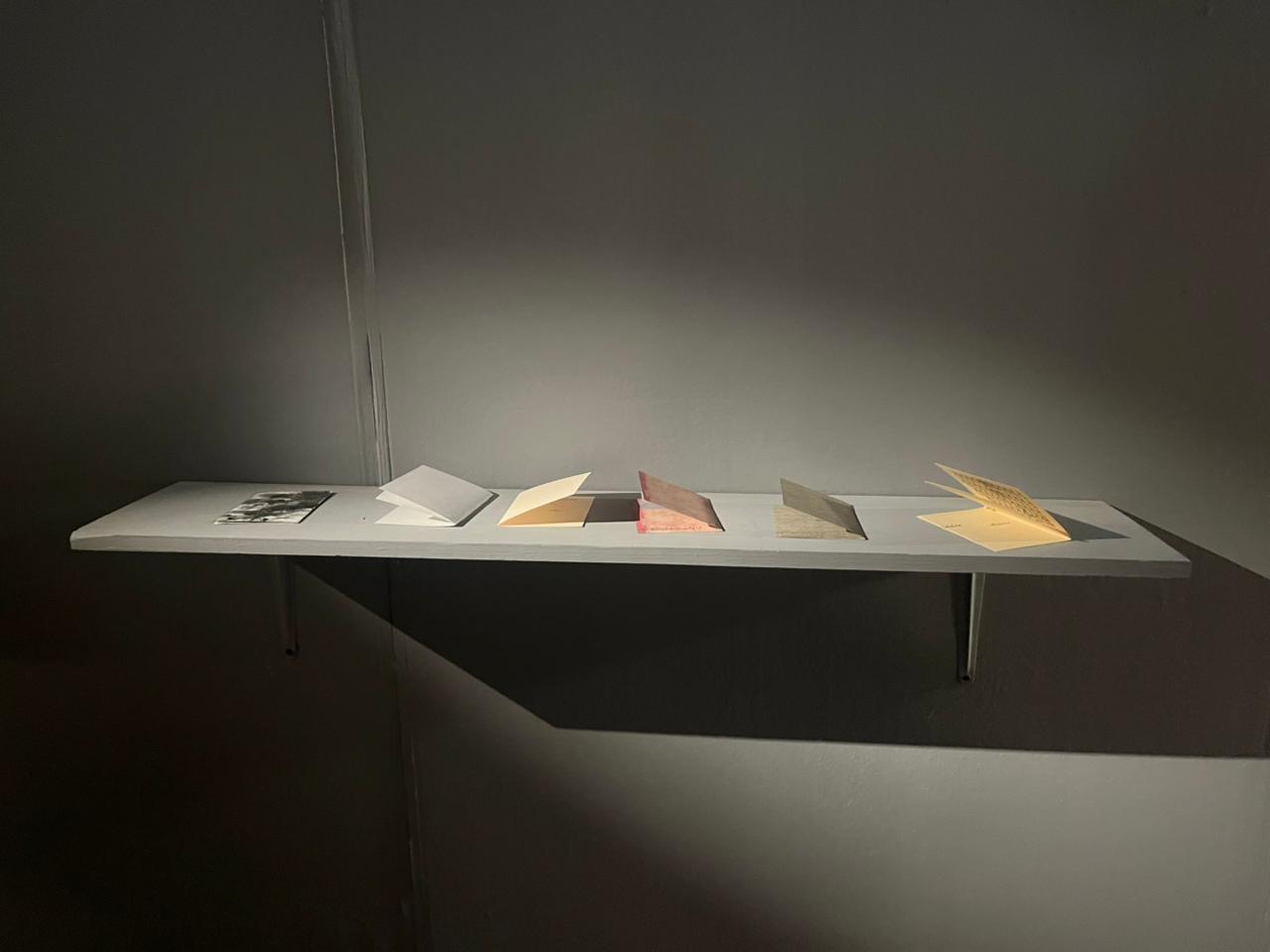
Meanwhile, the active preservation of memory circles in Fatima Hussain’s installation, Dagh. Accompanying a sound-scape room mapped with sawdust and ceramic works, Hussain presents a series of zines that translate soz khwani into the physicality of print. The zines are thin, designed with imagery and verses from Hussain’s grandmother’s books. These books carry the history of Hussain’s community and her upbringing. With the sonic, breathy, repetitive nature of soz khwani, she references memory as community, its preservation an act of love.
Care undulates across these works, exemplified by the student’s choice and treatment of medium across a year of development. Moving in and out of the personal and the universal, the two-dimensionality of art is never presented as static, but dynamic. Farheen Arshad Awan takes on a bolder approach in The Residual Body. Rendered in blizzards of charcoal, feminine frustration takes center stage. Exploring the psyche of the South Asian household, Awan’s charcoal drawings inform her sculptural works: the softness of charcoal against the meshy limbs of shadowy metal structures. The work deters touch yet invites curiosity.
Traversing the binaries of boldness and quietness, the 2D works from the Fine Art Class of 2025 present nuanced and layered narratives. The public, the private space, the home, and the psyche are all touched upon in a myriad of contemporary methods.