
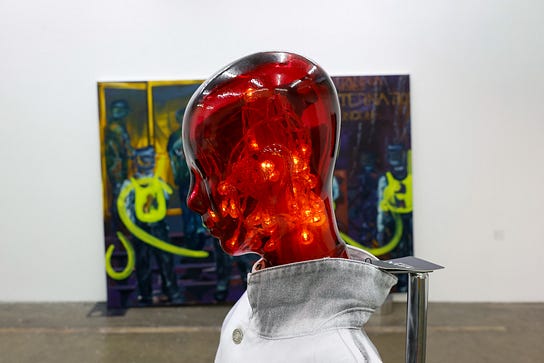
French-Palestinian artist Gaby Sahhar moves between painting, film and installation, using each medium to explore questions of migration, queerness, identity and belonging. Rather than treating displacement simply as a story of loss, Sahhar is interested in what happens when culture is carried elsewhere—how it adapts, fragments and reinvents itself within new contexts. Working from London while remaining connected to Palestinian heritage and family in the West Bank, their practice examines the tensions between distance and intimacy, visibility and erasure, permanence and change.
For Sahhar, medium is never simply a technical choice. Painting allows for fiction, abstraction and world-building, while film offers different ways of structuring research and information. The decision is intuitive but deliberate: each idea demands its own form. This approach also informs their engagement with institutions. As a member of Whitechapel Gallery’s Ethics Committee, Sahhar brings the critical perspective of an artist into institutional conversations, arguing for spaces that listen and respond to the changing needs of artists.
Their interest in cultural displacement extends beyond the studio. Through projects such as Queerdirect and the recently co-founded Or Associations, Sahhar has also explored alternative ways of creating artistic networks and relationships outside conventional gallery structures. These initiatives reflect a broader concern with agency, solidarity and the ways artists can build spaces that respond to an increasingly unstable art world.
Across these different practices, Sahhar resists the idea of a fixed identity or a singular narrative. Instead, their work considers what happens in the spaces between places, identities and forms—where something is lost, but something else is also created. For Sahhar, distance is not merely separation; it can become a productive space from which to examine how culture survives, changes and finds new forms of expression.