
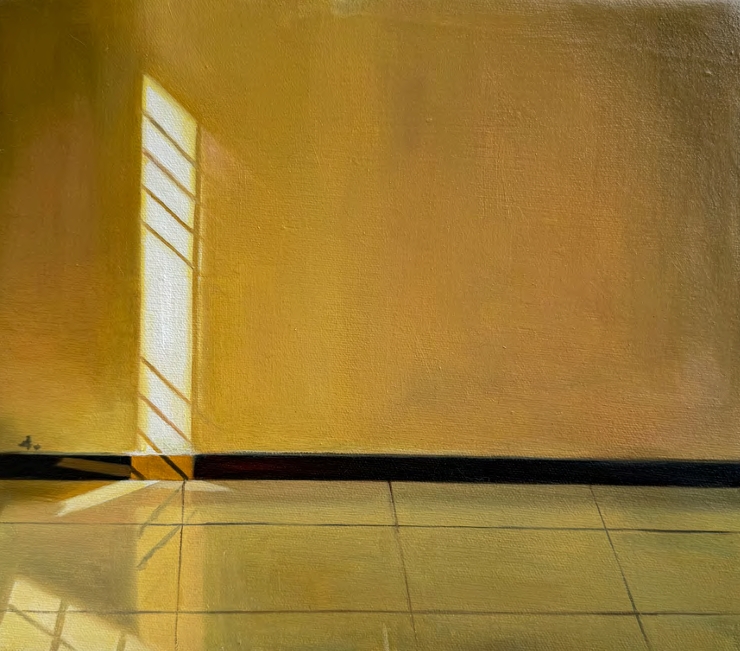
Nothing is ever the same twice because everything is always gone forever, and yet each moment has infinite photographic possibilities. In-Visible bought us works of two women, Duraeshawar Tariq and Fakhra Asif, who, like photographers, capture moments on their canvas that might otherwise pass unnoticed. Private rituals, fleeting digital encounters, solitary landscapes, remembered rooms and everyday gestures; while both artists take up these subjects from different starting points, they both arrive at making the invisible visible.
What made this exhibition particularly fascinating is that it did not take up the challenge to force a dialogue between the two practices, but the paintings conversed naturally through their shared interests in absence and stillness.
Duraeshawar Tariq’s paints what we can possibly call an autobiography. According to her own statement, her practice explores serenity, melancholy, displacement and emotional vulnerability, often using self-portraits and symbolism as a way of dealing with personal memory and identity. Her paintings don’t seem to be recording experiences. They become visual metaphors that merge her life experiences with imagined spaces.
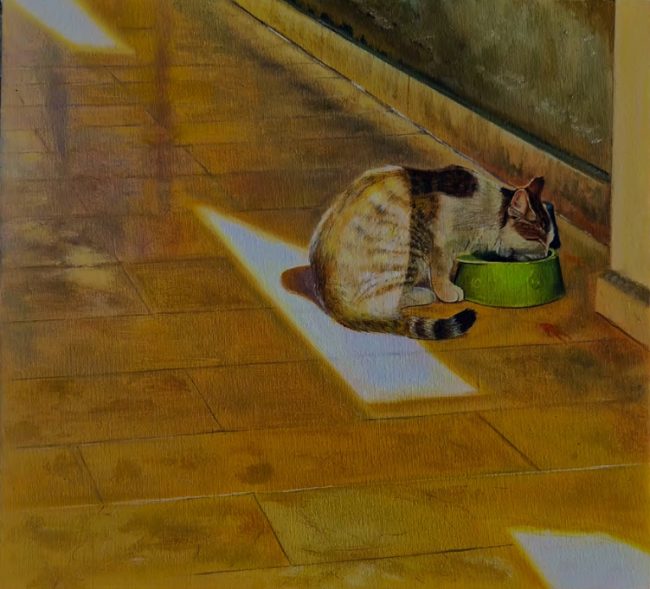
In this restraint lies, perhaps, a strength of her practice. One is not overwhelmed with symbolism. Duraeshawar makes ordinary objects and domestic interiors heavy with emotional weight. In ‘A Place To Be’, a modest architectural setting becomes a psychological refuge. The composition is deliberately sparse, relying on subtle tonal transitions and controlled lighting to portray a feeling of contemplative isolation. Similarly, ‘The Room Remembers’ transforms an empty interior into an important part of memory. The room becomes an archive of emotional residue, signifying that spaces remember what people apparently forget. Across the series, light functions practically as another character. Windows, doorways and soft directional illumination repeatedly interfere with the otherwise enclosed spaces.
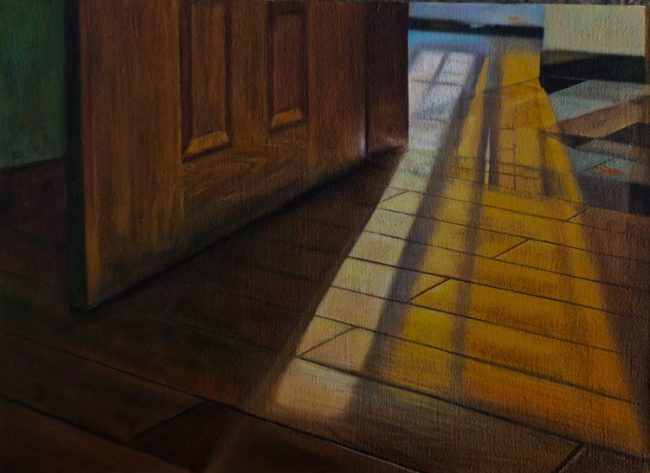
The figure also takes up an interesting spot within these works. In ‘Deep Thoughts’, the seated body folds inward in solipsism. Likewise, ‘A Small Ritual’ turns an ordinary household moment into a meditative visual. The paintings live within transitional moments; like the pause before action and the solitude that exists alongside everyday life.
Interestingly so, Duraeshawar’s practice refuses to dramatise melancholy; it disperses in the surroundings as an everyday ritual. Her paintings acknowledge emotional vulnerability and offer comfort and reflection.
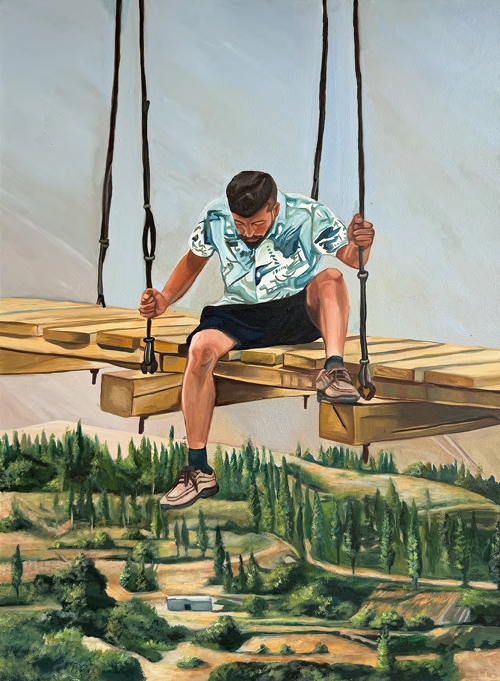
While Duraeshawar Tariq’s work circles inward, Fakhra Asif’s paintings begin from an outward-facing archive such as Instagram stories shared by friends scattered across different parts of the world. Her paintings are translations of temporary digital images into permanent painted objects, curious about how contemporary relationships and memories are arbitrated through social media platforms now more than ever.
This puts us in an inquisitive place. In an era when billions of images disappear after twenty-four hours, what happens when those same fleeting moments are carefully recreated onto a canvas? Fakhra explores this curious emotional economy that these social media platforms yield. In her paintings, digital images become deeply personal but strangely anonymous. They document lives while keeping us oblivious of the complete narratives.
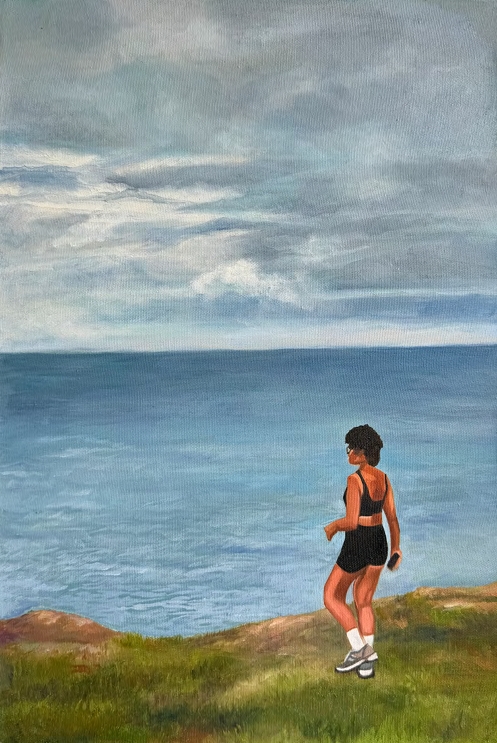
Her paintings depict figures embedded within landscapes or everyday situations. ‘The Horizon Within’ and ‘The Shape of Stillness’ show solitary figures facing vast skies and bodies of water. These compositions recall the contemplative tradition of landscape painting, particularly of the romantics like Casper David Friedrich. Yet their origins in social media thinly obscure their apparent stillness. Large stretches of sky regularly take up most of her canvas, balancing the relatively small human figures below. This imbalance underlines the emotional distance that resides within digital communication: despite unprecedented visual access to one another’s lives, genuine intimacy often remains absent.
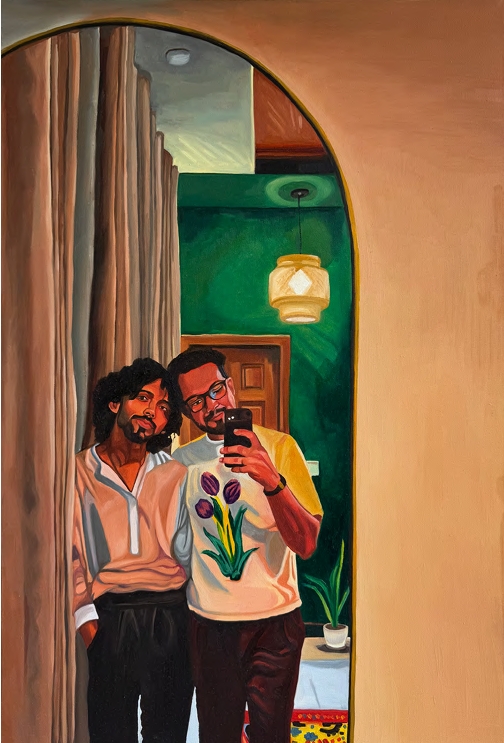
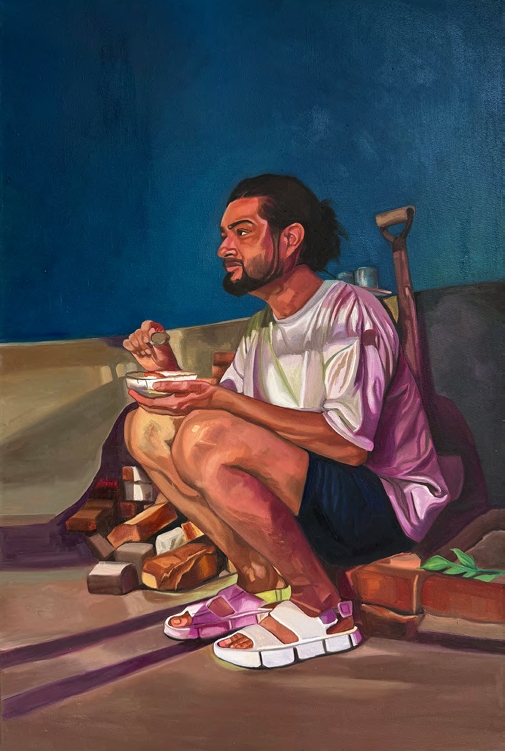
Paintings such as ‘Reflection of Us’ and ‘A Quiet Feast’ introduce interpersonal relationships and intimate moments. Yet even here, the figures seem in limbo between documentation and performance. Apparently, though, they carry the familiar visual language of photographs made for sharing online, but painting them onto a canvas destabilises that familiarity, allowing us to choose to pause longer in front of gestures that would ordinarily disappear with a swipe of the screen.
Technically, Fakhra Asif’s practice is equally interesting. Her use of a saturated yet controlled colour palette and carefully observed natural light shows her as a painter deeply invested in translating photographic reference into a painterly ordeal. Importantly, she negates photorealism for its own sake. Subtle painterly decisions preserve the physicality of oil paint, reminding us that these are not reproduced photographs but observantly constructed images.
An interesting angle of the exhibition was how differently each artist approached memory. Duraeshwar Tariq reenacts memories from within as metaphorical interiors and intimate self-portraits. Fakhra Asif takes as her reference images already filtered through digital culture, questioning how memory itself has become increasingly outsourced to technological platforms. One artist paints what is felt while the other paints what is seen. Yet both ultimately reach similar concerns of presence-absence and human connection.
This shared perspective gives IN-VISIBLE its visibility. Whether examining the emotional architecture of a room or the carefully curated fragments of an Instagram story, both artists reveal how much contemporary life exists beneath visible surfaces.
The two-person show featuring works of Duraeshawar Tariq and Fakhra Asif was exhibited at Numaishgah Gallery, Lahore in late July 2026.