
The group exhibition opened at Canvas Gallery, delving into the profound theme of absence, projecting many dimensions of the void.
In the exhibition Traces and Voids at Canvas Gallery, four artists, Karim Ahmed Khan, Mahbub Jokhio, Rafay Talpur, and Rehana Mangi, converge around the delicate theme of absence. The exhibition does not announce itself with spectacle or monumentality; rather, it draws the viewer into a slower, more contemplative mode of engagement. Each artist works with materials that embody fragility, charcoal, paper, ink, and dry point, to probe the intersections between memory and material, disappearance and persistence, silence and breath. Together, their practices suggest that voids are never truly empty, but rather saturated with traces: of histories, of personal trauma, of environmental change, and of the act of making itself.
Karim Ahmed Khan
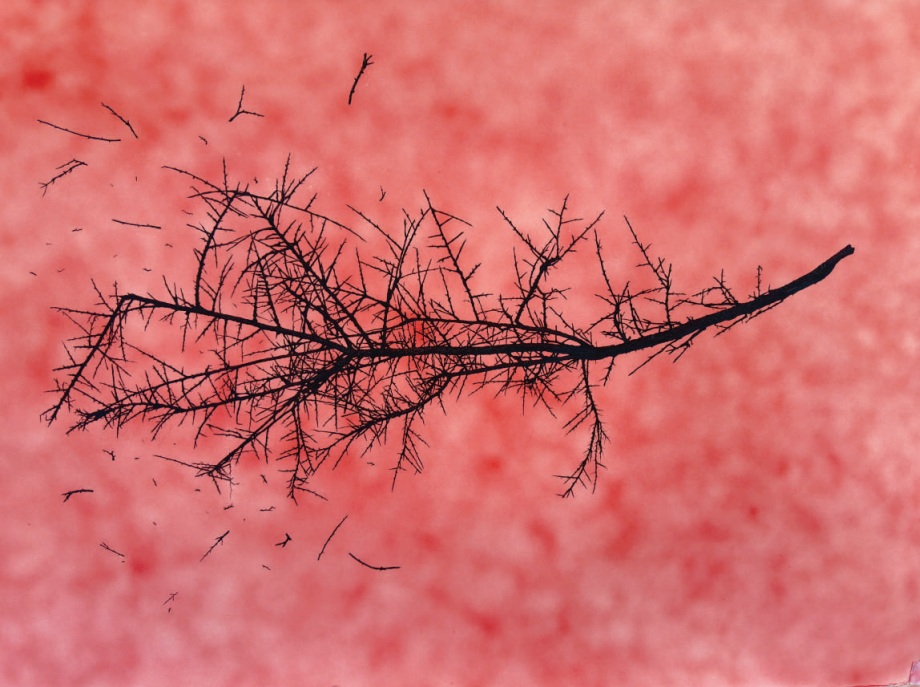
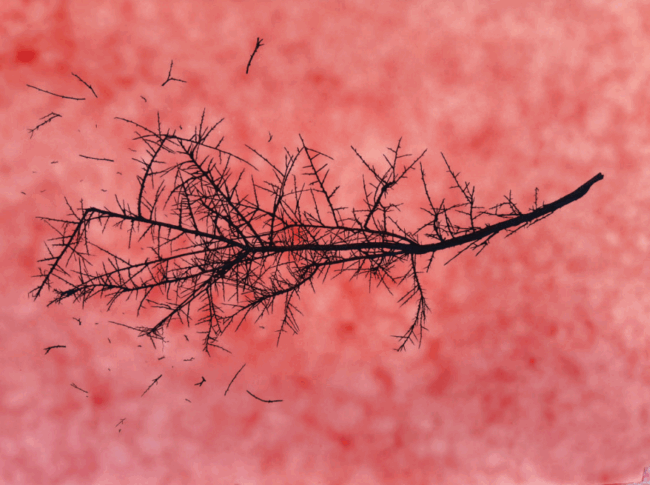
Karim Ahmed Khan’s contribution to the exhibition anchors the show in the elemental. His series of large-scale charcoal drawings, including Awaiting the Green (2025) and A Promise to Bloom Again (2024), transform the burnt residue of trees into images of the very organisms that produced it. In this circular gesture, trees drawn with their own carbon, Khan captures a paradox central to his practice: that destruction and regeneration are not opposites, but interdependent forces within the natural world.
Having begun his career as a sculptor, Khan has gradually moved toward two-dimensional works that retain a strong sense of material density. His technique, influenced by miniature painting, involves the slow layering of charcoal and gouache on wasli and Arches paper. The results are surfaces that appear to breathe: fissures open like wounds or cracks in bark, and small sprouting leaves break through the darkness. In his statement, Khan describes fissures as “spaces where light can enter,” borrowing from Rumi’s metaphor for healing. This spiritual dimension is inseparable from his environmental concerns; his drawings mourn deforestation and ecological loss while simultaneously envisioning renewal.
In the context of Pakistan’s shifting climate and the accelerating loss of forest cover, Khan’s work operates as both elegy and resistance. The use of charcoal, a by-product of combustion, literalizes the destructive cycle of industrial extraction and climate crisis, yet through the artist’s hand, it becomes an instrument of reanimation. His drawings, though visually quiet, resonate with an undercurrent of political urgency: they remind us that the landscape, like the body, bears scars that are also sites of potential rebirth. Khan’s “voids” are thus not nihilistic gaps but living apertures, thresholds between ruin and hope.

If Khan’s drawings dwell on the organic, Mahbub Jokhio’s series of folded fish renders the geometric sublime. Across works such as Clownfish and Pondicherry Shark (both 2025), Jokhio takes the humble act of folding, origami, and transforms it into a meditation on form, fragility, and the tension between structure and collapse. Each charcoal drawing depicts an origami fish, caught mid-transition between flatness and volume, between the diagrammatic and the animate.
In Jokhio’s hands, the fold becomes a philosophical proposition. The fish, simultaneously a constructed object and the trace of its making, embodies a dual temporality: it is both the living thing and its representation, the body and its blueprint. This oscillation recalls Deleuze’s concept of the fold as a site of infinite becoming — where form is never fixed but always in motion. Jokhio’s works thus resist stability, offering instead a dynamic space where pattern and life continually emerge and dissolve into one another.
The choice of subject, fish, carries ecological and mythological resonance. As species that exist within fluctuating ecosystems, often endangered by human activity, fish here become metaphors for survival and extinction. Yet Jokhio avoids direct representation of crisis. His drawings are not narrative but conceptual, emphasizing process over illustration. The meticulous repetition of folded forms turns each drawing into a study of rhythm and impermanence. The void, in this context, is the space between two folds, the momentary suspension where matter hesitates before taking shape again.
Jokhio’s long-standing engagement with systems of repetition and transformation situates this body of work within a broader discourse on the ontology of the image. By pushing the boundaries between two-dimensional and three-dimensional form, he challenges the viewer to reconsider how images occupy space and how meaning unfolds (and refolds) within them. The fish, in its suspended state, becomes a quiet metaphor for the contemporary condition: at once diagrammed and alive, mapped and vanishing.
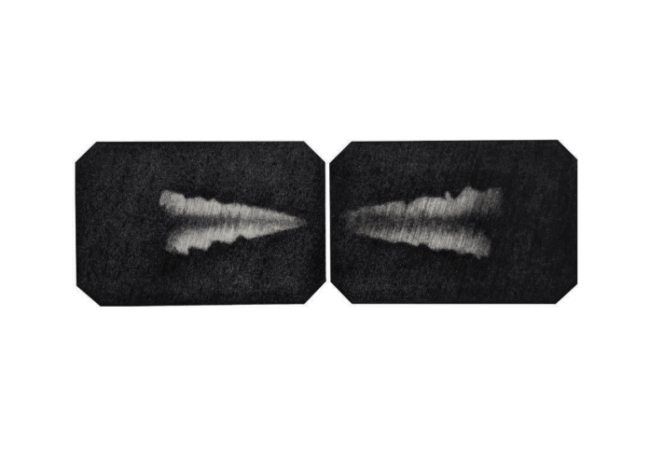
In Rafay Talpur’s delicate drypoint prints, darkness becomes both subject and method. Drawing on memories of his time in a madrassa, where mistakes were met with punishment and nights were spent in enforced darkness, Talpur transforms light into a metaphor for survival. Works such as Signs of Awakening and Two Faces of Light (both 2025) capture the faint, fleeting patterns of illumination on walls, as if recording the residue of a past that still trembles in the present.
The drypoint technique, which relies on scratching into a metal plate to create lines that hold ink, inherently carries a sense of wound and repair. Every etched mark is both an incision and an image. Talpur’s monochromatic palette amplifies this tension: the black lines seem to struggle against the white of the paper, echoing the artist’s own confrontation with confinement. Yet there is serenity in these works too, a meditative patience in how light is allowed to seep through the darkness, how each image becomes a threshold between fear and release.
By translating trauma into the language of shadow and reflection, Talpur situates his work within a lineage of artists who use abstraction as a form of testimony. The “voids” in his prints are psychic rather than physical, spaces of silence that hold memory’s afterimage. His art neither sensationalizes pain nor hides from it; instead, it dwells in the subtle gradations of emotion that exist between suffering and resilience. In this way, Talpur’s contribution deepens the exhibition’s engagement with the invisible, reminding us that what is withheld from view often speaks the loudest.
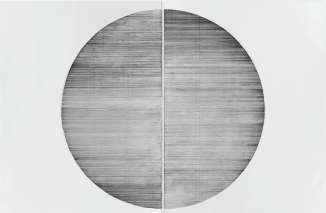
The exhibition concludes, fittingly, with breath, the most elemental act of continuity. In her Keep Breathing series (2025), Rehana Mangi transforms drawing into a durational, embodied practice. Each line she draws corresponds to a single breath held and released; the drawing is thus not only a visual record but a physiological one. “These are not just lines as marks,” she writes, “but records of the process and cycle of my breaths.” Through this meticulous repetition, Mangi transforms an intimate bodily rhythm into a cosmological gesture.
Mangi’s fascination with the moon, rooted in childhood memories of sleeping under open skies and later enriched by readings of Sindhi poet Shaikh Ayaz, grounds her work in both personal and cultural mythologies. The moon, a recurring symbol of love, longing, and transformation in South Asian poetry, becomes here a symbol of cyclical time and feminine endurance. The artist’s lines, rhythmic and circular, echo the moon’s waxing and waning phases, as well as the pulse of the body itself.
What distinguishes Mangi’s practice is her ability to fuse the miniature’s discipline with an expanded sense of temporality and space. Her drawings, executed with archival ink on paper, oscillate between intimacy and vastness. They invite the viewer to slow down, to match her breath with the work’s internal rhythm. Within the exhibition’s context, Mangi’s pieces serve as an epilogue, a gesture of continuity after rupture, of presence sustained through repetition. Her “voids” are spaces of meditation, not emptiness; they are the quiet intervals that make life perceivable.
Taken collectively, Traces and Voids functions as a meditation on the ontology of the mark, on what it means to leave a trace in this world. Each artist approaches this question through a distinct material vocabulary, yet the exhibition’s curatorial coherence lies in its shared poetics of restraint. There is no excess here, no spectacle. The works demand time, patience, and silence, qualities increasingly rare in the accelerated circuits of contemporary art.
In formal terms, the exhibition’s focus on drawing and printmaking situates it within a return to manual, meditative practices in South Asian art. Yet its conceptual reach extends beyond medium. Whether through Khan’s ecological allegories, Jokhio’s formal folds, Talpur’s psychological shadows, or Mangi’s breath-based inscriptions, Traces and Voids collectively proposes that absence can be generative. The void is not a lack but a space of potential, a site where form, memory, and spirit intersect.
Traces and Voids does not seek to fill the empty spaces it evokes; instead, it teaches us how to dwell within them, how to listen to what they hold.