
There is something arresting about a photograph that makes you stop and look again. Perhaps it is a face, a gesture, the way light settles across a surface, or the sudden recognition of something you have passed a hundred times without really seeing.
Photography has this peculiar ability to make the familiar unfamiliar, to hold a fleeting moment still long enough for us
to notice what might otherwise escape us. In The Unbearable Solitude of the Third Eye, Arif Mahmood’s retrospective spanning 1985–2025, this act of looking becomes the thread
connecting four decades of photographs. Arif Mahmood’s retrospective spanning 1985–2025, brings together four decades of photographic practice. Moving across cities, landscapes, cultural traditions and historical sites, the exhibition examines photography’s capacity to document the world while revealing the complexities of looking. Its title suggests that heightened perception carries its own burden: to notice what others overlook is also to recognise how much remains beyond the frame.
Organised into four sections: The City by the Sea, Endeavours of the Spirit, Citadels of Light and Legacies in Stone, the retrospective moves from Karachi’s streets to sites of spiritual
significance, architectural heritage and sculpture. Together, these bodies of work reveal the breadth of Mahmood’s interests and his enduring attention to how people inhabit, shape and
remember their surroundings.
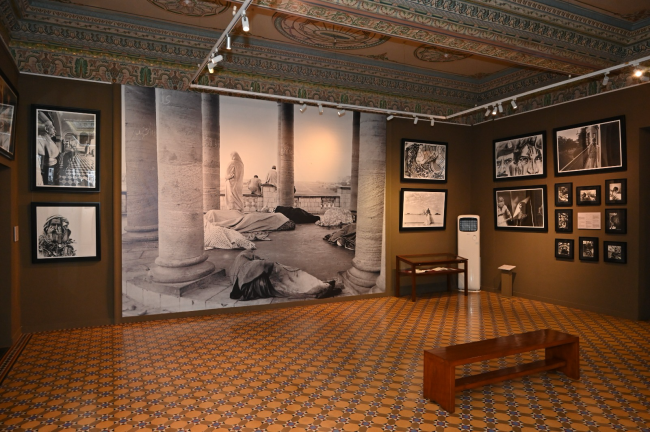
The monumental, life-sized prints are among the exhibition’s most striking features. Rendered in black and white, they give faces, gestures and architectural details a compelling physical
presence. At this scale, even subtle tonal variations become prominent. The absence of colour directs attention towards texture, contrast and the interplay of light and shadow, allowing the subjects to emerge with an intensity that avoids spectacle while retaining ambiguity.
The City by the Sea offers a starting point for understanding Mahmood’s relationship with his surroundings. Karachi is not merely a backdrop but a city continually observed and
reconsidered. Its streets, buildings, industrial spaces and maritime landscapes reveal overlapping histories and cultural expressions. In an interview for my thesis, Mahmood
reflected, “When I started photographing Karachi, I began seeing the city more clearly through the lens.”
His observation captures photography’s ability to interrupt familiarity. A place we know intimately can become almost invisible through routine; the camera makes us reconsider what we thought we understood. Mahmood’s sustained engagement with Karachi demonstrates that looking is never a finished process. As the city changes, its photographs preserve fragments of an evolving urban landscape, recording both its continuities and its transformation.
In Endeavours of the Spirit, the focus shifts between human vulnerability and cultural continuity. Photographs documenting the 2005 Kashmir earthquake and the 2010 Sindh floods appear
alongside images of Hinglaj, Khairpur, Sehwan and Bhitshah. The juxtaposition brings experiences of devastation, pilgrimage and spiritual devotion into a shared visual space, exploring how places acquire meanings that extend beyond their physical appearance.
Photographing tragedy carries particular responsibility. An image can bear witness to suffering, but it cannot contain the full extent of an event or the lives it alters. Similarly, a photograph of a sacred site can record its visible form without fully communicating the histories and beliefs invested in it. Mahmood’s documentary practice occupies this space between evidence and interpretation. The camera preserves something of the world, but the resulting image is always shaped by the encounter between photographer and subject.
In Legacies in Stone, the focus shifts to sculpture and archaeological heritage. Photographs of Gandharan and Italian sculptures, alongside works from the Mohatta Palace Museum, draw attention to form, texture and expression. The display of Takht-i-Bahi extends this engagement with architectural and archaeological remains. Photography becomes a meeting point between different forms of looking: the sculptor’s shaping of material, the photographer’s attention to light and surface, and the viewer’s encounter with objects that carry traces of another time. This movement from the contemporary city to ancient sculpture gives the retrospective its breadth.
The title The Unbearable Solitude of the Third Eye brings these varied subjects together through the idea of heightened perception. The third eye suggests the photographer’s ability to notice and preserve what might otherwise remain unseen. Yet this solitude does not necessarily imply separation from the world. Every photograph begins with an encounter, and the resulting image carries that moment forward, allowing others to participate in an act of looking they did not witness themselves.
In our interview, Mahmood described the photographer as “always collecting, always shooting, and always searching for that next great shot.” The statement captures the restlessness behind a practice spanning four decades. A retrospective gathers the past into a form that can be revisited, but it cannot bring the act of looking to a close. There will always be another encounter, another detail and another image waiting to be made.
The solitude of the third eye perhaps lies in recognising that seeing is never complete. Photography, as an art form, does more than preserve appearances; it transforms observation
into interpretation, making the familiar newly visible. Mahmood’s retrospective reminds us that the value of an image lies not in offering a definitive account of the world, but in opening it to further scrutiny.