
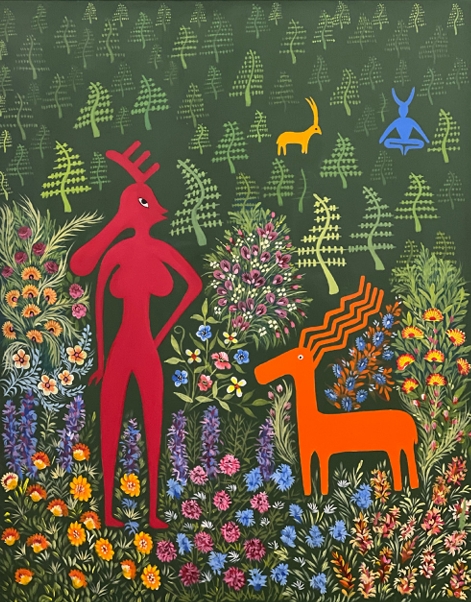
Curated by Ammar Aziz, The Shapes of Seeing, exhibited at ZQ Gallery in Lahore, stood as a testimony to the evolving language of contemporary visual perception and artistic inquiry.
Is vision merely an act of the eyes, or is it the slow unraveling of histories that live within us? For its inaugural exhibition, The Shape of Seeing, curated by Ammar Aziz, ZQ Gallery positioned itself at an axis where tradition and perception converged to challenge the temporality of seeing. Aziz makes clear that his conviction is in the continuing primacy of traditional mediums of painting, drawing, sculpture, and installation, as mediums capable of sustaining meaning, memory, and metaphysical depth in a cultural moment increasingly smitten with the impermanence of new media.
When I first entered the exhibition premises, I found myself momentarily absorbed not by the works but by the architecture itself: red brick walls, spacious verandas, and long hallways that carried with them the weight of colonial memory. The space, with its echoes of another era, framed the exhibition in a way that was both grounding and disorienting, as if one were already negotiating between past and present before even encountering the art. Stepping further in, what struck me most was the rare gathering of renowned and seasoned artists under one roof, a sight that has become increasingly uncommon in Pakistan, where many of these practitioners are now either represented primarily on international platforms or in isolated solo shows. To see them assembled together here was not only a breath of fresh air but also a reminder of the importance of collective exhibitions, where diverse practices speak to each other and expand the horizons of perception for both artist and viewer alike.
The exhibition’s premise rests on a deceptively simple yet conceptually dense question: what does it mean to see? By foregrounding vision not as passive reception but as an active, interpretive construction, the curator situates seeing as a process inseparable from memory, affect, and imagination. In doing so, he aligns himself with a lineage of thought that resists the instrumentalization of vision in contemporary culture, its reduction to data, surveillance, or spectacle and instead proposes art as a space of contemplative encounter.
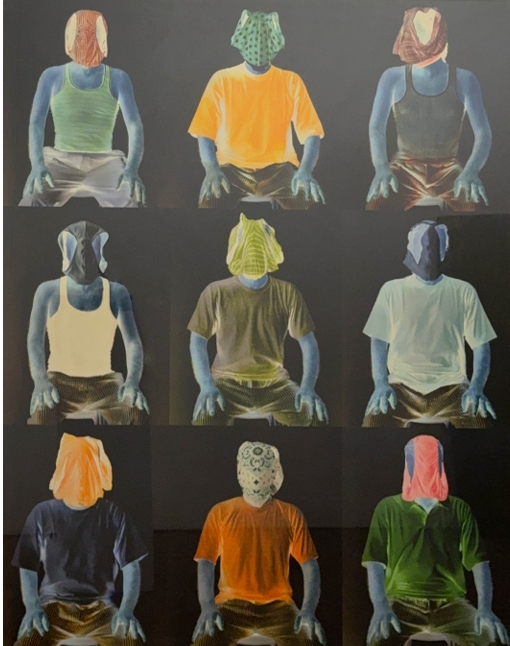
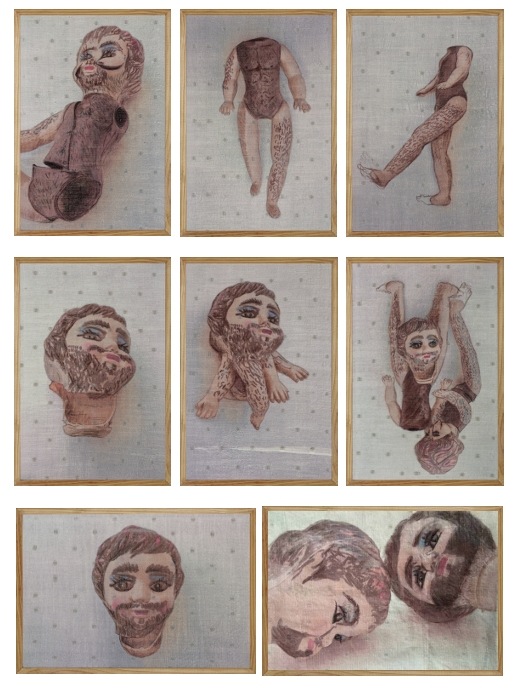
Several artists in The Shape of Seeing probe the ways perception is entangled with the body, identity, and performance. Anwar Saeed’s Undie ID uses intimate garments as masks to destabilize masculinity, while Mohsin Shafi’s Cut-Throat Colonics stages absence and vulnerability as central to reconstructing memory and self. Shahid Mirza, with his sculptures, invoking Nietzsche, reclaims seeing as a sensuous, personified wisdom rather than an abstract act. Collectively, these works foreground perception as an arena where identity is not simply revealed but contested, veiled, and reimagined.
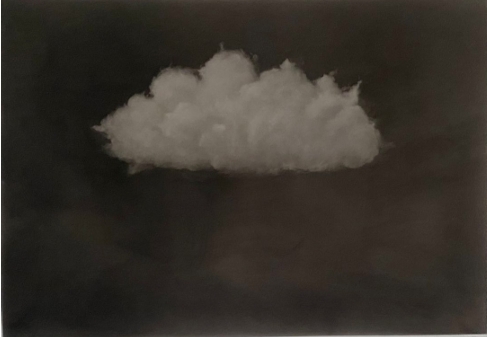
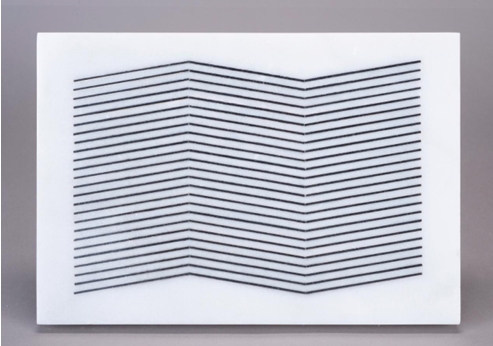
Other contributions turn to nature to question perception’s temporality. Ali Kazim’s renderings of clouds and lightning capture fleeting brilliance inscribed in memory, while Hamra Abbas’s marble Waterfall Drawings translate the fluidity of water into the solidity of stone. Sumera Jawad’s riverine and swan imagery meditates on tranquility as a mode of seeing, proposing serenity as resistance in an age of fracture. Together, their works suggest that vision is an active negotiation with time, holding onto what is fleeting while also acknowledging its inevitable dissolution.
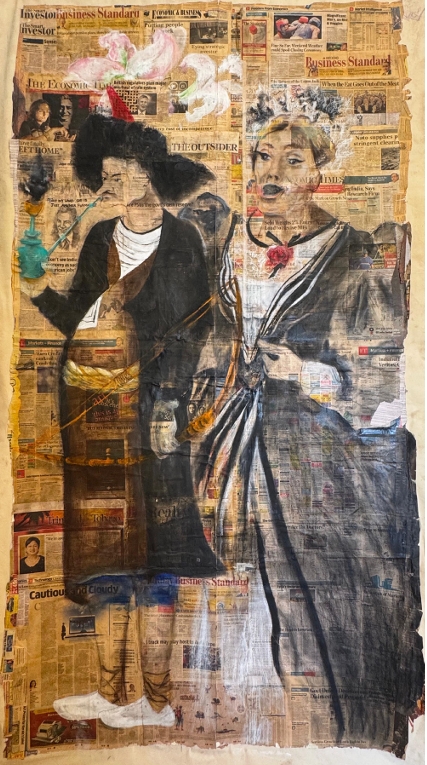
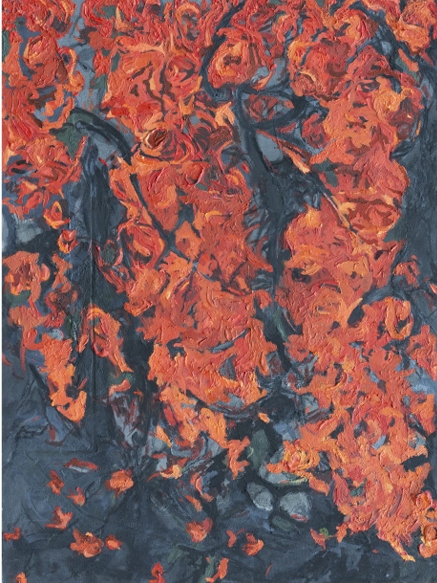
Materiality and fragility emerge as another key element in the exhibition. Masooma Syed’s collaged newspaper and chandelier fragments transform detritus into spectral light, while Imran Ahmad Khan’s terracotta and sandstone forms root perception in the weight of matter. Muhammad Ashraf’s flower-wound canvases stage beauty and rupture in fragile coexistence, oscillating between bloom and decay. These works remind us that to see is to reckon with fracture and precariousness, where vision is tactile as much as optical.
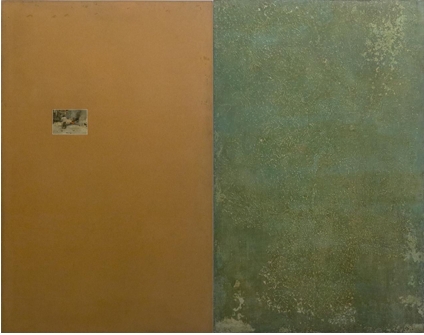
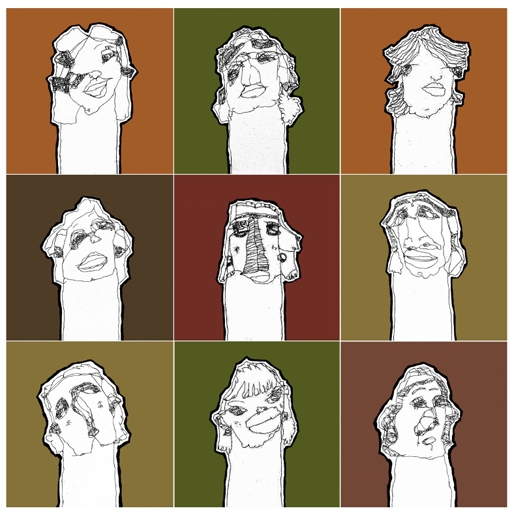
History and power also shape the terrain of perception. Risham Hosain Syed’s Texts and Contexts stages a dialogue between Victorian lace motifs and vernacular imagery, exposing how colonial aesthetics persist within contemporary identities. Sajjad Ahmad’s digitally manipulated prints shed light on the instability of the “real” and the “real-looking,” highlighting the mediated nature of vision in our times. Ayaz Jokhio’s wry Mugshots critiques the seriousness of art with humor, reminding us that perception is contingent, playful, and culturally coded. In these works, seeing is revealed as an ideological act: always structured by archives, histories, and systems of representation.
Finally, Rabeya Jalil’s paintings anchor the exhibition in play, chance, and improvisation. By elevating banal subjects through repetition and satire, her work critiques academic formalism and disrupts binaries of high and low art. Perception here becomes open-ended and improvisatory, reminding us that seeing can also be subversive, mischievous, and joyful.
What stood out to me in The Shape of Seeing was not only the strength of individual works but the collective reminder of what it means to encounter art shaped by time, experience, and persistence. In a society where gallery spaces are increasingly filled with the energy of young graduates and emerging practitioners, a vibrancy that carries its own importance, it felt equally necessary to pause and look at work that is seasoned. The gathering of these established artists in this exhibition emphasized the value of continuity, of practices that have matured over decades and carry with them not just technical mastery but also the sediment of lived histories. To encounter such work alongside one another was to be reminded that the ecology of art requires both the urgency of the new and the depth of the established, and that meaning emerges most fully when these different temporalities of practice coexist in dialogue.
The Shape of Seeing invited viewers to live in the liminal spaces between the visible and the unseen, between permanence and loss and between what is given and what is imagined. It put forward the idea that vision is not only about recognition but about negotiation; between memory and fantasy.
– Sumbul Natalia is a correspondent for ArtNow Pakistan, bringing informed and engaged coverage from Lahore’s vibrant art scene