
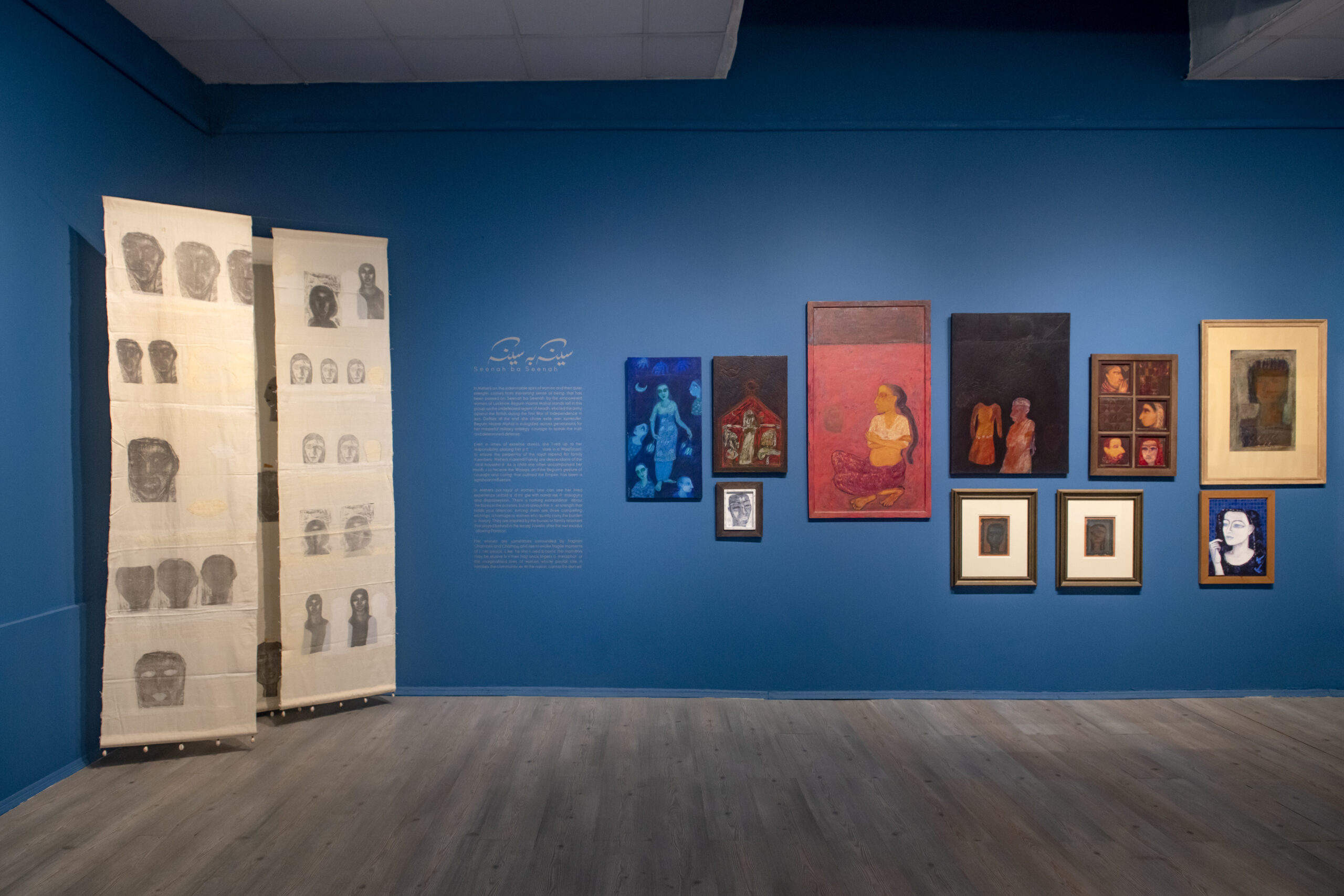
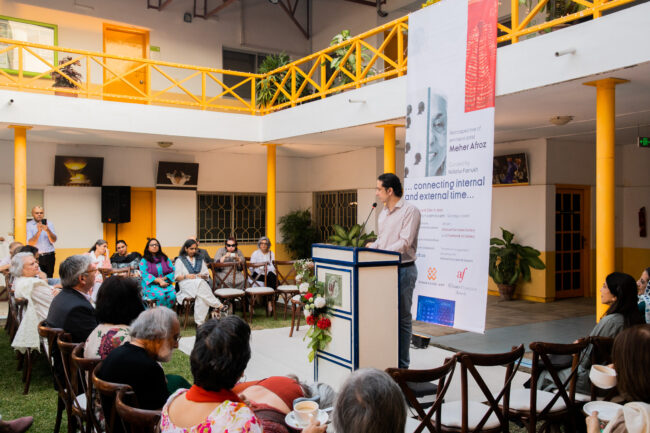
You can’t know an artist’s practice without knowing the contexts within which the works have been conceptualized. Meher Afroz’s practice is, if put simply, an observation of the times she lived and, if put more eloquently, a discourse on matters beyond linear time, paving a path where the self situates itself in multidimensions of contexts. Fifty years of the award-winning artist’s practice were showcased in her first retrospective titled “…connecting external and internal time…” between Nov 24th to Dec 17th, at Alliance Francaise and Chawkandi Gallery, curated by Niilofur Farrukh. The retrospective was accompanied by critical and historical discourse, and to commemorate the event, a catalogue was launched.

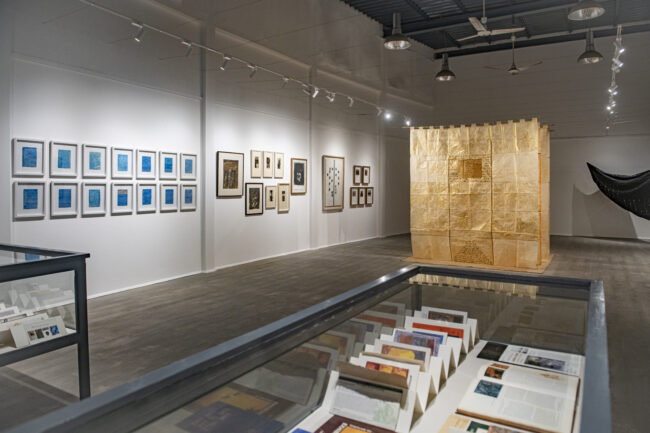
Coordinating with the title of the retrospective, the curator designed the exhibit to be viewed in relation to the times the works were created, as they influenced the artist’s thought spectrum and empathy. The early works in painting created in Pakistan were produced at the onset of limited access to printmaking equipment. There were works hinting at politics and activism, through the symbolism of guns and theatrical masks, as the artist witnessed war and violence in the country in 1970s, as East and West Pakistan were divided. And then the spiritual, held together through the symbolism of the cloth and dress in Sufism, the cathartic repair of the needle and embroidery and elements of sacred geometry. Though the paintings, prints and mixed media works were organized in the said manner with respect to the times, but they resisted linearity in thought. One such example is present in the collection,“Seenah ba Seenah” capturing the womanly spirit and resilience in 1997, which seems to reappear in the 2005 “Poshaak” series. Although the latter was organized under the spiritual emblem, we see a circularity in the practice.
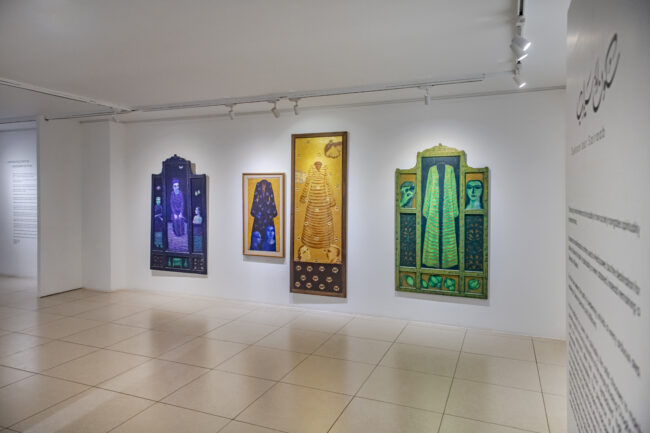
I thought immediately as I saw the works simultaneously, a rigorous exploration of surfaces; from canvas, wood, to Nepalese paper and handmade paper, marked expressively through acrylic painting, embroidery, charcoal, intaglio print, etc. To begin reading the work, any contemporary thinker would, at the very first glance, situate the practice as feminist or as naive. I believe looking at Meher’s practice this way would be a boxed perspective. In fact, the imagery of boxed forms as metaphors to boxed thinking appears across many works; in “Gulistan Humara”, 2010 as a graphite rendered box, in the wooden surfaces, resembling windows or “jharokay” in “Poshaak” series, 2005. Within these straight, angled, safe boxed containers are floating bodies, familiar everyday objects, and bodily adornments, showing disintegration, alienation and ungrounded reality. The representation of separation and loss shifts; it appears as repetitive motifs, delicate needlework, Urdu text and screen print, as in “Dastavaiz” series, 2007 and her more recent untitled works from 2025. In these works, time is marked through duration and intensive ritualistic treatments, hinting at a subliminal reality. Inquisitions like this one can only be made when they see the artist’s practice throughout the five decades in a single day, though I wish it were located in a single exhibition space.
Public Programming
The retrospective initiated with the curator’s walkthrough and a performance by Meher Afroz. Throughout the exhibition, Niilofur continued to engage educational institutions with tours, enabling contextualisation of the artist’s work through the historical lens. Having attended a walkthrough arranged with my own students, I truly commend the facilitation by both the curator and the artist, especially their usage of accessible language and studio anecdotes to build relatability and conceptual understanding in the students’ minds.
To speak to a more critically advanced audience of artists and academics, the talk “Meher Ka Pakistan ki Art History Mein Muqam” was held on Dec 12th at Alliance Francaise, with the curator and notable art critic, Amra Ali. A viewer born in times of neoliberalism, of specialisation and production in linear terms, someone such as myself, would think the artist’s exploratory practice lacked “focus”. The talk clarified such contemporary ambiguities. In the talk, Niilofur highlighted how the viewers from the newer generations found it challenging to understand the vastness of Meher’s practice or felt difficulty in relating to the works. She shared that the artist’s practice hasn’t been inspired by any specific Western art movement and hence, is considered an “other”. In forgoing the Eurocentric categorisation, the practice opens itself to layered meanings and associations and reclaims narrative agency, a prize for postcolonial criticism.
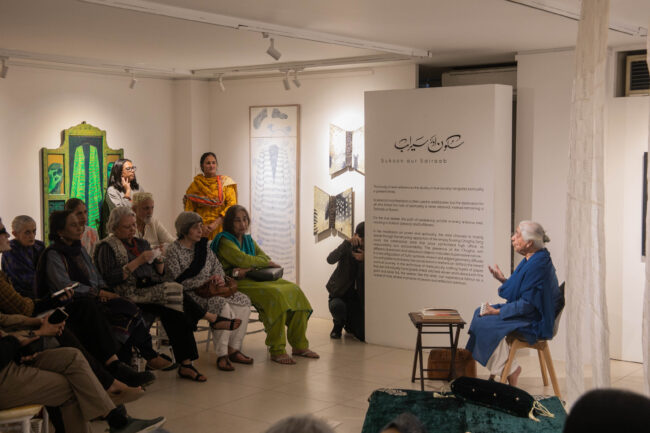
Furthermore, it opens itself up to critique by the younger generation of artists and thinkers who have been formally trained under Western influences, and perhaps, they resist an awareness of their surroundings? The talk offered critical insights into the documentation of Pakistani art practices and the institutional barriers that prevent dialogue and access, especially for students. The exchange was a delight for academics, theorists and practitioners and the curator saw it as the beginning of a series of talks on the subject of art history and postcolonial criticism. I hope the video recordings of such discussions be available for public access as works of academic scholarship to assist both students and scholars.
The Collectors’ Role
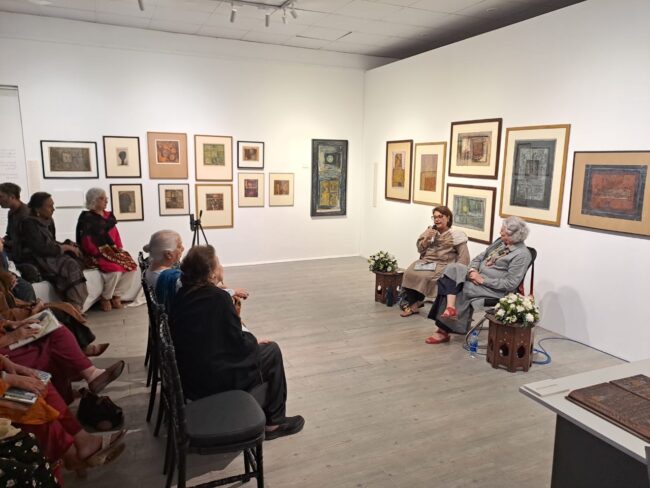
As a closing ceremony, on the last day of the exhibition, another talk was hosted with the curator and two collectors of the artist, Zohra Hussain and Gertrude Jatoi. As compared with “Meher Ka Pakistan ki Art History Mein Muqam”, this talk was more intimate, hosted at Chawkandi Gallery, attended by collectors and patrons of the arts. “Why collect Meher?” was primarily the topic of discussion. Zohra Hussain recounted the opening of Chawkandi Gallery and hosting the exhibitions of her cousin, Meher; cautious of how the personal association would be viewed by the visitors of the gallery at the time. Gertrude Jatoi recalled waking up to the sounds of bombing in the early 1970s and how Meher’s work brought a sense of familiarity to the internal fears. “I think people don’t understand where she came from and what she left behind,” shared Mrs. Jatoi, highlighting the importance of empathetic viewing and collecting.
Listening to the talk between the curators and the two collectors proved deeply enriching as the history of Karachi and the art market was shared from lived experience. Niilofur acknowledged the role of the collectors for the realization of the retrospective and shared how “connection” was the core of the retrospective; in the viewing of works as well as collector’s participation. In addition to the retrospective at hand, it was discussed how collectors can add to the cultural knowledge of the city by facilitating public access to their private collections.
Catalogue Launch
On the day of the talk “Meher Ka Pakistan ki Art History Mein Muqam”, a catalogue on Meher Afroz’s retrospective was launched. Along with the curator’s notes and images of artworks and their descriptions, the essays in the catalogue “…connecting external and internal time…” provide thorough insights into history and the artist’s practice. Among the essays are critical writings based on a series of works, like “Azaad Shehr Ki Ghutan”, “Sukoon aur Sairaab” and text discussing the artist’s strategy of making in “Thinking Through Urdu: Embedded Epistemologies”.
The retrospective raises a multitude of thoughts around the institution of teaching art, of exhibiting and of artistic practice in the present day and age. In contemporary politically charged practices of colonialism, especially for those born in the current millennium, it is debatable whether inspiration can parallel lived experience. Neoliberalism favours representation over embodiment and so, politics and social critique have become themes behind practice, merely illustrating the ordeals. The lack of exploration, duration and sustained contemplation risks cultural and historical erasure. “…connecting external and internal time…” reminds us that the artist’s work is not to impose or illustrate but to provide a spectrum of thought, all the while being aesthetically grounded in an uncategorized, multidimensional Pakistani identity.
All picture courtesy to Bilal Danish and Humayun Memon.
Jabeen Qadri is a multi-disciplinary artist, lecturer and writer based in Karachi.