
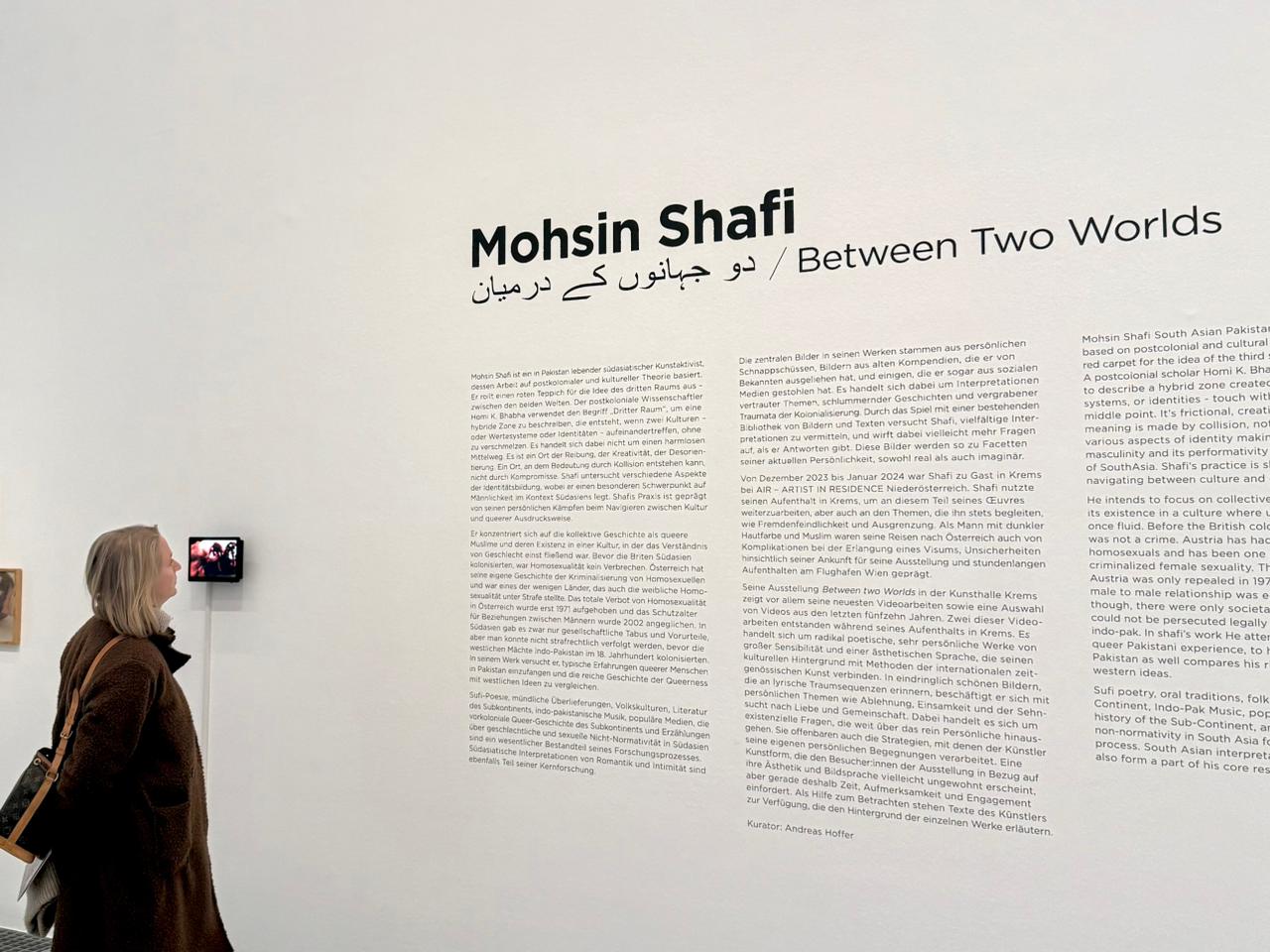
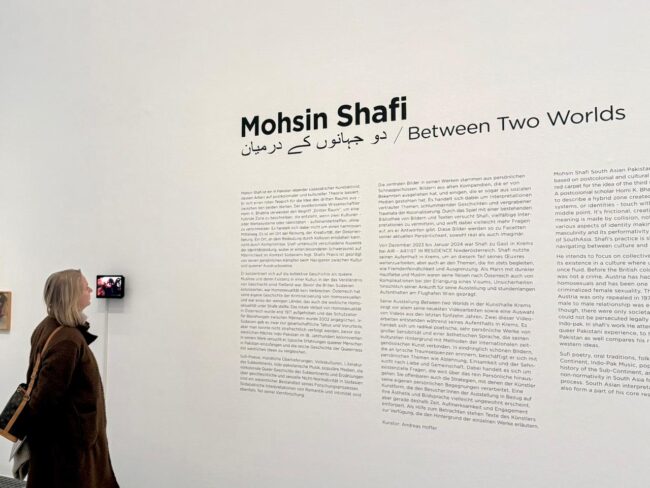
Mohsin Shafi’s current exhibition titled “Between Two Worlds” at Kunstmeile Krems presents a complex negotiation between the personal and the archival, the intimate and the public, revealing an artistic practice that is as introspective as it is socially conscious. As a mid-career artist, Shafi navigates the tensions between the self, memory and the sociocultural expectations imposed by class, family and nationhood, using his work as both a record and a reflection of lived experience.
One of the striking features of this exhibition is its engagement with personal grief and memory. Having lost both parents, Shafi anchors his work in objects and photographs left behind, transforming personal loss into a wider meditation on inheritance, absence, and the traces that remain after death. Shafi notes “how unsafe it feels to be an adult orphan in a society where family is the basis for all parts of life.” Shafi finds solace in safety in spaces like shrines, particularly the shrine of Shah Hussain because it’s unique even within shrine culture. These elements are commemorative and they are reframed within layered, often contradictory, forms that challenge the viewer to confront the tensions between private experience and public display.
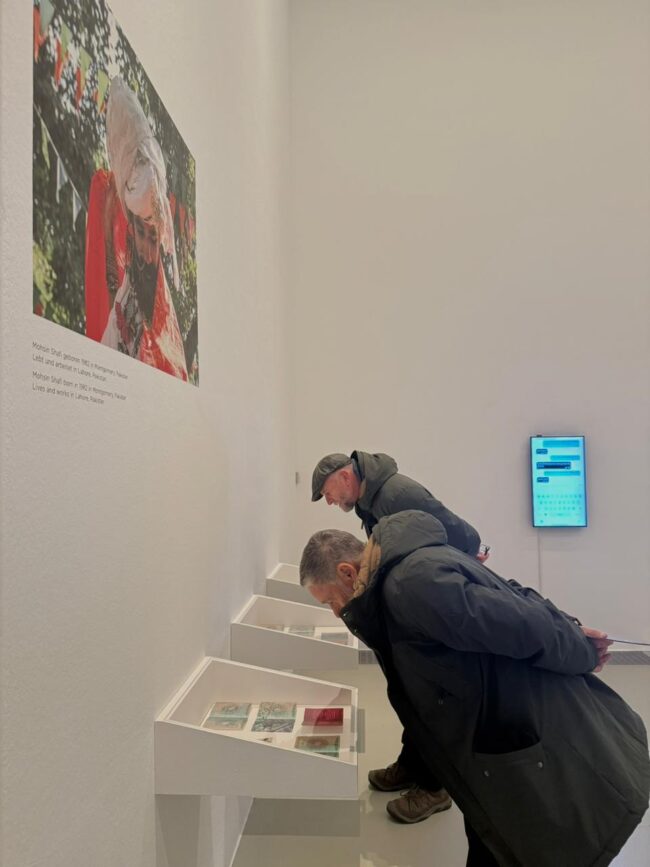
Shafi notes “[It is] confusing that our society can have two approaches, one side that it is taboo to even talk about intimacy of any genders but on the other hand there exists a shrine in precolonial Lahore, where two lovers are buried next to each other and being celebrated.”
Shafi also mentioned a story about Shah Hussain wandering the desolate outskirts of Lahore by day, returning at night to the shrine of the city’s patron saint, Ali Hujwiri. This period of ascetic withdrawal, he observes, sharpened the poet’s mystical sensibilities, transforming him from a weaver’s son into Lal Hussain — the figure remembered for ecstatic dances in crimson robes through Lahore’s streets. Shafi suggests that in these public eruptions of devotion, where verse dissolved the boundary between the earthly and the eternal, Hussain cultivated a form of free-spirited humanism that privileged love over dogma. Such a stance unsettled the rigid orthodoxies of his time, earning him both adoration and controversy, a duality that, Shafi intimates, continues to resonate within his own artistic practice.
The exhibition also marks a notable departure from Shafi’s signature satirical commentary. While his earlier work often critiqued society through irony, here the focus shifts toward the process of archiving and introspection, experimenting with mediums he hasn’t previously showcased, sculpture, video and drawings that are presented as part of an evolving practice. In particular, the use of video incorporating texts from journals, voice recordings, and layered narratives constructs a living archive, emphasizing the artist’s ongoing evolution and the fluidity of selfhood.
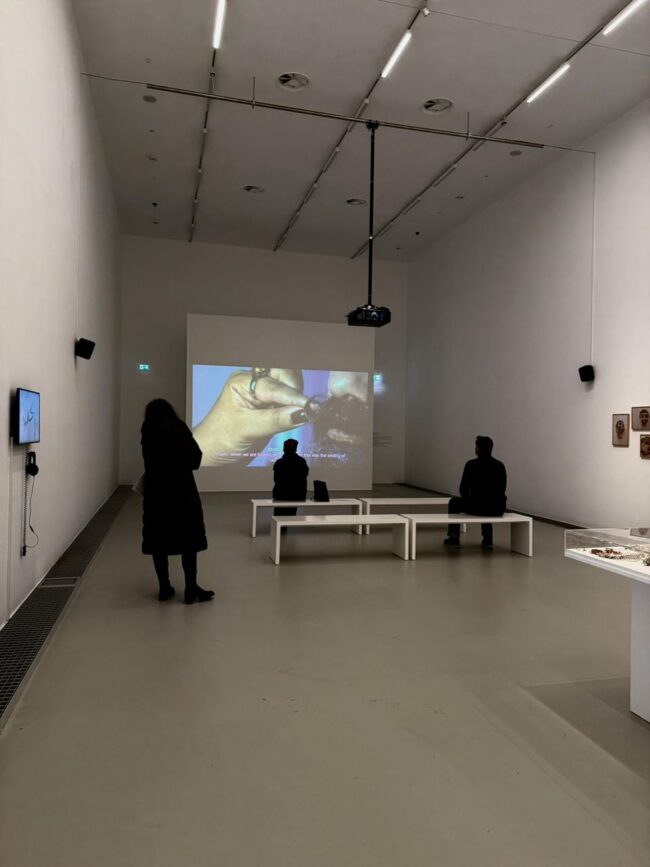
In a work titled The Space Between Us, he recites a passage from his own writing: “One last long look to you, beloved sea, then farewell, however difficult it may be.” The spoken words unfold alongside visuals of gently shifting water, its movement so gradual that the viewer can observe each ripple soften, disperse and slowly dissolve. The pairing of sound and image creates a meditative atmosphere, where departure feels prolonged and almost suspended in time.
In Myths and Creed Are Heroic Struggles, the imagery shifts to that of an unidentified man sowing seeds in the soil. Accompanying the scene is another excerpt from Mohsin’s writing: “I do not belong to those whose visual senses are closed off. That is why I hear, or rather, feel, the movements and the persistence that unfold before my spirit.” Here, the act of cultivation becomes both literal and symbolic, echoing the text’s emphasis on perception that extends beyond sight into a deeper, almost spiritual awareness.
Shafi’s engagement with Sufi concepts, especially the “Malamatiyya” tradition, introduces a spiritual dimension to the work. The Sufi idea of confronting societal taboos to subdue the ego resonates with Shafi’s own negotiation of personal and collective identity. Visits to the shrine of Shah Hussain, and reflections on the seven stages of love, infuse the exhibition with a sense of longing and reflection, where grief, desire, and memory coexist in complex, poetic ways.
The Malāmatiyya (ملامتية), known as the Malamatis, were an early Islamic mystical movement that emerged in 9th-century Greater Khorasan. Their name derives from the Arabic term malāmah (ملامة), meaning “blame.” Central to their philosophy was the principle of self-reproach. They held that genuine piety should remain private and that public admiration for one’s devotion risked fostering ego and attachment to worldly recognition.
According to Shafi, “Shah Hussain was known a Malāmatiyya, he offered the world different reasons to blame him, he challenges social order and established norms of the society because there lies a rebel in him. This was my understanding of Shah Husssain and Madhu’s love.”
To guard against spiritual pride, members deliberately concealed their virtues and spiritual knowledge, while allowing their shortcomings to be visible. By doing so, they constantly reminded themselves of their own imperfection and guarded against hypocrisy. For the Malamati, even elevated “spiritual states” were viewed with suspicion, as they could easily become subtle forms of self-deception. Their rejection of overt displays of piety was not driven by concern for public opinion, but by a deep, ongoing awareness of the ego’s tendency toward self-righteousness.
As a lot of the work in the show brings the element of language, sufi vocabulary is important in Persian and other literatures related to it, such as Turkish, Urdu, Sindhi, Pashto, and Punjabi. Through the poetry of these literatures, mystical ideas spread widely among the Muslims. In some countries Sufi leaders were also active politically. Framing the exhibition through this lens brings the following question: if Sufi poetics reveals how language can both veil and unveil power, then every artistic gesture, however intimate or abstract, is already entangled in the political.
The artist’s approach to the personal is politically aware. His work addresses the erasure and taboo surrounding queer identities in Pakistan, reclaiming terms and symbols while resisting the reduction of queer experiences to cliche. He talks about the term “two spirted” here “which he reclaims and prefer instead of the term queer as It serves to reclaim
perspectives on gender fluidity that existed before European colonization.” Through motifs such as miniature garments, stitched dolls and layered video narratives, Shafi explores the intersections of intimacy, identity, and societal expectation, making visible what is often relegated to silence.
A recurring theme is Shafi’s negotiation of “third spaces”, both physically and conceptually. In his teaching, he emphasizes egalitarian spaces, drawing on postcolonial theory to position himself and his work as part of an ongoing dialogue rather than a static artifact. Shafi resists easy categorization, demanding an active engagement with our enriching cultural history of gender binaries and divisions from viewers. His work challenges the audience to acknowledge the intensity behind accessible forms, confronting the “digestible” with the deeply personal.
In reclaiming personal histories, engaging with spiritual and queer frameworks, and exploring new mediums, Shafi crafts an artistic space that is as much about presence, memory and longing as it is about form. The exhibition shows the art as an archive, where grief, desire, memory and identity converge in layered, often uncompromising ways.