
Curated by Qasim Bugti, the recent show at the VM Art Gallery was a display of thought-provoking and evocative works by seven commendable artists
At VM Art Gallery, Whispers of the Wild, curated by Qasim Bugti, stages an evocative dialogue between seven artists, Aasim Akhtar, Atif Khan, Jamil Baloch, Minaa Haroon, Munawar Ali Syed, Rahat Naveed Masud and Romessa Khan.
Two artists oscillate between intimacy and public discourse; the works of Minaa Haroon and Munawar Ali Syed had a unique connection. While their approaches differ in form and material, both artists operate within the terrain of transformation, rooting their work in what has been overlooked, abandoned, or eroded. Together, their works probe the spaces between decay and endurance, asking what remains when the visible world begins to fracture.
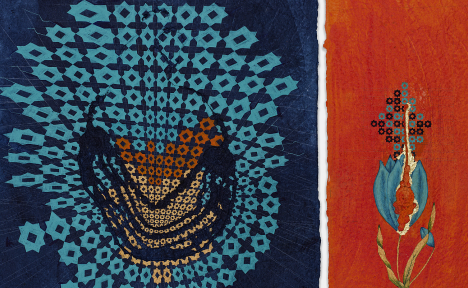
Minaa Haroon’s practice, anchored in material poetics, situates fiber, thread, and organic matter as carriers of memory. Her installations often emerge as tactile topographies, fragile yet forceful compositions that appear to breathe with the pulse of the earth. She reimagines objects of inheritance not as static heirlooms but as mutable archives that record resilience, grief, and continuity. Each fibre, dyed, pressed, and layered, retains traces of its origin and decay, gesturing to cycles of survival and transformation. In Haroon’s hands, materials become sentient. They speak of women’s domestic labour, of the quiet endurance embedded in care work, and of the invisible ways memory is transmitted across generations.
Her process-based approach, almost ritualistic in its repetition, recalls practices of mending and repair. Through this tactile engagement, Haroon resists the idea of preservation as stasis; instead, she allows her materials to age, warp, and change over time. The resulting surfaces, texturally dense yet understated, function as metaphors for the body, resilient but marked by experience. There is a certain tenderness in her treatment of organic matter, as though she trusts the material to reveal its own history. Her work thus becomes a meditation on how memory survives not through monumentality but through the continuous act of care and reconstitution.
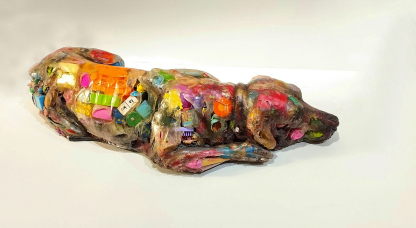
Opposite Haroon’s quiet materialism stands Munawar Ali Syed’s urban sensibility, raw, charged, and confrontational. Syed’s multidisciplinary practice stretches across drawing, installation, sculpture, and performance, each medium serving as a site to interrogate the hierarchies embedded within everyday life. His work draws attention to systems of social stratification that define cosmopolitan existence, class, race, colour, and access, and how these frameworks generate alienation within the urban fabric. In his practice, the city itself becomes both subject and collaborator: its discarded objects, its cracked walls, its forgotten corners all become stages for reimagining collective life.
Syed’s engagement with public art, particularly through projects like Rung Dey Karachi and Reimagining Walls of Karachi, illustrates his commitment to accessibility and collaboration. By working with truck artists and local craftspeople, he dissolves boundaries between “high” and “low” art, creating participatory spaces where aesthetics and activism merge. His installations often utilize discarded or functional materials, scrap metal, industrial waste, found debris, each transformed into sculptural form that critiques material excess while recovering beauty from ruin. Syed’s practice is grounded in the politics of visibility: to whom does art belong, and where does it live? His interventions within public spaces attempt to democratize artistic experience, situating it within the very streets that bear witness to social inequality.
When viewed together, Haroon and Syed’s works form a symbiotic narrative. Haroon’s world is intimate, inward-looking, and attentive to the slow time of growth and decay; Syed’s world is outward, engaged with the accelerated temporality of the city and its inequities. Yet both artists share a deep concern with regeneration, with how fragments, whether material or emotional, can be reassembled into new structures of meaning. Their dialogue in Whispers of the Wild is one of resonance rather than contrast: Haroon’s whisper emerges from the soil, Syed’s from the city’s hum, but both speak of endurance as a form of rebellion.
Bugti’s curatorial approach allows this conversation to unfold organically. The exhibition’s pacing encourages viewers to move slowly, to oscillate between Haroon’s meditative surfaces and Syed’s layered constructions. In this movement lies the exhibition’s strength; it compels us to attune ourselves to the quieter rhythms of material transformation. The “wild” of the title does not refer merely to nature but to a deeper, unruly vitality that persists beneath systems of control, hierarchy, and decay. It is the wildness of resistance, of care, of things that continue to grow despite neglect. Whispers of the Wild is a study in regeneration, of how art can emerge from the discarded and the forgotten to propose new forms of life. Their works, when held together, invite viewers into a space of reflection: to listen closely, to trace the murmurs of the materials that surround us, and to recognize in them the enduring will of the wild.