
Culinary practices and food depict the culture, traditions, and lifestyle of the people of any region. These practices evolved as every generation added something new to its ancestors’ culinary practices and dietary habits. From consuming leaves and hunting animals during ancient times to today’s elaborate cuisines, food has undergone numerous changes. The surge of global food chains has further influenced this evolution. However, after promoting convenience in culinary practices for decades to accommodate the life-in-the-fast-lane, the world seems to be reverting from fast food to traditional cuisines.
Food is a fundamental element of human life, essential for survival and pleasure. How could it have remained distinct from philosophy, religion, literature, and art? From Plato’s Republic to folklore, food was prominent in innumerable narratives. Similarly, from the history of Greek art to the inscriptions on the Egyptian pyramids’ inner walls, food remained a central theme—particularly in painting. Be it da Vinci’s The Last Supper, Carracci’s The Beaneater, Van Gogh’s The Potato Eaters, or Vermeer’s The Milkmaid, food has been a part of every art movement in Europe—sometimes as a metaphor of realism, and at other times, representing pop art or consumer culture.
Maryam Arslan is a contemporary artist who intends to carry on this tradition in a unique way, reimagining food and cuisine through her art. She aptly selects everyday food, using vibrant colors to add flavor to her depiction of varying delicacies. Her paintings transcend mere decorative artwork for dining rooms or kitchens; instead, she portrays a visual history of both traditional and modern cuisines. Her work bridges the gap between art and culinary culture, showcasing how food can be a powerful medium for storytelling.
During the Realism movement, food was typically portrayed on canvas in its natural form. Maryam’s work not only gives these cuisines an effervescent identity through colors, but it also reflects their importance and appeal in people’s lives. Some of her paintings depict food in its consumed state. Unlike cooking magazines or restaurant advertisements, where images are artificially enhanced and portrayed in a glamorous way purely for marketing purposes, Maryam’s art unequivocally fulfills both aesthetic and commercial purposes. However, her true skill as an artist lies in her ability to paint these food items across diverse surfaces. She doesn’t restrict herself to canvas but makes use of steel plates, wood, glass, and porcelain as her mediums of expression. Maryam’s broader body of work showcases her skill in oil painting, focusing on figurative compositions.
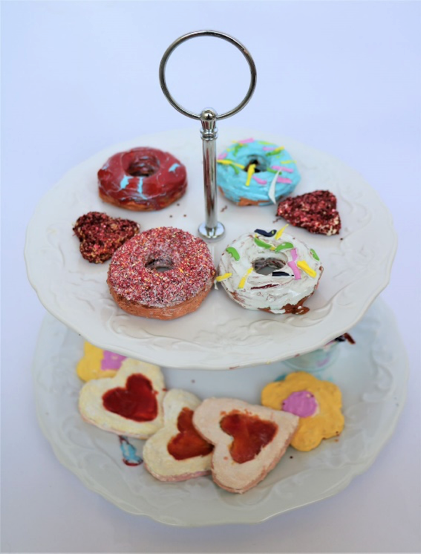
Dessert Platter, 10*12, Acrylic and enamel oil on plate, 2020
Maryam’s artistic practice delves deeply into how food evokes memory and emotion. In her pieces, such as “Dessert Platter” and “Chai,” she captures the intricate details of sweets and beverages, imbuing them with a sense of warmth and familiarity. Her compositions celebrate the aesthetics of food, often presented in ways that blend realism with an artistic flair. The bright colors and textures she employs resonate with viewers, evoking a sensory connection that transcends visual appeal to engage the imagination through taste and smell.
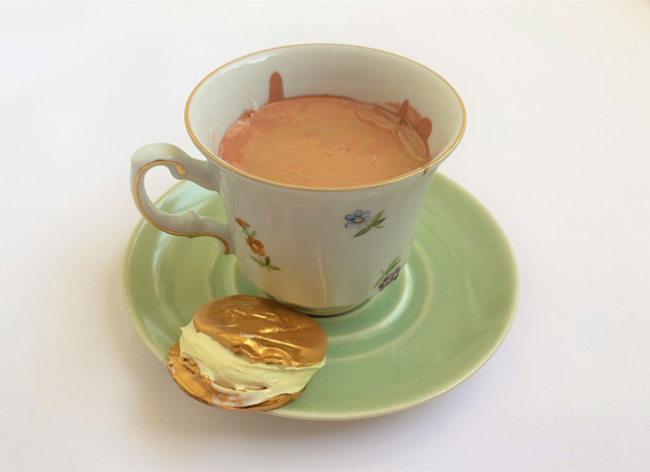
Chai, 4*6, Acrylic and Enamel on ceramic, 2020
Maryam’s art represents a feast of foods—from hurriedly made eggs for breakfast to donuts, and high tea platters served at luxurious hotels. Some pieces even evolve into narratives, where she creates a savanna of donuts and strawberries, coloring them in her palette rather than using their natural hues. This indicates how she combines her passion for food and painting to create something entirely different. Her brushstrokes and layers of color are a testament to her mastery of craft.
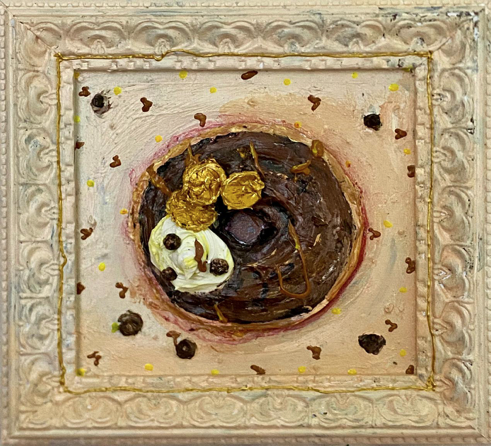
Choco Cream, 8*8, Acrylic and Enamel on Canvas, 2025
When she intends to highlight dishes alongside utensils or crockery, Maryam employs 3D techniques, painting on surfaces like frying pans, wooden frames, or glass tables to create a multidimensional effect. Achieving this requires extensive use of colors, and she is by no means penurious with them. The details in her artworks are so precise that one can discern the texture of the food ingredients or the degree to which they’ve been cooked or fried, as seen in paintings like Fries, Breakfast Egg, Mixed Vegetables, or Brownie. She masterfully captures even the solid, liquid, or semi-liquid states of food, making it appear as though ketchup is dripping from a burger or chocolate is melting from an ice cream.
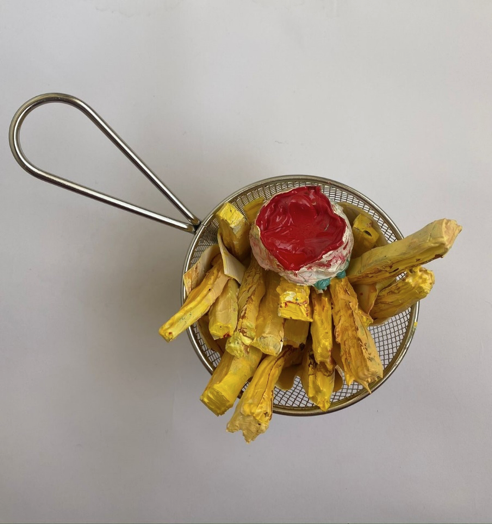
Fries, 6*4, Acrylic and oil enamel on steel, 2016
Her painting series, including works like Dessert Platter and Chai, uses vibrant colors and intricate details to evoke a sense of shared cultural experiences. The pieces highlight how food serves as both sustainer of life and connector of memories, blending realism with subtle symbolism. In these works, Maryam goes beyond mere representation, exploring food’s role in identity and tradition. Her paintings of chai, for instance, reflect Pakistan’s deeply embedded tea culture, presenting it in a delicate, almost celebratory manner. The intensity of her passion and devotion to this genre can be reflected in the following instances.
Arsalan’s work presents an intriguing visual arrangement of a chocolate-covered dessert served on what appears to be a circular picture frame, blending the lines between art and culinary presentation. The rich chocolate sauce dominates the plate, accompanied by a dollop of cream with chocolate drops, creating a striking contrast against the golden inner rim of the frame. The unusual choice of serving medium sparks curiosity and adds an element of playfulness, merging the aesthetic appeal of fine art with gourmet indulgence.
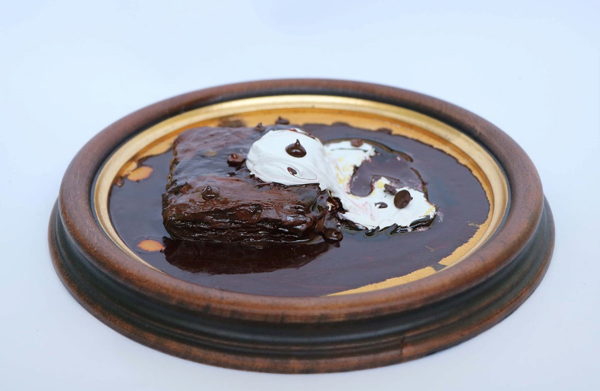
Brownie, 8*8, Acrylic and oil enamel on canvas, 2016
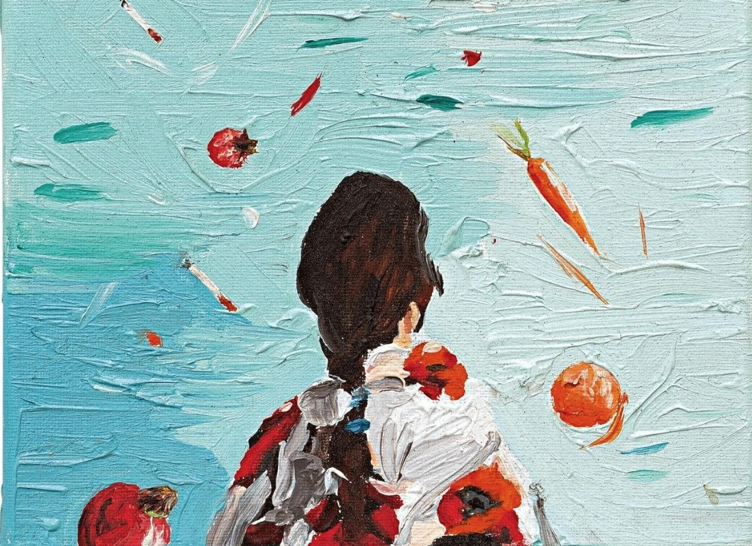
This artwork portrays a whimsical, textured painting of a woman viewed from behind, surrounded by vibrant, floating vegetables such as carrots, tomatoes, and possibly onions. The loose brushstrokes and pastel-blue background evoke a sense of surrealism and playfulness. The subject’s braided hair and patterned clothing add depth and personality, suggesting cultural or personal narrative connections. The dynamic arrangement of vegetables against the serene backdrop introduces a playful contrast, making the scene imaginative and evocative.
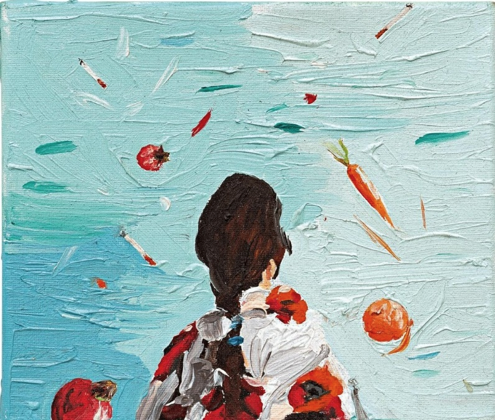
Women with floating food, 10*12, Acrylic, 2016
In an interview, Maryam highlighted her fascination with food as both a necessity and a form of celebration. Her work invites audiences to reflect on their own personal and cultural associations with food, making it a universal yet intimate subject. By painting items like tea and biscuits or festive desserts, she redefines them as symbols of shared experiences and comfort, particularly within South Asian culture. She creates semi-autobiographical pieces that include her observations, investigations, and conjectures.
Her practice often draws inspiration from personal and collective experiences, portraying the interplay of nostalgia and present-day realities. By reimagining everyday objects through her lens, she invites viewers to question and rediscover their perceptions of the ordinary, creating an intersection between fine art and cultural commentary 8.
While her imagery appears playful and accessible, the repetition of food as a subject introduces a deeper psychological layer. Food, especially sweet food, is closely tied to comfort, reward, and memory. By isolating these objects from human presence, Arslan allows them to stand in for emotional states. The absence of figures is important: the viewer implicitly occupies the role of the consumer. In this sense, her work quietly implicates the audience, turning looking into an act of wanting.
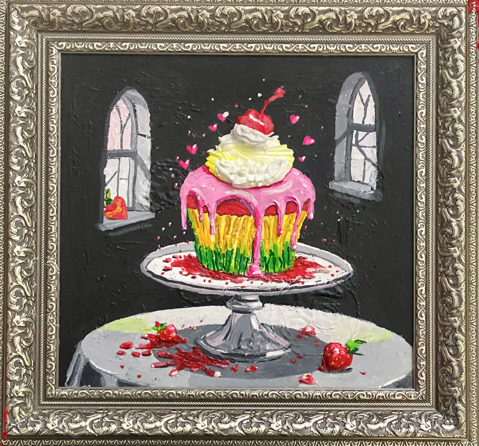
The Celebration Was a Crime Scene, 20*20, Acrylic, Glitter and Oil on Canvas
2025
Arslan’s paintings operate in a space where pleasure becomes the primary subject, not as a side effect but as an intentional artistic strategy. By choosing food, especially desserts and comfort items, as her central motif, she shifts painting away from narrative urgency or overt symbolism and toward immediate sensory engagement. This decision is neither naïve nor purely decorative; it is a conscious alignment with how contemporary viewers consume images today: quickly, viscerally, and emotionally.
These flavor-filled artworks span a wide variety of food items, from fruits to curries and fast foods to desserts. At first glance, the idea of painting food might seem trivial, perhaps not even serious art, to some critics. Kitchen adornment depicting food or the famous guava tiles often found in middle-class kitchens are considered mere decorative arts. However, Maryam’s work goes far beyond the ordinary—along with aesthetic appeal, it resonates with human emotions and societal perceptiveness, making it a profound artistic expression.
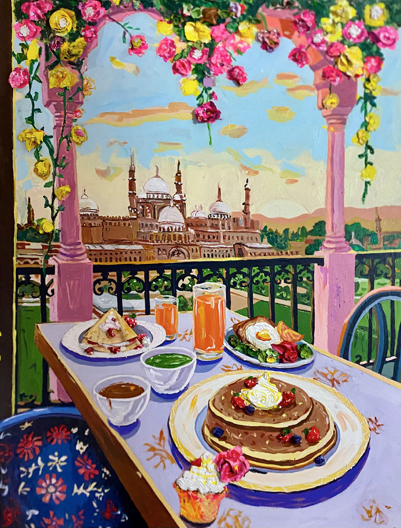
My Sky, my food, 39*53, Acrylic and Oil on Canvas, 2025
Maryam Arslan’s work has been showcased at national and international galleries. Maryam doesn’t work on individual pieces but prefers to create a sequence. Previously, she completed a self-portrait series that explored her personality and included sketches. Recently, The Celebration Was a Crime Scene series, and my Sky, My Food series is full of socio-cultural connections. At the same time, she could have chosen any other subject; her focus on food and cuisine reflects her personal satisfaction and connection with her art. When a piece of art is created with such deep personal resonance, it becomes something talismanic. It’s no wonder her paintings are not only pleasing to the eyes but also stir hunger, and the viewer feels an appetite to see more of such luscious art.
Maryam Arslan (born 1992) is a Karachi-based visual artist and art educator whose practice is rooted in an expressive engagement with colour, gesture, and everyday experience. She earned her BFA from the Indus Valley School of Art and Architecture, Karachi (2015), followed by an MA in Art and Design Studies from Beaconhouse National University, Lahore (2018). Arslan’s paintings are marked by bold palettes and a deliberately loose, energetic handling of paint, through which she explores pleasure, intimacy, and the quiet poetry of the familiar—often drawing inspiration from food, domestic spaces, and sensory memory. Exhibiting actively since 2012, her work has been shown both locally and internationally, including at Aicon Gallery, New York; O Art Space, Lahore; Chawkandi Art Gallery and Full Circle Gallery, Karachi. In 2018, she was selected for the Taaza Tareen Residency at Vasl Artists’ Association. Her artworks are also part of the permanent collection of Ambiance Boutique Art Hotels, reflecting her growing presence within contemporary Pakistani art discourse.