
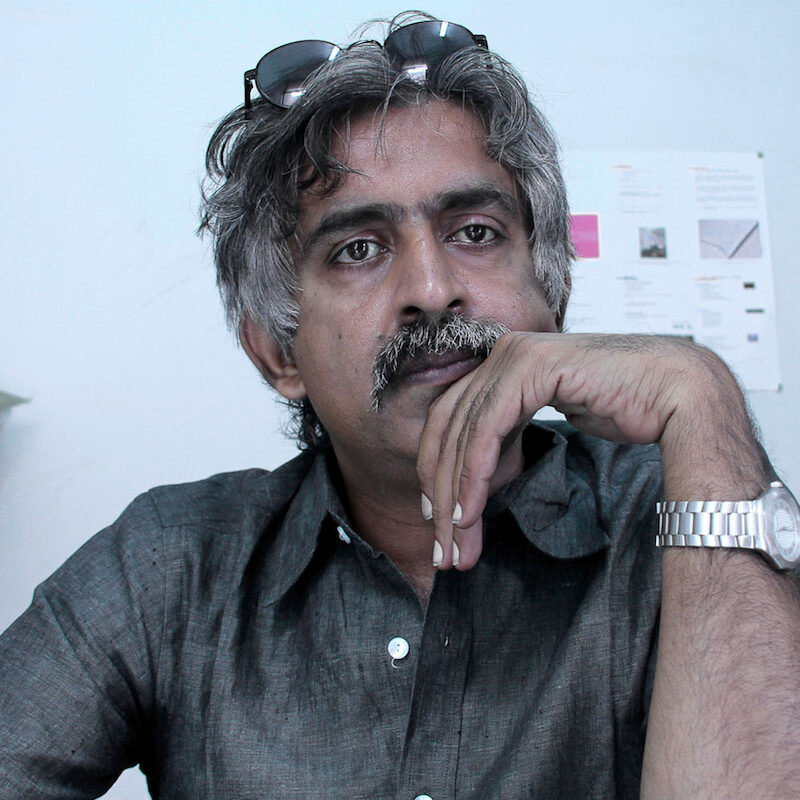
Some people possess the enviable ability to laugh at themselves. They understand the absurdity of taking life, and especially oneself, too seriously. Such people move through the world with a certain detachment, amused by the frantic importance others assign to things that, in the larger scheme, hardly matter. They are either pioneers in registering unfamiliar territory or cheerful characters who have simply stepped outside the usual rules. And that is exactly what I felt chatting with Talpur on a calm Ramzan evening.
Throughout his career, Mohammad Ali Talpur has remained deeply engaged with calligraphy, language, and abstraction. His work often merges calligraphy with abstraction, stripping written language of its literal readability while retaining its visual rhythm. The result is a body of calligraphic work that carries an almost optical quality. When asked how his early explorations with lines and repetition evolved and how his understanding of the Urdu-Arabic script informs the abstraction in his calligraphy, Talpur admits that he has never been a quick learner. Instead, he has always preferred to take his time, allowing practice and repetition to guide his understanding.
Talpur received formal training in calligraphy from Ustad Gohar Qalam. The first script he learnt was Sulus, after which he moved on to Naskh. His mother tongue, Sindhi, which is written in the same script, further strengthened his familiarity with the structure and rhythm of the written form. Despite this rigorous training, Talpur is reluctant to identify solely as a calligrapher. “I am a visual artist,” he says, “and for me calligraphy is what I do, not what defines me.”
Within Islamic culture, calligraphy carries a significance unlike any other artistic practice. Historically tied to the transcription of the Qur’an and religious texts, it occupies a revered space within visual traditions. In Pakistan, the practice of calligraphy is still deeply associated with religious expression and sacred scripture. Talpur’s work, however, moves in a somewhat different direction. Rather than treating calligraphy as a devotional or spiritual exercise, he approaches it as a visual system; one that can be manipulated, deconstructed, and reimagined.
His works often carry a minimalist sensibility, appearing as a form of linear abstraction. Through the careful orchestration of line and color, Talpur constructs calligraphic arrangements that can subtly disorient the eye. Viewers often experience flashes of movement or color within compositions that may otherwise appear in monochrome at first glance. For Talpur, language itself is among humanity’s most extraordinary inventions. Once translated into text, language acquires a visual form. a structure that can be explored beyond its semantic function. His practice attempts to dismantle that structure, freeing text from the burden of meaning so that it can exist as an independent visual entity. In doing so, Talpur treats calligraphy as an artistic language rather than a cultural obligation, distancing it from the hierarchies imposed by tradition.
When asked whether he sees any dialogue between Western minimalism and South Asian calligraphic traditions in his work, Talpur’s response is characteristically disarming. “I don’t even know what minimalism is,” he says with a laugh. For him, the label is largely irrelevant. What might appear minimalist in the finished work, he explains, is the result of a pared-down process of decision-making. Minimalism exists not in the final image but in the choices that shape it. For Talpur, form itself is the idea.
This philosophy becomes evident in his calligraphic compositions. Elements such as scale, color, and spatial arrangement actively participate in shaping meaning. A shift in color or proportion can alter the emotional weight of the written form, while repetition can transform individual letters into rhythmic patterns that verge pure abstraction. In this sense, Talpur’s work operates at the intersection of writing and image: the script retains its structural identity but simultaneously dissolves into visual rhythm.
Talpur’s creative process is as intriguing as his finished works. Much of his inspiration comes from observing the world around him. He recalls a moment when he finds himself struggling with what to write, only to hear a piece of music playing on the radio. The rhythm of the tune unexpectedly guided the movement of his qalam. “Sometimes every artist gets stuck,” he says, “and that is when I look and listen around to see where inspiration might come from.”
Contrary to the popular assumption that calligraphy is a calm, meditative act, Talpur describes it as a demanding and even exhausting process. It requires intense concentration, where every curve, angle, and proportion must be carefully considered. “Calligraphy is not a two-dimensional art form,” he explains. “The process of writing with a qalam is very much three-dimensional. With every movement of the pen, every curve and every tight spot, a certain depth is created.”
Architecture also plays a significant role in shaping his visual sensibility. The architecture of Thatta in Sindh, with its monochromatic surfaces and geometric structures, remains a constant source of inspiration for him. The disciplined repetition of patterns and the balance between structure and ornament in these architectural forms echo in his own calligraphic compositions.
For Talpur, making art is less about producing finished objects and more about the process of learning. “Working is just an excuse,” he remarks. What truly matters is the act of discovery. He describes the creation of an artwork as unfolding in two stages: “In the first half, you make mistakes. In the second half, you resolve those mistakes.” This philosophy reveals much about his approach to practice. Rather than aiming for immediate perfection, Talpur allows the work to evolve through trial, correction, and refinement. The artwork becomes a record of thought in motion and a space where experimentation and discipline coexist.
Alongside his artistic practice, Talpur has also spent many years teaching at the National College of Arts, Lahore. Having worked closely with younger generations of artists, he acknowledges the growing influence of digital media. In his view, platforms such as YouTube have effectively become the largest universities in the present age. At the same time, he notes that contemporary media culture has also created certain standards and expectations for art; conditions that artists must navigate if they wish to remain relevant today.
Talpur emphasizes that calligraphy should be understood as a creative process rather than a rigid tradition. Spontaneity, he believes, is precisely what disrupts the rigidity of classical calligraphic practice. “The arrangement of text and other elements such as colors, washes and other elements is as important as the finesse of the written word itself,” he says. For him, a calligrapher must remain conscious of the aesthetic possibilities embedded within composition, allowing the script to interact with color, space, and gesture.
Talpur’s work ultimately exists in a space that resists easy categorization. Rather than pursuing transcendence in any mystical sense, he quietly constructs his own visual logic. One where repetition, rhythm, and subtle variation create their own kind of contemplative experience. At first glance the repeated marks may appear calming, almost mesmerizing. But the longer one looks, the more one realizes that the lines are looping endlessly, returning themselves again and again. In that moment, Talpur seems to share a quiet joke with the viewer. And this delight is part of experiencing Mohammad Ali Talpur’s work.
Mohammad Ali Talpur was born in 1976 in Sindh, Pakistan. He attended the National College of Arts in Lahore, where he obtained his bachelor’s degree in fine arts in 1998. Talpur’s work has is firmly rooted in calligraphic heritage, while retaining a very contemporary aesthetic. Throughout his career, he has exhibited widely in Pakistan and abroad. In 2020, his work was displayed at the Lahore Museum as part of the Lahore Biennale (LB02), curated by Sheikha Hoor Al-Qasimi. While working at his studio in Lahore, he also teaches at the Fine Arts Department at the National College of Arts.