
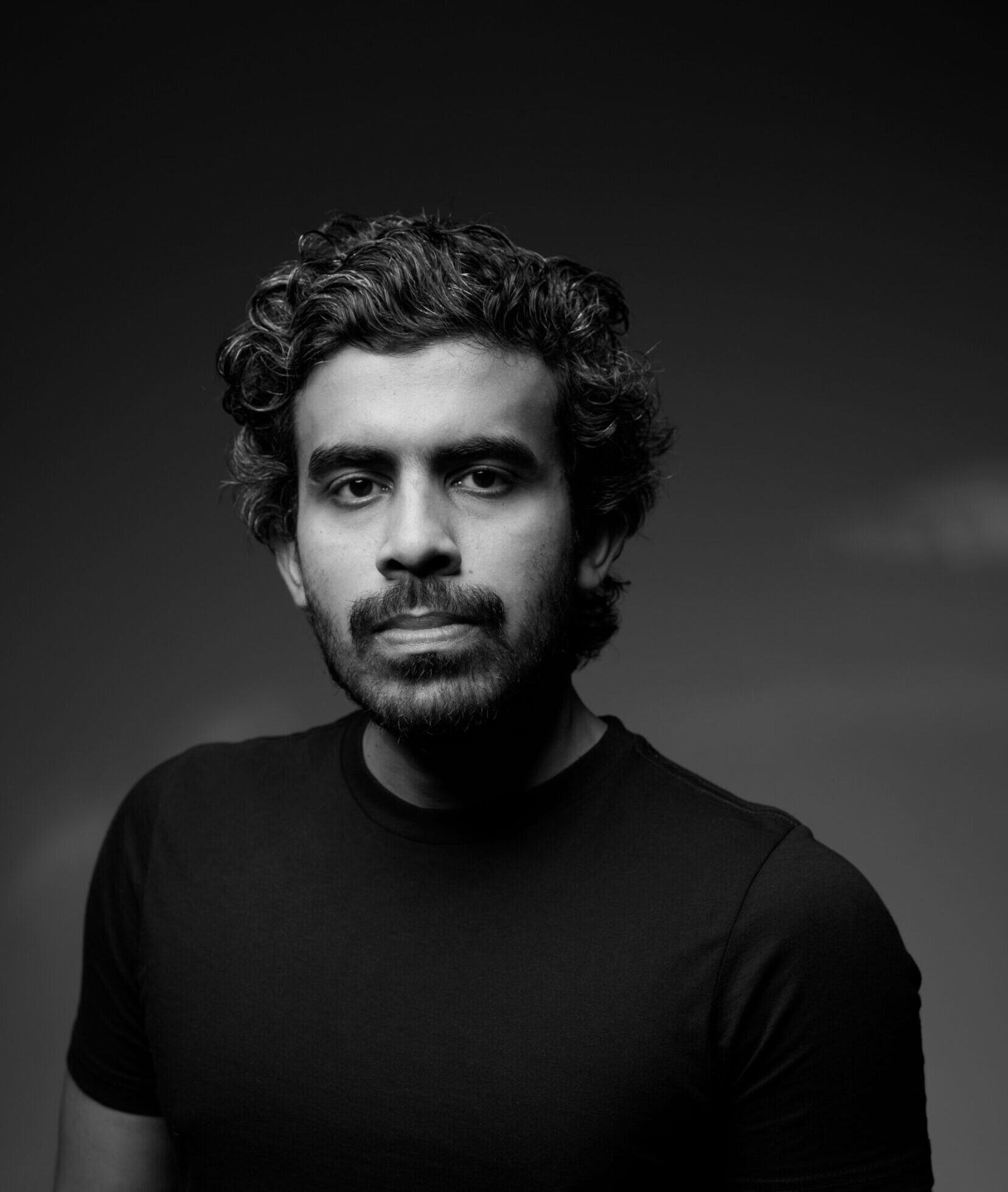
Sanki King’s presentation at Louvre Abu Dhabi reflects his pursuit of a universal artistic language that transcends conventional artistic boundaries
The artist Sanki King aka. Abdullah Ahmed Khan emerged on Pakistan’s art scene through an unusual and unexpected route. Instead of the conventional art school background, it was as if he brought real life, and investigated disciplines such as linguistics, philosophy, poetry, and psychology into a visual paradigm. The other connection has been to hip-hop, b -b-boying (street dancing) and graffiti art with its youthful, defiant, exploratory and fun street aesthetics and music; embracing a universal language epitomized by the outlook of his generation; no barriers, no divisions, but the freedom to dream, and to express.
He arrived with an unrestrained body of work, which he referred to as ‘calligraffiti’, at his solo showing at Sanat Initiative, Karachi, in 2016. The psychedelic colors of his paintings supported a secret code of writing, an exhibition that made a strong impact on viewers. A special work was created on-site on the boundary wall on the street. I think this was a profound moment, one that gave King immediate recognition in the art community. “There were two murals at Sanat Art Gallery, one indoors, painted on the biggest wall in the gallery with five canvases hung on it, so when I painted the mural, five different parts of it were on those canvases, and together they were a single pentaptych work. The other one was a performance abstract mural painted on the facade wall of the gallery”, explains King.
The 9 x 19 ft mural, titled Solitude, opened two parallel strands of exploration. One was the psychological terrain within which the narrative was situated, and the other was the enormity of scale, which extended or visualized the outside. These dynamics of the inside/outside continued in a preceding site-specific mural titled Mind Palace at the Karachi Biennale 2017. (It) “inhabits and unfurls itself across the rooftop of the Theosophic Society/ he has taken the location and its interaction with his graffiti to be a representation of his mind, deliberately exposed and made public. In fact, the architectural context of the rooftop, surrounded by dilapidated apartment blocks, suggests that the audience for the work is primarily the local public residents who have witnessed the entire process of the work’s realization. The painting, osmotically diffused throughout the rooftop’s topography, is based on writings of King’s own interpretation, collectively entitled ‘Freedom of Thought/the viewer, in the literal sense, can enter, walk and exist within King’s artistic representation of his consciousness, his psyche, his Mind Palace’. (Work description by the curatorial team KB17). It would take a curator and creative person like Amin Gulgee to identify and invite a dreamer like King to realize his potential. King has also collaborated with Gulgee in performative work, in which the body of the performer was an active participant in the physicality and scale of King’s vocabulary.
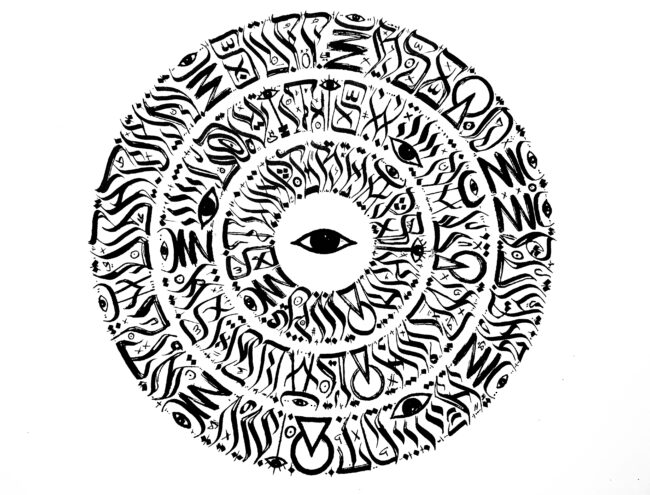
(drawing); 29 × 41.5 cm (folio). Inventory No. LAD 2023.002.
Produced in Karachi, Pakistan. © Louvre Abu Dhabi.
Inside this larger parameter of unlimited space was the equally powerful centre around which the symbols within “calligraphic “ circulated with balance, layering, and transformation from thought to language and meaning. The meaning, of course, alluded to abstraction and metaphysics. To quote him, there was an order in the text and in the order that it was created. Starting from the outermost ring and moving towards the centre, and sometimes, the other way around, the eye in the middle was painted at the end. The circular movement of form, the Mandala, has been a constant. He started painting Mandalas in 2016, which were first exhibited publicly at his first solo. The eye in the centre came in 2019. To decipher his imagery which initially pulls you towards its curvilinear script, there is an immediate desire to read, and because the script carries elements of Arabic calligraphy, there is a recognition of something familiar, the possibility of it being from a manuscript. Unreadable to the viewer, but not to the artist; that is a fascinating proposition. “The text and the order of the text don’t change, but symbols replacing text happen frequently. My symbols are actually an invented script which I created to replace the usual common writing systems and give different sounds and emotions my own symbols would represent them”, he says.
At our recent conversation, he spoke of dream interpretation, and how the symbols, shapes or sounds are transported from his dreams onto a visual form, and his study of Freud and Jung. In the book, Man and His Symbols, the Swiss Psychologist Carl Jung emphasizes that man can achieve wholeness only through knowledge and acceptance of the unconscious—a knowledge acquired through dreams and their symbols. Every dream is a direct, personal, and meaningful communication to the dreamer—a communication that uses the symbols common to all mankind but uses them always in an entirely individual way, which can be interpreted only by an entirely individual “key”.
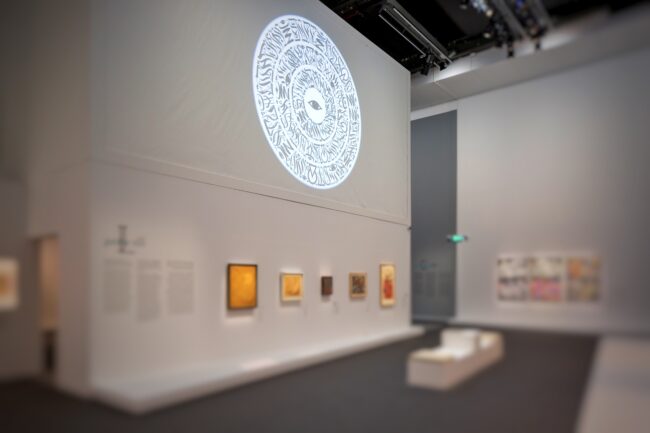
Noor / Seeing Things
The calligraffiti, as King refers to it, is stoic and classical in its formation; no doubt the influence of a father who was a master of many languages, a khattat (calligrapher), well versed in the poetry of the Subcontinent, and a great support in encouraging his son to think outside the box. Text is not only a visual tool here, but encapsulates a thought process, a soch and enters the realm of contemplation, fikr. In Solitude, the text in green is derived from English, from Hunter Thompson’s The Proud Highway: Saga of a Desperate Gentleman, and the text in red is derived from Urdu, from Jon Elia’s anthology (lekin), and starts from: ‘Abhi ik shor saa uttha hai kaheen, koi khaamosh ho gya a kaheen/mil ke har shakhs se hua mahsoos, mujh se yeh shakhs, mil chuka ha kaheen’.
It is no surprise that King’s newest work has landed in the collection of Louvre Abu Dhabi. Here I Am (2020), commissioned by Louvre Abu Dhabi for its 2021 exhibition, Abstraction and Calligraphy — Towards a Universal Language, in collaboration with Centre Pompidou, became part of the museum’s collection in 2023. As the official text reads, ‘the exhibition charts sites of mutual inspiration around the world, and (is) dedicated to artistic practices of abstraction, the show explores how 20th century artists established a new visual language by merging text and image, inspired by the earliest forms of mark making and particularly, calligraphy. The exhibition brings together 101 masterpieces on loan from 16 partner institution collections, alongside seven works from Louvre Abu Dhabi’s permanent collection, and two monumental artworks by contemporary artists whose current-day practices bring recurring themes of the exhibition to life. Works by Dia Azzawi, Mona Hotoum, Vasily Kandinsky, Paul Klee, Lee Krasner, Andre Masson, Jackson Pollock, Anwar Jalal Shemza, and Cy Trombly were shown for the first time together in the region. The show included two original artworks by contemporary French Tunisian artist El. Seed and Sanki King.
Sanki King was a featured artist in the exhibition and the youngest among the 41 artists presented, making King the first contemporary Pakistani artist to exhibit at Louvre Abu Dhabi. Here I Am becoming part of the museum’s collection in 2023 further marks King as the first contemporary Pakistani artist to secure a place within Louvre Abu Dhabi’s collection. The show has been curated by Didier Ottinger, Deputy Director, and assistant curator Marie Sarré, Associate Curator, Musée national d’art moderne, Centre Pompidou. In the curatorial statement, Ottinger comments that the project has been conceived as ‘a dialogue between spaces and times that are embraced by the Universal Museum; dialogue between images and letters, illustrated by mutual fascination between calligraphy and image makers, and vice versa.
© Louvre Abu Dhabi. Courtesy Ismail Noor / Seeing Things
Dr Souraya Noujain, Curatorial and Collections Management Director at Louvre Abu Dhabi, discusses the cross-cultural influences of the showcased artists, such as in a painting by Paul Klee, who was influenced by his travels to Tunisia, creating work influenced by Egyptian hieroglyphics. His work influenced artists such as Josquin Torres-Garcia from Spain, Iraqi artist Dia Al-Azzawi, and Pakistani artist Anwar Jalal Shemza. Works by Adolph Gotleib were inspired by Native American art, and French artist Andre Mason, who was inspired by 17th-century Indian Figurative inscriptions and Arabic calligraphy.’ She further writes about Joan Miro, who referenced how closely painting and poetry were linked in the East. Following in his footsteps, the poets Brion Gysin, Henri Michaux, etc, pursued the same path by painting poetry, inspired by their trips to North Africa and China, Henri Matisse’s studies for the illustrated book Jazz, which he called “arabesques” in a tribute to Arabic writing. Dr Noujain also mentions the regional artists Shakir Hassan Al Said and Sliman Mansour, who sought to free calligraphy from its purely linguistic function. She refers to “two monumental works”, by El Seed and Sanki King.
King’s work, Here I Am, is a calligraffiti inspired by Allama Iqbal’s poem, Shama (Flame). ‘In one of the passages, Iqbal says, You are the path, the traveller, the guide, the destination, he expresses the human instinct to strive for self-awareness and self-actualization. With this artwork, Sanki King wants to present himself to the viewer in his totality explaining his own journey to self-awareness. The circular shape refers to a mandala, a symbol of self and cosmic wholeness (Marie Sarre, Associate curator, Centre Pompidou)’. Louvre Abu Dhabi’s shift to conversations between the West and the East will initiate and encourage the re-reading of colonial histories through a regional lens. Access to first-hand viewing of art will open many dimensions of art history and facilitate research. A place where dreamers like Sanki King can access the world and the world through their eyes.
‘Shama’ (Flame)
By: Muhammad Iqbal
Beware of your own reality O farmer!
You are the grain, the cultivation, the
rain, as well as the produce
Ah! Whose search keeps you aimlessly
wandering
You are the path, the traveler, the guide,
the destination
Why is your heart trembling with the fear
of the storm?
You are the sailor, the ocean, the boat, the
sea-shore
Come frequent the alley of the torn-
collars sometime
You are Qais, Lailah, the wilderness,
the litter on the came
Written by: Muhammad Iqbal
Recited by: Sanki King
Inspired by: ‘Here I Am’
By Sanki King, Part of the exhibition ‘Abstraction and Calligraphy – Towards A Universal Language’
Portrait Courtesy Chandan Pirzada
Amra Ali is an art critic and curator based in Karachi. She is a co-founder of NuktaArt magazine. She has edited the book, ‘Homecoming, Rasheed Araeen.’