
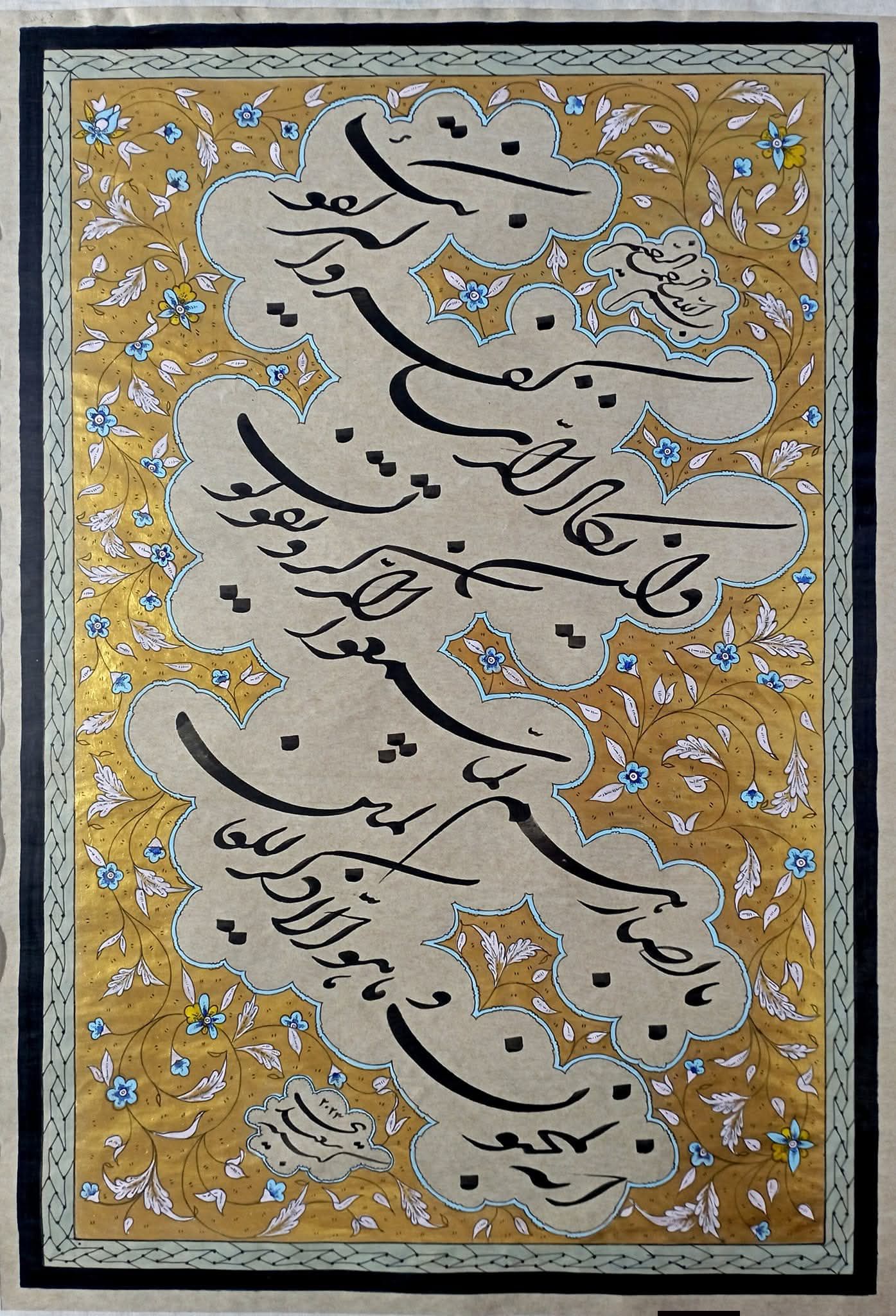
To view the calligraphers of Balochistan is to witness a profound paradox: a collection of voices as distinct as the province’s jagged terrain, yet all bound by a shared, singular spirituality. There is always that startling softness inherent to this mystical art juxtaposed with an aesthetic drawn from the inhospitable harshness all around. Between an interminable yearning for the genteel breeze that carves inconceivable sandstone marvels and a palette drawn from the region’s remarkable sunsets, these artists find a spellbinding rhythm. Their work is a testament to riyazat, a sacred vocation where the discipline of continuous practice begins to translate into a transcendent creative expression. In this thin space between survival and skill, the script becomes more than words; it assumes a fiercely unique identity while honoring a centuries old, rigorous code; sowing of a sacred seed through the rhythmic dance of the reed and ink upon the page.
In the unassuming studios that dot the streets of Quetta and beyond, the art of the letter has undergone a quiet transformation. While masters like Ustad Esmatullah Saidi remain anchored in classical control, others weave ancient precision into a raw, contemporary energy. For over three decades, Saidi has dedicated himself to the laborious practice of Khat-e-Nastaʿlīq Farsi, often lauded as the ‘bride of calligraphy scripts,’ and Khat-e-Shekaʿsteh, a more fluid and ‘broken’ variation used for rapid execution and abstract compositions. In Saidi’s hands, the ink achieves a celestial finesse, where every calculated angle and sweeping curve feels less like a stroke of the hand and more like a sacred celestial alignment.
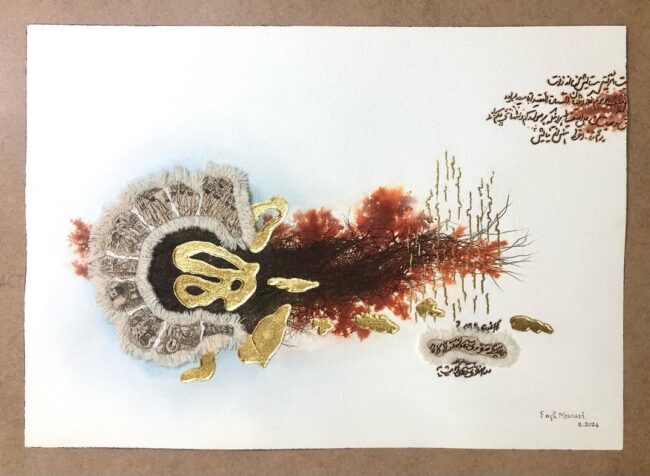
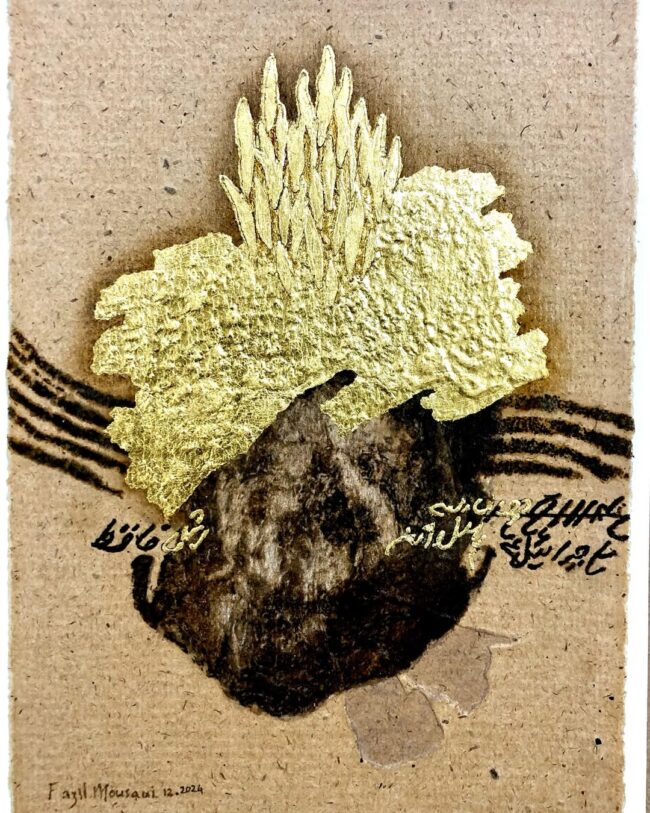
Unlike the traditionalists, his fellow Hazara master artist Fazil Hussain Mousavi has developed a unique style of conceptual art where the verses of Ferdowsi, Hafiz, Rumi, and Iqbal quietly permeate the canvas. Khat-e-Nastaʿlīq Farsi historically traces its roots to the lyrical world of poetry and literature, utilizing softer, sweeping strokes that differ from the structural precision of the Naskh or Kufic scripts tied to Quranic scripture.
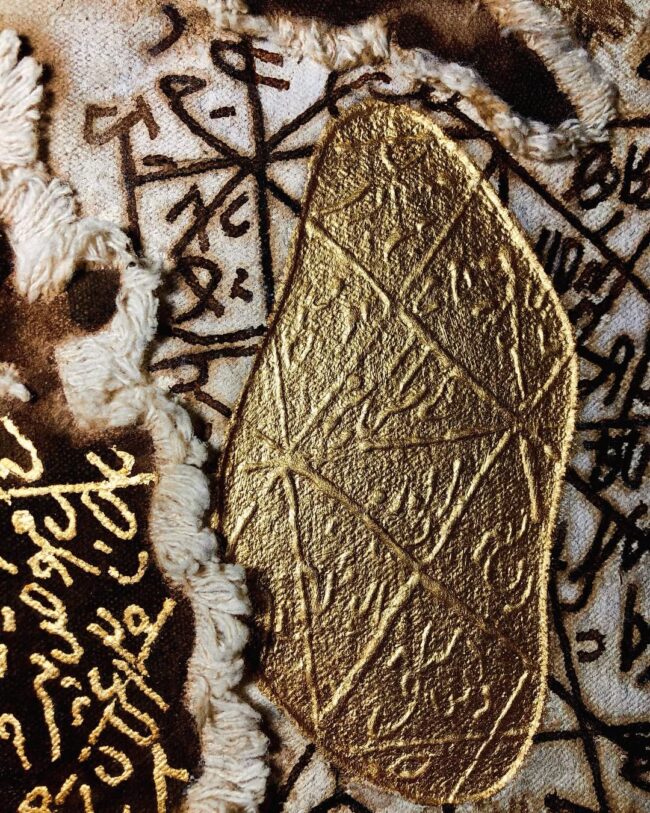
Mousavi was already a father when he joined University of Balochistan to get his art degree. “An important facet of my experiences and advancements into the field of art was my deep engagement with literature. I owe it to my late father who painstakingly taught me Persian from a very early age. He introduced me to the Panj-Ganj (by Nizami Ganjvi) during my primary school days and by the time I was in grade six or seven, my initiation into the poetic world of Hafiz Shirazi was under way. Another past learning and training experience is my familiarity with Persian and Arabic calligraphy in the traditional script, then known as Khat-e Mirzāī. A number of these impressions and experiences gradually started to manifest themselves in my paintings. At times I realized their presence only after the painting was near completion, sometimes making me wonder how and when I had allowed them to enter my visual vocabulary.” Mousavi reflected in an interview.
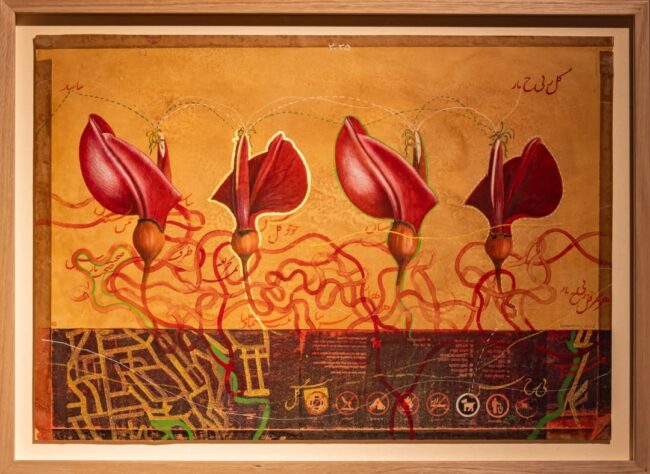
Like Mousavi, Khadim Ali is also a Hazara artist who was born in Quetta and now resides in Australia. Khadim’s parents migrated to Pakistan from Bamyan province of Afghanistan and hoped to one day return to their homeland. During his formative years, Khadim too was deeply influenced by his grandfather, a Shahnameh singer, and by the miniature paintings that illustrated the stories of the Shahnameh-e-Ferdowsi. Ali studied miniature painting at NCA and calligraphy at Tehran University. His intricate works encompass imagery from history, politics, literature, poetry and mythology to contemporary events such as the civil war in Afghanistan and personal experiences of persecution, displacement, and discrimination.
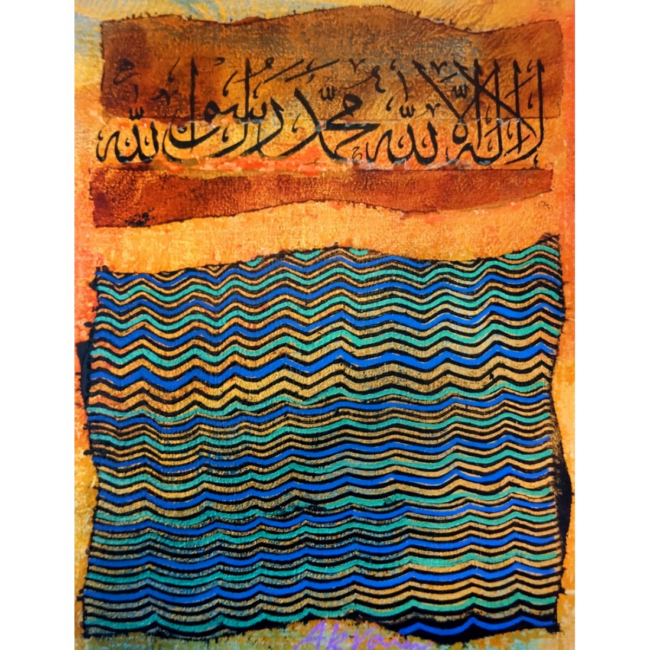
Akram Dost Baloch’s art is essentially a profound visual synthesis of indigenous tradition and contemporary socio-political commentary, characterized by a rugged, monochromatic intensity that mirrors the landscape of his birth. Unlike traditional calligraphers who treat the script as the primary subject, Dost who hails from Noushki, employs it as a textured, symbolic element that roots his modern compositions in historical depth. “Calligraphy in my work makes occasional appearances not merely as text but as a rhythmic inscription that honors the intellectual and spiritual history of the region that I come from.” He shares.
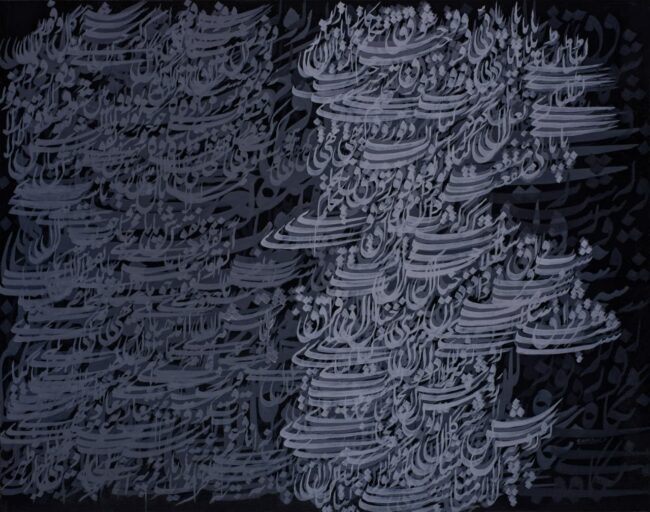
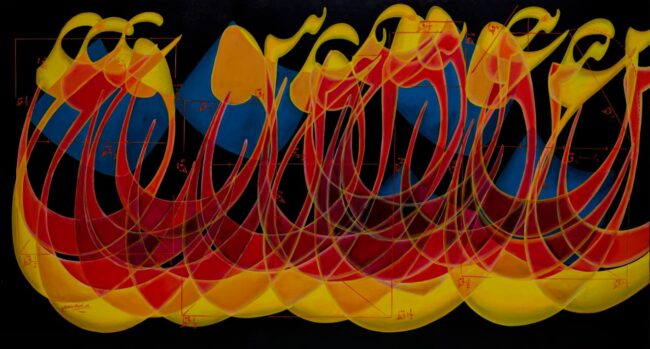
Qasim Bugti is a Contemporary Visual Artist, Miniature Painter, and Art Educationist. Born in 1984 in Jaffarabad, a district in southeastern Balochistan, he currently lives and works in his studio in Karachi. He earned a Bachelor’s degree in Fine Arts with a specialization in Miniature Painting from the National College of Arts, in 2009. “I grew up in Dera Allah Yar, Jaffarabad. It is there I picked up my passion for calligraphy under the tutelage of Ustad Allauddin who used to paint sign boards. Over time script assumed a role much greater than just a medium of communication for me. In my work, repeated rendition of script creates an impact similar to what a devout would experience during zikr or a sage during a dance of transcendence.”
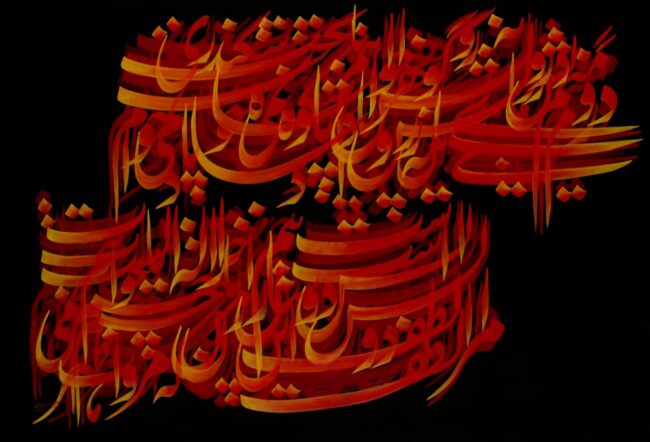
Bugti uses oil paints on canvas for Khat-e-Nastaʿlīq Lahori he learnt from his later mentor Ustad Khursheed Gohar Qalam during his time at NCA. “In my perception, calligraphy and miniature painting are inseparable, making calligraphy an integral part of traditional painting. This art form demands not only dedication and perseverance but also hard work and discipline. I am deeply inspired by the subtlety, delicacy, and beauty of calligraphy, which possesses its own unique rhythm and expression. My inspiration stems from both the personality and poetry of Allama Iqbal. I adhere to the principles of nasta’liq, paying close attention to the precision and grace of its strokes. Additionally, I strive to express the essence of Sufism in my work. Some emotions may seem inexpressible, yet through my work, I attempt to give them form and voice.” Bugti believes.
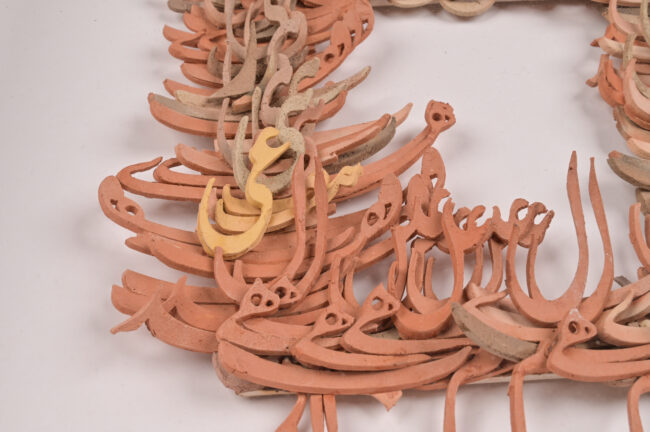
Imran Ahmed Qambarani graduated with a degree in Fine Arts from the University of Balochistan in 2015. He began his career as a commercial signboard painter and later moved to Lahore to further develop and refine his artistic practice. In 2021, he completed his M.A. (Hons) in Visual Arts from NCA. Since completing his master’s degree, he has actively participated in numerous national and international exhibitions and has conducted several workshops on traditional Islamic calligraphy. “My artistic practice revolves around the ideas of language, identity, and cultural memory.” Also, an exponent of Khat-e-Nastaʿlīq Lahori, Imran forms words from terra cotta, using the material as a metaphor for language itself.
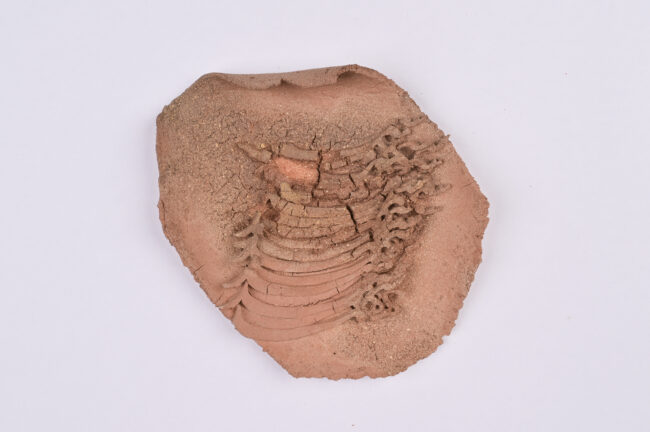
“The medium and process play a central role in expressing concepts from selecting and shaping the terra cotta to constructing the words. This process mirrors the historical journey of languages that have evolved over centuries through human effort, yet today face the risk of being neglected and forgotten.” He shares.
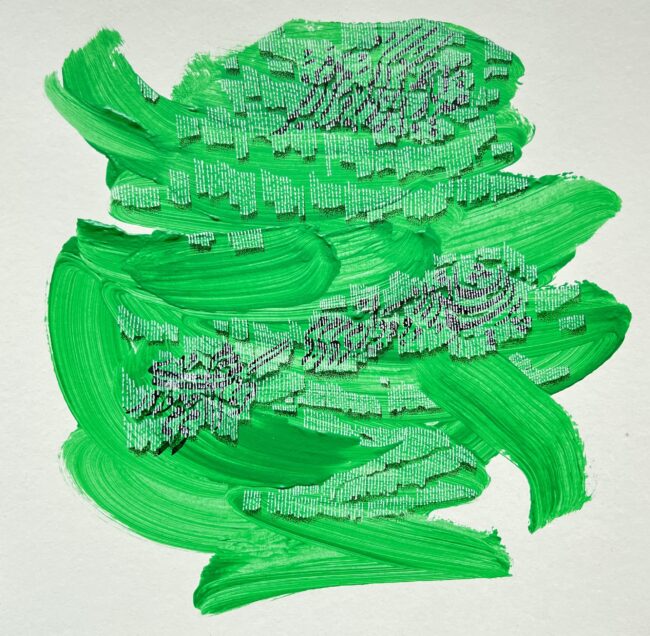
Zakir Baloch is a visual artist, researcher, and art educator from Quetta currently based in Lahore. With a bachelor’s degree in painting from the University of Balochistan and an MA (HONS) in visual arts from the NCA in 2017, his multidisciplinary practice spans painting, drawing, image analysis, and leather accessory design. Rooted in traditional craftsmanship, his work reflects his early experience as a signboard painter in Quetta.
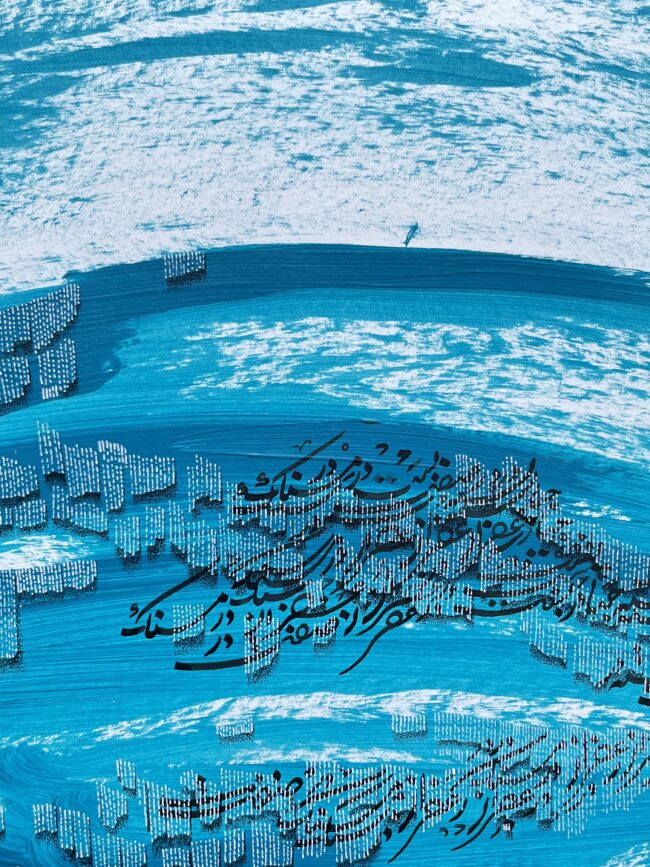
“My work is inspired by the quiet, emotional experience of walking through nature. In these moments, I feel deeply connected to the world around me where sound, movement, textures and stillness blend into a meditative rhythm. The experience shapes my creative process. I begin with bold, spontaneous strokes; gestures that reflect energy, emotion, and the act of moving forward. As the work unfolds, I slow down and begin layering fine detailed marks, allowing time and thought to guide the surface, much like the slow unfolding of a journey. I use Nastaʿlīq calligraphy not for its literal meaning but as a visual form. Its flowing, delicate lines carry a sense of tradition, memory, and movement. These lines become pathways, whispers, or traces echoing the curves of nature and the emotions of the walk itself. “ Zakir reflects on his approach towards calligraphy.
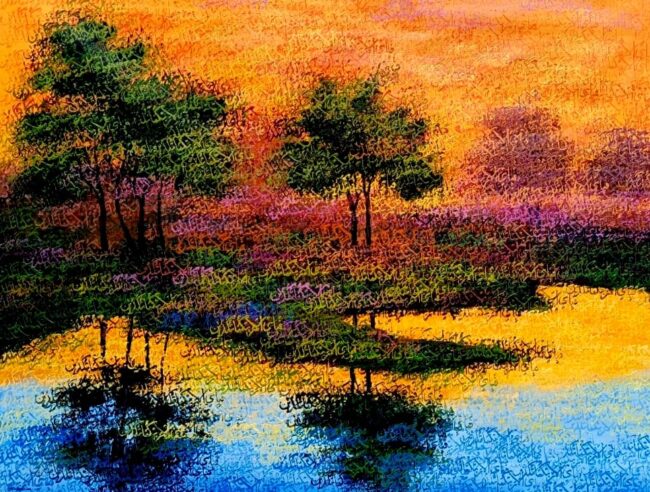
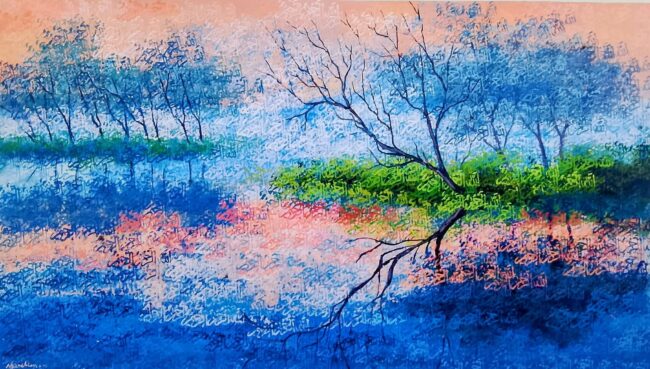
With repeating the divine name on his canvas, Mohammad Ibrahim, another graduate from the University of Balochistan, transforms his landscapes into the spiritual practice of Zikr. “In my work, the repeated patterns and colors show the rhythm of breathing, the heartbeat, and the connection with the Divine. My goal is to create not just beautiful paintings but also quiet spaces where a viewer can find the calm, presence, and connection to something higher.” He shares.
Whether through the celestial precision of a classical curve or the raw, earthen weight of a contemporary expression, each artist is transforming their riyazat into a quiet act of preservation. In the stillness of their studios, the script is a vessel for resilience, carrying the collective memory of a people through the friction of history and the harshness of the elements – a pursuit transcending each rhythmic movement of the reed and stroke of the brush into a testament of endurance. By weaving the ancient word into the fabric of the modern world, they ensure that the essence of great words remain a living, breathing force and shall continue to live on. Ferdowsi concludes the Shahnameh with the same thought:
Much I have suffered in these thirty years,
I have revived the Ajam with my verse.
I will not die then alive in the world,
For I have spread the seed of the word.
Whoever has sense, path and faith,
After my death will send me praise.