

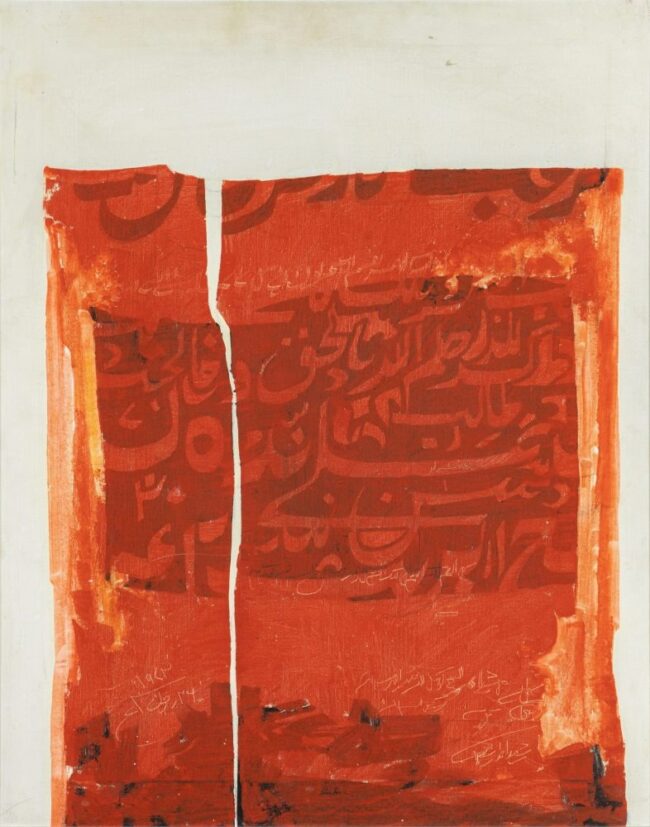
Arabic calligraphy has occupied a central position in Islamic art since the emergence of Islam, shaping not only devotional practices but also the broader aesthetic language of Muslim societies. Across centuries, it has been revered as a sacred and disciplined art form, deeply embedded in cultural and spiritual life. Over time, this rich tradition informed new artistic directions, eventually contributing to the evolution of modern calligraphy. Within Pakistan’s art sphere, artists have played a crucial role in expanding and reinterpreting this genre. By developing distinct visual vocabularies, they transformed calligraphy into a powerful contemporary medium. The early pioneers of modern calligraphy in Pakistan employed it as a form of visual communication, establishing a new trajectory that significantly influenced later generations. Their work effectively mediated between inherited classical traditions and emerging contemporary practices, narrowing the divide between past and present.
Among the artists who gained prominence during this formative period was Rashid Ahmed Arshad (b. 1937). As a calligraphic painter, he merged tradition and modernity with remarkable inventiveness. His artistic pursuit sought to reconcile classical calligraphic conventions with modern painterly concerns, carving out a distinct creative space among his contemporaries. His dedication to this synthesis is evident in the metaphoric depth of his imagery. His engagement with calligraphy did not stem from political or religious pressures of the 1970s; rather, it arose from a deeply personal inclination. He consciously adopted calligraphy as his chosen visual language.
In his early modernist phase, Arshad drew inspiration from the compact, cubic architectural forms of mosques. These structural references lent his compositions a flattened, two-dimensional quality and an abstract sensibility. Gradually, he developed a vocabulary centered on textual and calligraphic elements that symbolized both earthly and transcendent realms. Approaching the surface as a structuralist, he treated composition as an integral framework through which text and form interacted. His work reflects a profound spiritual conviction: he believed that words, when rendered with sincerity and integrity, could attain a sanctity comparable to prayer. For this reason, he frequently employed the Iranian script Shikasta, sometimes adapting it to preserve what he perceived as its sacred integrity.
In one notable example, calligraphic forms appear softly articulated against luminous fields dominated by blue and red hues. The composition incorporates the visual suggestion of aged manuscripts, while a circular form resembling a royal seal rests upon an oval, stone-like surface inscribed with script. The textured application of color reinforces this evocation of antiquity and permanence. Above, faint calligraphic impressions emerge in green against a red ground. Arshad was less concerned with textual legibility than with conveying the metaphysical resonance embedded within script. Through metaphor and abstraction, he sought to reveal the hidden philosophical dimensions of language. His modernized calligraphic idiom appears deeply rooted in an aspiration to renew and reanimate its connection to Islamic heritage.
As a modernist, Arshad manipulated calligraphic form according to his own aesthetic sensibilities, treating it as a medium for introspective exploration rather than doctrinal instruction. The inherent geometry of script provided him with a structural foundation for experimentation within painting. Incorporating both Shikasta and Kufic-inspired scripts, he emphasized compositional balance, rhythm, and design. He avoided didactic or overtly literal uses of text, instead allowing words to function as symbolic devices. Through this approach, his work sought not merely to display calligraphy but to generate layered meanings, ultimately reasserting its spiritual and cultural legacy within a modern artistic framework.