
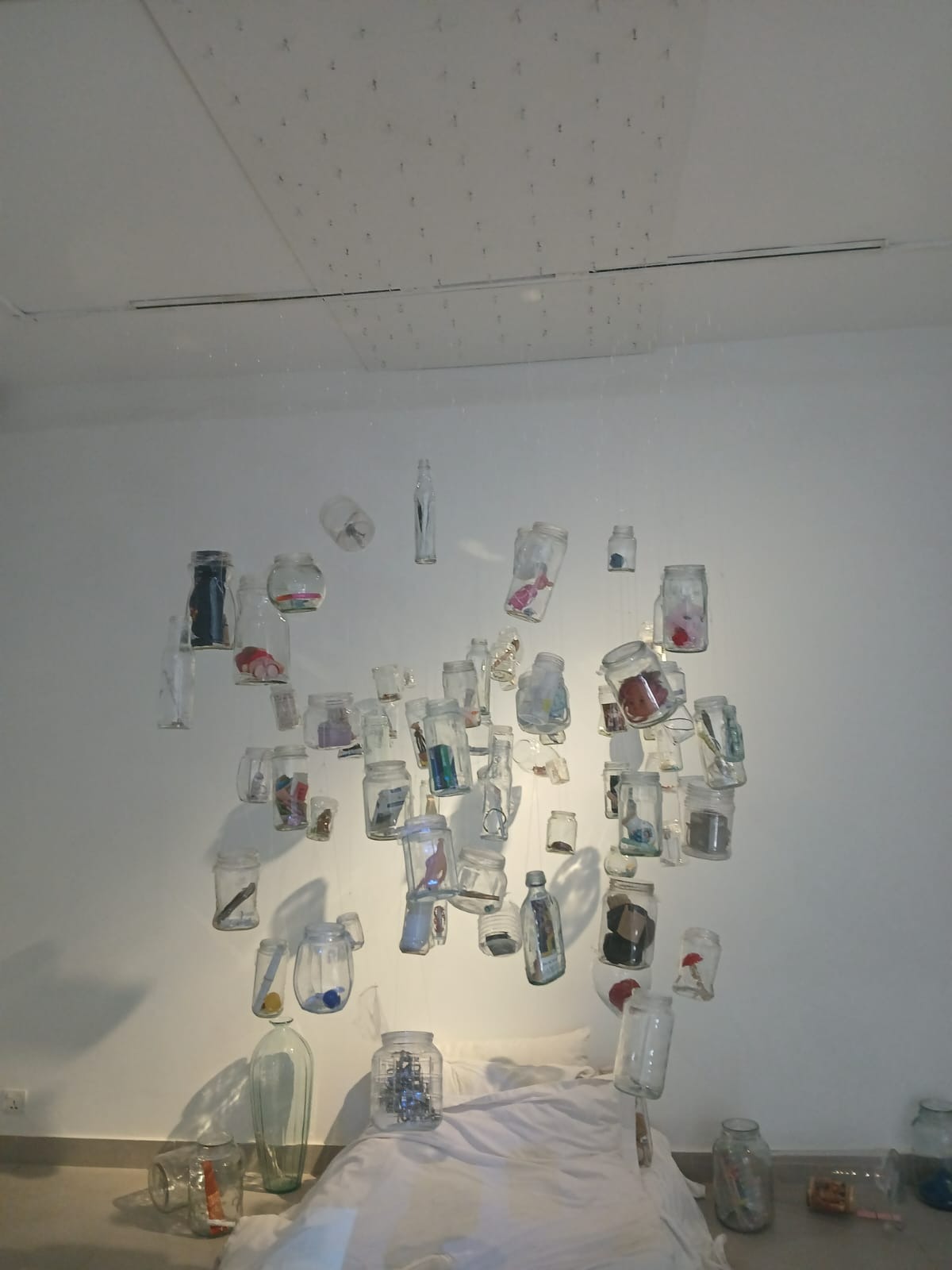
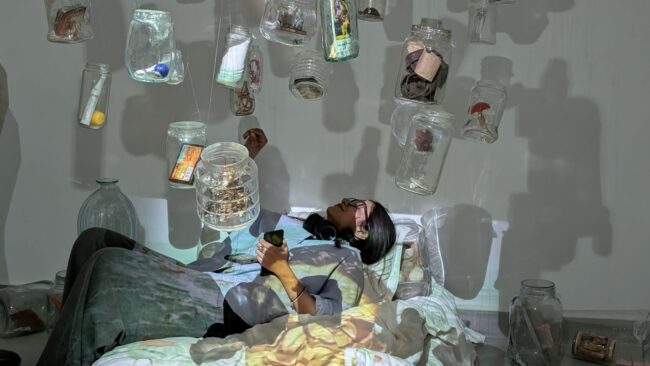
Maryam Kouhestani’s sixth iteration of the Recycle Bin Project, exhibited at the Vasl Artists’ Association in November, offers one of the most compelling engagements with material memory and participatory archiving seen in Karachi this year. The installation unfolds across multiple registers: suspended glass jars containing personal objects, a bed-like structure onto which viewers can lay, and carefully arranged story cards documenting the provenance of each contribution. These elements construct a multi-sensorial environment where memory is spatially enacted.
The suspended jars, each holding an object which has a story attached to it, operate as affective containers. Their suspension creates a field of precariousness, suggesting that memory itself hangs between fragility and persistence. While the objects inside the jars vary widely, fragments of toys, documents, jewellery, scraps of cloth, handwritten notes, they share a common function as carriers of lived experience. Within the gallery’s white space, these jars read as a dispersed, transnational constellation of personal histories. The clear glass renders each object simultaneously protected and exposed, echoing the paradox of memorialisation: the desire to preserve a past moment while confronting the impossibility of returning to it.

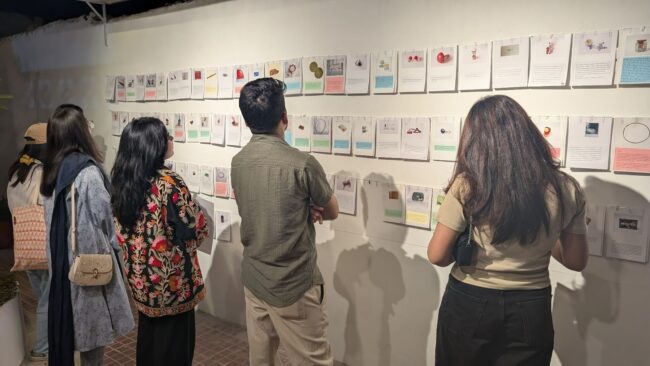
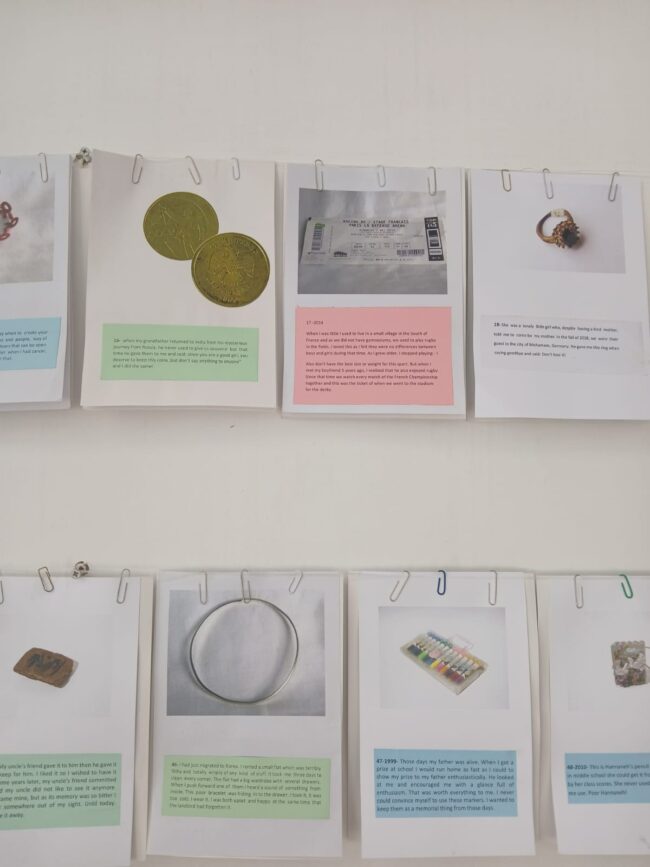
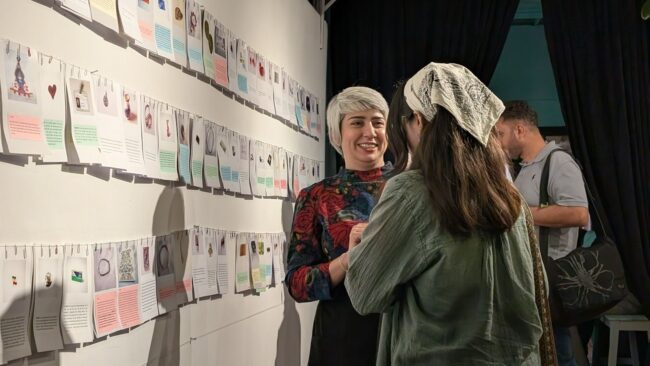
This affective atmosphere is deepened by the presence of a soft, rumpled bed on the floor. On the surrounding walls, rows of printed story cards document each object and its accompanying narrative. They function as an expanded field of the artwork. The uniformity of the format, photograph, coloured block of text, paper clipped and pinned, produces an archival aesthetic that complicates the intimacy of the shared stories. The stories range across decades and geographies, articulating grief, migration, childhood memory, familial love, or the remains of relationships. The visual discipline of the display underscores how disparate personal memories can be sutured into a collective structure without homogenising individual experience.
A separate wall features photographs of earlier iterations of the Recycle Bin Project, extending the work’s temporality beyond the present exhibition. These historical traces situate the installation within a long-term artistic practice, reinforcing that this is not a one-time gesture but an evolving transnational memory project. The presence of previous participants, previous objects, and previous spaces leads the viewer to understand that the project is accumulative rather than finite. Each iteration becomes a chapter in a growing archive of interpersonal trust and inter-cultural exchange.
Kouhestani’s project participates in contemporary debates around participatory art, archival practice, and the ethics of collecting. Rather than assuming the authority of the institutional archive, she adopts a relational approach where the archive is co-authored. The requirement for participation, the object must be small, and its story must be shared with the artist, introduces a formal constraint that generates intimacy. The act of relinquishing a personal object, however small, is not neutral; it necessitates vulnerability, memory work, and an ethics of giving. The participant must decide what part of themselves they are willing to make public through material form.
By foregrounding everyday memorabilia as conduits of transnational connection, the Recycle Bin Project destabilises simplistic narratives of globalisation or cultural difference. Instead, it frames solidarity as something materially grounded, forged through objects that ordinary people carry, protect, and ultimately release. The exhibition asks viewers to consider their own stories. Would they, too, part with an object of significance? What story would accompany it? What does it mean to convert private memory into a collective resource?
In this way, the exhibition exceeds the boundaries of a static display. It becomes a processual, open-ended archive that continues to grow, transform, and circulate. Kouhestani’s work reminds us that memory is not an inert matter; it is a living practice shaped by the objects we hold, the stories we tell, and the communities that form around them.
Maryam Kouhestani is a Vienna-based multimedia artist, curator and activist from Zahedan, Iran. Her work spans sculpture, video installations, and socially engaged projects exploring memory and resilience. She has exhibited internationally and leads art initiatives empowering women and children.
Photographs Courtesy of Ayesha Chandio, Vasl Artist Association’s Gallery Manager