
The exhibition, Remains, opened on August 19, 2025 offered a compelling glimpse of four emerging voices, Dua Azeem, Fatima Shah, Neha Ufaq, and Swarim Abid Hasan, each negotiating various themes, the weight of memory, intimacy, or time through their own distinct material vocabularies. While their practices are individually distinct, together they marked out a generational sensibility: attentive to the overlooked, unafraid of fragility, and invested in finding beauty within processes of change and decay.
Dua Azeem’s approach was through objects and spaces that have silently absorbed histories. Her intricate pen drawings translated the surfaces of furniture, worn wood, and decorative motifs into cartographies of memory. Works such as What Are We Leaving Behind? and Steps Between the Stories suggested that craftsmanship itself carries intergenerational echoes, the marks of makers long gone persisting in lines and patterns. Azeem’s kinetic sculpture, Second Act of a Chair, went further, animating reclaimed rosewood to emphasize how material culture is never inert, it is always shifting, balancing, reconstituting itself. Azeem’s practice reminded viewers that the remnants of the everyday are not simply debris but carriers of stories.
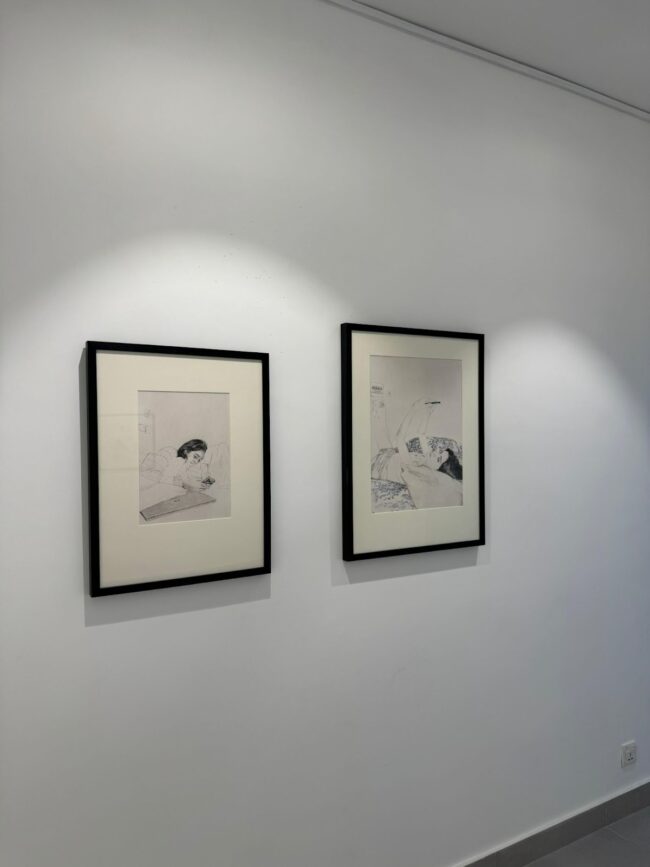
Fatima Shah confronted the body, particularly the female body, as a site of intimacy and vulnerability. In works like Blue Light Baby and Doomscrolling, she layered traditional print aesthetics with the glow of digital culture, producing images that oscillated between tenderness and critique. Shah’s exploration of “girlhood” tapped into Gen Z subcultures, yet it resisted flattening these experiences into aesthetics alone. Instead, her reframing of voyeurism through a female gaze carved out a space where the politics of looking were unsettled. Vulnerability was not weakness here; it was a form of insistence, a way of holding onto the everyday in its most unvarnished state.
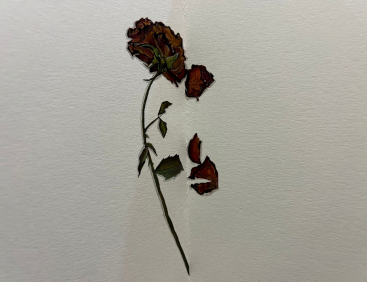
Neha Ufaq’s contribution was quieter, yet no less resonant. Her series of roses, painted in oil on mixed media sheets, functioned as visual metaphors for the fragility of memory. In Scattered and Traces, the rose appeared not as a static emblem of beauty but as a shifting portal, sometimes vivid, sometimes blurred at the edges. Ufaq’s practice leaned into the impossibility of fully preserving the past, suggesting instead that memory is always partial, fleeting, and unstable. The works carried an elegiac tone, as though trying to hold onto something that slips away the moment it is grasped.
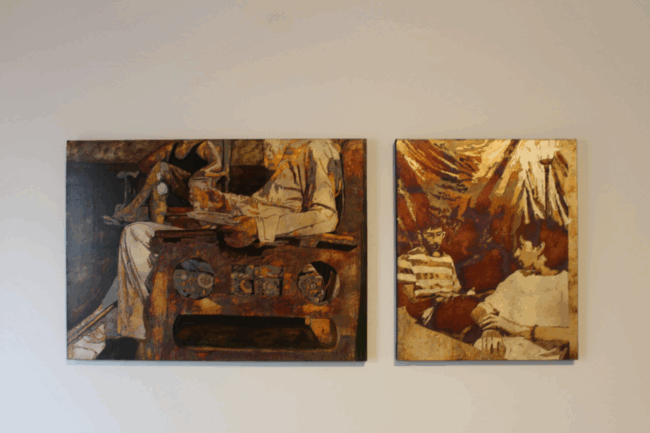
Meanwhile, Swarim Abid Hasan introduced an entirely different material and temporal register. His canvases, built from layers of oxidized silver leaf and oil paint, embraced tarnish as a painterly collaborator. In works such as Under the Fabric and Seated in Oak, figures and forms emerged from the unpredictable chemical processes of oxidation. Here, decay was not destruction but transformation, a slow unfolding that allowed new surfaces and narratives to emerge. Hasan’s juxtaposition of geometric precision with organic patina-like effects reflected a tension between order and entropy, permanence and impermanence. The unpredictability of the process echoed human experience itself; we are altered, marked, and remade by the passage of time.
Taken together, these four practices mapped out a generational landscape of contemporary art in Pakistan. What made Remains particularly compelling was its refusal to frame memory and transformation as loss alone. Instead, the exhibition suggested that residues, however fragile, fractured, or decayed, can be generative. They can open new ways of seeing, connect us to overlooked narratives, and remind us that beauty often lies in what survives imperfectly. Vasl is known as a platform for experimentation, and the show underscored its role in amplifying emerging voices at a critical juncture in their careers. For the artists, Remains was less a conclusion than a beginning, a marker of what is possible when four distinct practices are allowed to converge around shared concerns.
The show ran at the gallery until September 5, 2025.