
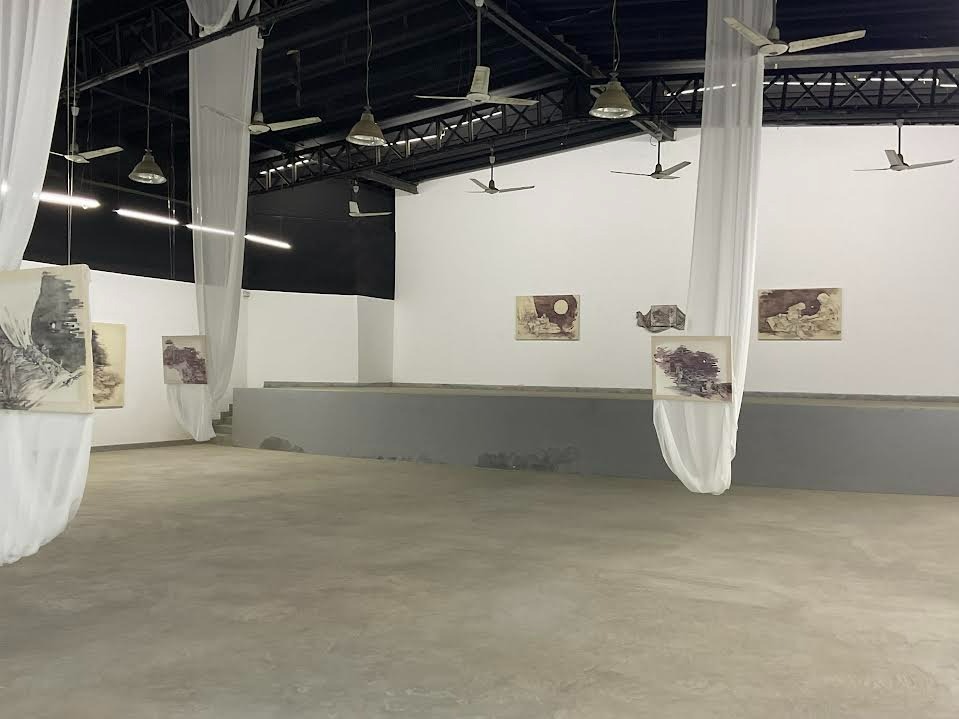
Zahra Mansoor’s solo exhibition entitled “fanaa is the eclipse” was presented at Sanat Gallery, thoughtfully curated by Noor Ahmed. The title Fanaa is the Eclipse evokes the layered meanings of fanaa, a term that denotes mortality, vanishing, and self-annihilation, as well as the literary and mystical idea of being consumed by intense emotion, often love, to the point of dissolution. In the context of Zahra Mansoor’s exhibition, fanaa captures the frailty and impermanence of the body, the way desire and attachment can simultaneously sustain and erode the self and how figures appear to dissolve into their surroundings, their outlines softened and indistinct. The notion of the eclipse amplifies this reading: just as an eclipse temporarily obscures the sun or moon, the exhibition stages moments of vanishing, where identity and desire are partially hidden, partially revealed and always in flux. Through this interplay of disappearance and illumination, Mansoor enacts a meditation on the self-consuming intensity of love and longing, positioning fanaa as a condition of existential intensity.
Mansoor returns insistently to recurring figures and symbols, most notably the female body, the moon and scenes of intimate encounter, constructing a visual language that resists linear narration in favour of cyclical time, mnemonic slippage and recurrence. The body of work reads as a labour of love and friendship, an intimate articulation of desire that is both personal and collective. In the context of South Asia and Pakistan specifically, where desire is often suppressed or rendered precarious, Mansoor’s repeated figures and gestures of intimacy carry the weight of what cannot be openly expressed. The exhibition transforms these private acts, touch, gaze, longing, into a space of visibility, insisting on the persistence of desire even under conditions of social constraint. Repetition here is both a strategy and a survival mechanism: it registers the persistence of emotional life despite erasure, censoring or disapproval.
Central to the exhibition is the articulation of the female body through a softer gaze. The body is presented as a carrier of sensation, memory and desire, but the ambiguity destabilizes fixed identity, aligning the work with feminist critiques of representation that resist coherent or consumable subjecthood. In doing so, Mansoor’s practice can be read in dialogue with Laura Mulvey’s seminal work on the “male gaze,” which critiques the objectifying cinematic framing of women. While Mulvey identifies the gaze as a mechanism of patriarchal control, Mansoor’s work reorients this dynamic: the female body becomes an agent of looking as well as being looked at, creating a space where desire is expressed on the artist’s terms and the subjectivity of the depicted figures is prioritized over voyeuristic consumption.
The repeated appearance of the moon functions as a structuring motif rather than a singular symbol. Its varying scale and placement evoke the persistence of desire across time. The moon’s presence underscores the exhibition’s concern with circularity: the idea that personal histories, romantic attachments and political conditions are lived as spirals.
Mansoor’s engagement with archetypes, romantic women, intimate domestic scenes, gestures of care, signals a critical awareness of how narratives of love and femininity are historically inherited and reinscribed. Mansoor inhabits these tropes fully, exposing the perversity of pleasure that emerges through repetition. The works suggest that intimacy itself can be a site of both comfort and erasure, where the self risks being consumed by attachment. This ambivalence recalls literary and psychoanalytic conceptions of desire as a force that destabilizes boundaries, drawing the subject toward dissolution rather than fulfillment.
Themes of mortality, vanishing and frailty permeate the exhibition. Figures appear to dissolve into their surroundings, their outlines softened by layered washes and eroded edges. This visual instability reinforces the sense of impermanence that runs through the work: bodies are not fixed entities but transient forms, perpetually at risk of disappearance.
Noor Ahmed’s curatorial framework foregrounds intimacy. The decision to hang some works away from fixed walls allows viewers to encounter the reverse of the canvases, the visibility of the back of the canvases subtly destabilizes the autonomy of the image. What is typically concealed becomes part of the viewing experience. This gesture resonates conceptually with Mansoor’s thematic concerns, just as her figures oscillate between revelation and obscurity, the works themselves hover between visibility and vulnerability. The draped fabric, suggestive of veiling, further complicates the politics of concealment and disclosure. It produces a spatial rhythm of partial visibility, echoing the exhibition’s dreamlike logic in which clarity is always deferred and forms appear in states of emergence.
Mansoor’s exhibition challenges dominant expectations of what contemporary art should do, refusing immediacy, clarity or resolution. Mansoor positions desire, memory and the female body as sites of ongoing negotiation. Through her engagement with the gaze, the exhibition reclaims the act of looking for women, offering a counterpoint to Mulvey’s critique of patriarchal visuality. The exhibition insists on returning. In doing so, it articulates a quietly rigorous meditation on how intimacy, history, and subjectivity are continuously re-lived, re-imagined and re-inscribed.