
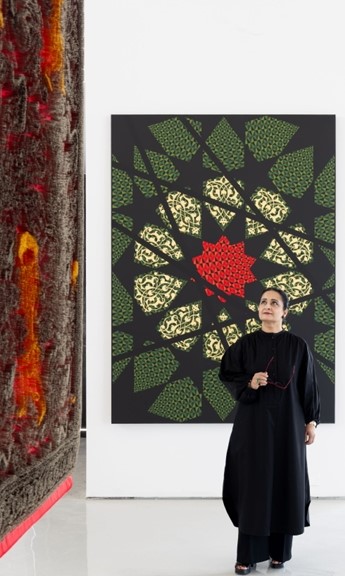
Aisha Khalid’s exhibition was a meditation for viewers where miniature discipline and monumental form converge to chart grief and devotion as acts of quiet endurance.
On a cold November day, wrapped in that peculiar Lahore winter chill, I walked toward Nasir Bagh with the golden sun warming my shoulders. The garden was unusually still; its trees holding long shadows, its pathways carrying the sound of leaves rather than people. As I descended toward the Barracks Gallery, the warmth outside gave way to a sudden, hushed coolness. The moment I stepped inside the old war bunker, the air shifted: thick, quiet, almost reverential. The stone walls seemed to hold not only temperature but memory, and the weight of history pressed gently but unmistakably on the chest. In that dim, enclosed space, Aisha Khalid’s works glowed with an inner heat, their delicate surfaces standing in stark contrast with the bunker’s austere architecture. It felt less like entering a gallery and more like entering a sanctum; one where grief, devotion, and contemplation gathered in the air like breath.
Aisha Khalid’s survey exhibition Scattering Stars Like Dust, a collateral to the NCA Triennale, spread across the Barracks Art Museum at Nasir Bagh and the expansive IQ Studios, functions not merely as some sort of a micro-retrospective but as a multi-sited meditation on the evolving emotional, political, and spiritual undercurrents of her practice. Bringing together works from 2000 to 2025, the show oscillates between the devotional and the deeply political, foregrounding Khalid’s unrelenting commitment to expanding miniature painting far beyond its conventional visual grammar.
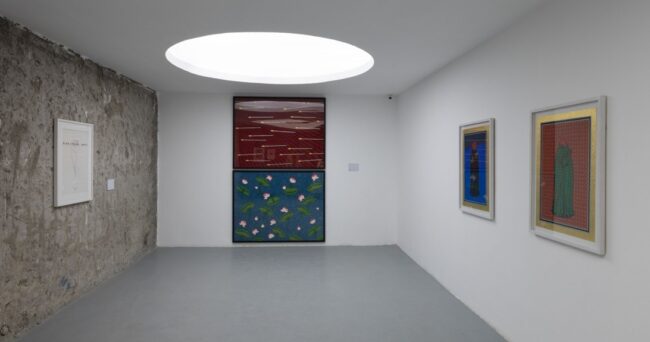
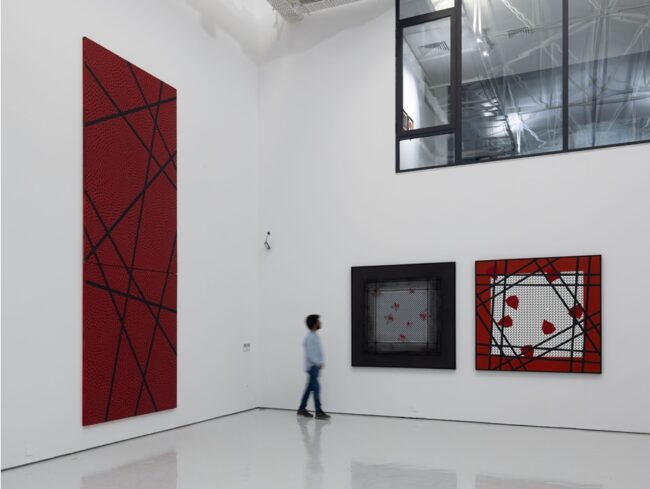
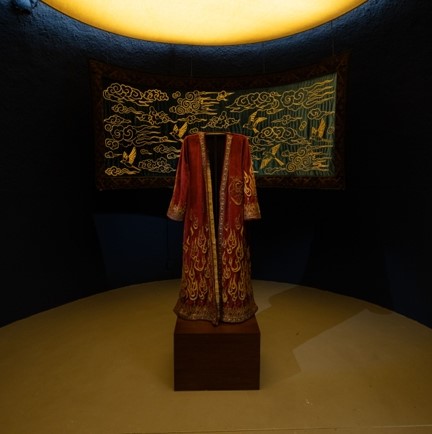
This two-venue curatorial strategy is critical, not just logistical. The Barracks Gallery, once a war bunker, carries the sediment of conflict in its very architecture, making it an apt home for Khalid’s recent works responding to the war in Gaza. Conversely, IQ Studios, with its open industrial scale, becomes a site for expansiveness: here her large-format canvases, textiles, and installation works breathe at their fullest. The contrast between the two spaces sets up a dialogue between compression and expansion.
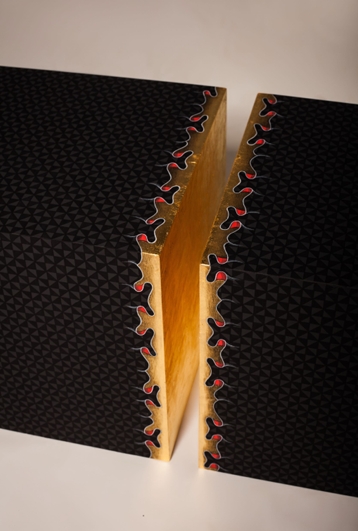
Among the most arresting pieces are her gouache works on wasli; disciplined surfaces carrying immense psychic weight. Scattering Stars Like Dust present celestial mappings that feel ruptured, fragile, or interrupted. These works retain the precision of classical miniature but destabilize symmetry, as if the universe itself has been knocked off balance. Gold leaf, traditionally a marker of sanctified imagery, here takes on the quality of fissures, glimmers of hope or remnants of ruin.
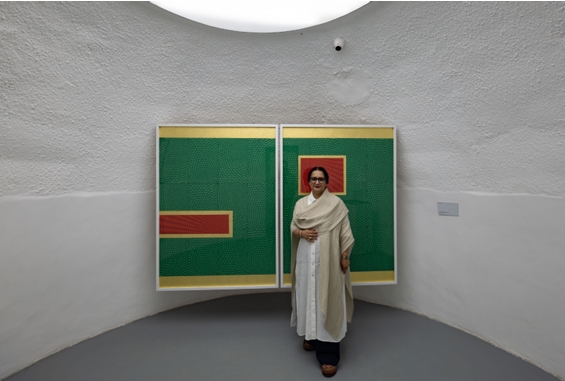
In Name, Class, Subject, the deceptively simple diptych format echoes bureaucratic forms, yet the delicacy of the brushwork undermines their institutional coldness. The title reminds one of the erasure and flattening of subjecthood, an ongoing political violence mirrored in the contemporary moment. Displayed in the war-bunker-like gallery, the work reads as a mourning register for lost identities, vanished bodies, and children denied even the administrative dignity of being named.
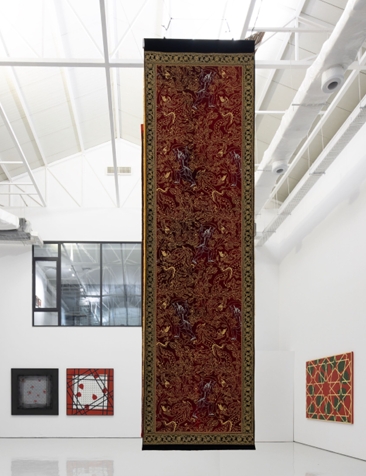
Two Worlds as One, 2015, offers a contemplative balance to the exhibition’s emotional intensity. Their symmetrical botanical forms reference both Persianate gardens and Sufi metaphysics, proposing love as a non-binary, ever-expanding terrain. Yet even these works, often read as serene, feel charged in the context of Khalid’s Gaza-related pieces; greenness becomes a metaphor for a world that insists on renewal despite devastation.
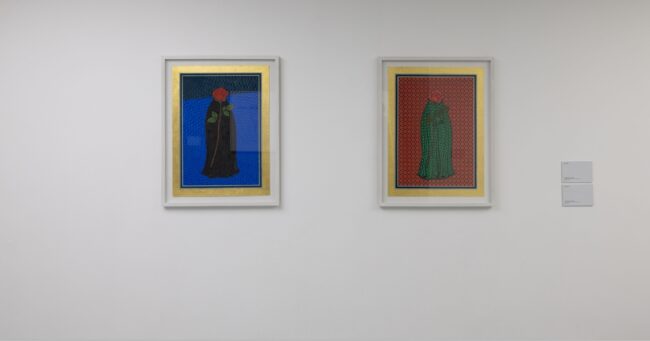
The series Thousands of Rose Gardens features patterns rendered in gouache with silver and gold leaf on paper board. Roses in Khalid’s vocabulary often oscillate between metaphysical symbols and political metaphors. Here, the gardens feel wounded; each petal precise yet brittle, as if held together by sheer force of will. Within the vault-like rooms of the Barracks, these works take on a memorial function: beauty, like memory, becomes an act of resistance.
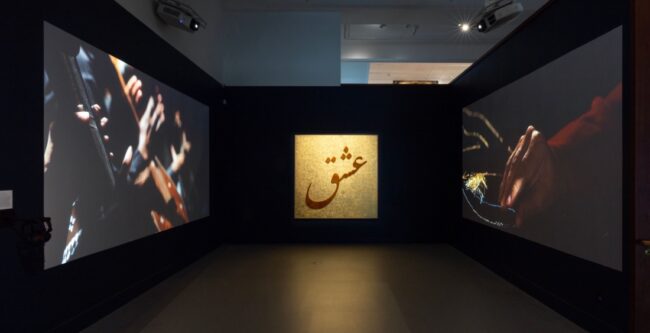
The curatorial choice to place politically inflected and emotionally dense miniatures in an ex-war space is powerful. The Barracks becomes both container and collaborator: its narrow corridors echo with the quiet of withheld breath, making the viewer hyper-aware of fragility, precarity, and the intimate violence that miniature painting can register despite its small scale.
The journey to the second venue i.e. The IQ studio, took me to the far edge of the city, past fields, new constructions, and those long open stretches where Lahore begins to lose its density. When I finally reached the studio, its scale was the first thing that struck me: vast, open, almost warehouse-like, with sunlight pouring in from high windows and skylights as though the building itself inhaled light. The space seemed to exhale expansiveness.
Walking inside, the sheer size of the installations commanded not just attention but bodily awareness; the kind that makes you move slower, breathe differently, look upward. Khalid’s large canvases, tapestries, and video installation felt as though they had finally found a home spacious enough to contain their ambition. In this light-filled openness, the artworks did not merely hang or stand; they unfolded, radiated, and enveloped, captivating me in a way that made the long journey feel not just necessary, but inevitable. The works here dominate the space with pulsating symmetry, dense patterning, and the illusion of infinite depth
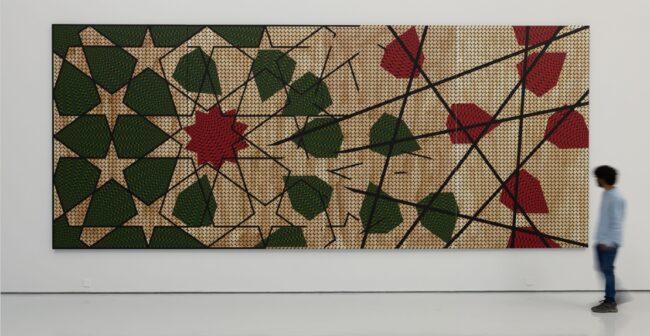
Khalid’s language of geometry, often associated with Islamic spiritual aesthetics, here becomes tense, almost vibrating with unease. The iconography feels stretched to its limits, mirroring a world whose spiritual and political fabrics are under strain.
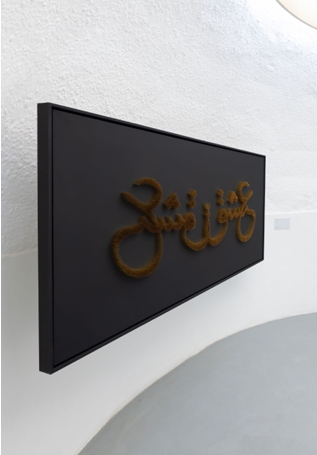
The work Ishq revisits Khalid’s iconic use of pins, first extensively explored in her I Am And I Am Not series. Here, the pins, sharp, luminous and dangerous, both attract and repel. Their metallic grid catches light like a constellation, but the materiality resists romanticization. Love (ishq) here is not mystical surrender; it is a piercing, a wound, a site of endurance.
The triptych video work I Am and I Am Not, with dual projections and a central panel of gold-plated pins, bridges performance, temporality, and objecthood. The repetitive, meditative gestures in the video become rhythmic incantations, reinforcing the exhibition’s larger themes: circularity, return, cosmology, and the impossibility of stillness in a world of perpetual upheaval.
The curatorial strategy achieves a layered coherence. The Barracks, a site of historical violence becomes a sanctuary for intimate, emotionally charged works, primarily miniatures, that address contemporary violence. Whereas in IQ Studios, a capacious environment becomes the site for Khalid’s monumental and materially ambitious works, allowing viewers to experience her formal evolution.
The spatial bifurcation mirrors the duality in Khalid’s practice: the micro and the macro, the body and the cosmos, the wound and the world. Importantly, the split avoids the pitfall of chronological curation; instead, it is thematic, emotional, and phenomenological.
Scattering Stars Like Dust succeeds as both an introspective retrospective and a timely political response. Khalid’s works, whether rendered in gouache on wasli or articulated in steel pins, refuse spectacle in favor of quiet, insistent intensities. The exhibition’s empathetic tone is not sentimental; it is ethical. Its beauty is not escapist; it is confrontational.
In this dual-venue exhibition, Aisha Khalid reaffirms her status not merely as a leading neo-miniaturist but as a cartographer of both the visible and invisible worlds, charting the intimate tremors of grief, the geometry of devotion, and the enduring human compulsion to make meaning even in the shadow of catastrophe.