
In Space and Place: The Perspective of Experience, Yi-Fu Tuan writes, “Place is security, space is freedom: we are attached to one and long for the other.” His formulation is deceptively simple, but its tension is profound. Security and freedom are rarely found together. To dwell is to accept boundaries; to move beyond them is to risk displacement. In Reconstructing Space, the artists appear to situate their practices within this threshold, between rootedness and drift, between the remembered home and the imagined horizon. One is compelled to ask: are these works truly reconstructing space, or do they merely represent it.
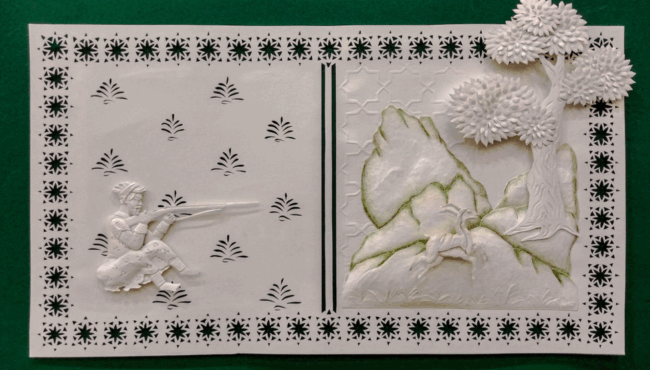
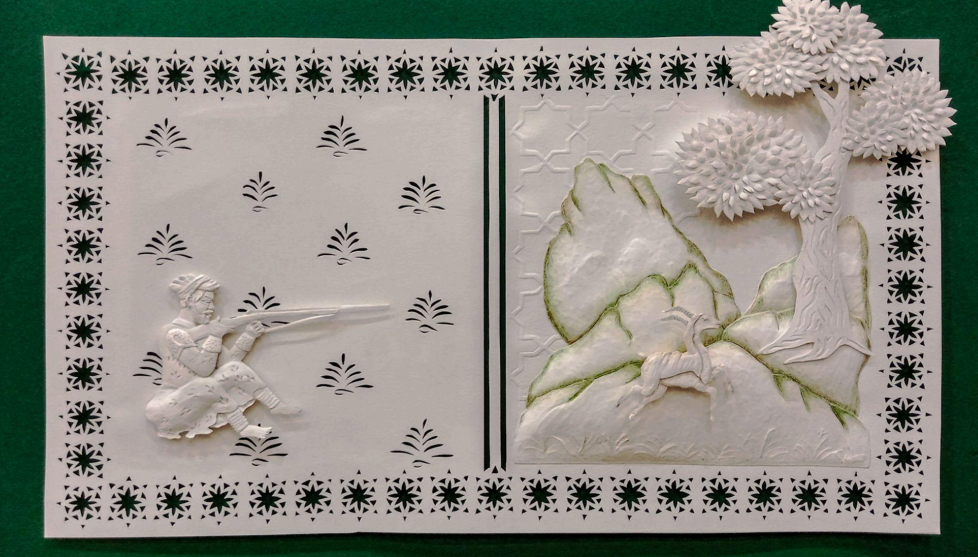
The exhibition is filled with works that treat space as a subject of recollection, not an experience to be lived through. Farah Anwer’s delicate paper sculptures evoke the architectural impulse to contain. Their lightness seduces, but their fragility betrays a kind of nostalgia for order. Her gardens, waves, and patterned enclosures become metaphors for the human desire to frame experience, to secure the fluid into the formal. What does it mean to “reconstruct” space when the material itself resists permanence? The precision of her cuts and the orchestrated play of light and shadow stage a space of meditation rather than habitation. One might say Anwer builds memory palaces rather than spaces, places that secure feeling, but do not permit movement. Her “gardens” are walled, controlled; her “waves” are contained within frames. The freedom Tuan attributes to space becomes a carefully managed illusion.
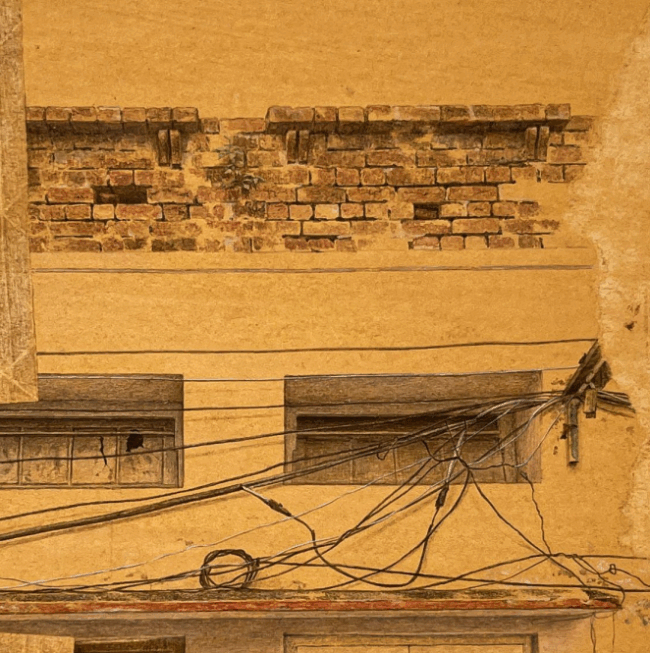
Hamza Bin Faisal’s miniature interiors deepen this paradox. His architectural compositions are haunted by absence, rooms emptied of bodies, homes stripped of voices. Rendered in the subdued palette of sepia and dust, they appear archaeological, as if painted from within ruins. These are not spaces reconstructed but spaces mourned. The works perform nostalgia rather than spatial inquiry. In Tuan’s terms, they cling to place as the residue of security, unable or unwilling to step into the risky freedom of space. The viewer is invited not to inhabit these interiors but to peer into them, to witness memory’s claustrophobia. Perhaps that is the quiet critique embedded in Hamza’s work: that reconstruction is itself an act of containment, an attempt to fix what should have been allowed to dissolve.
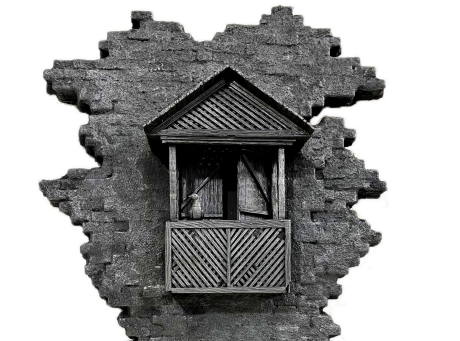
If Anwer and Faisal dwell on containment, Hasnain Noonari literalizes fragility through his graphite architectures. His sculptures, carved from the very medium of drawing, carry an exquisite contradiction; graphite, a material meant to inscribe, is made to occupy space, to become an object. Noonari’s houses, temples, and fragments of modernist concrete emerge as if from the residue of erasure. There is poetry in their transformation: memory made tangible, the act of drawing becoming architecture. One wonders if the gesture risks fetishizing transience, turning loss into aesthetic form. The graphite surfaces gleam like relics of a world already vanished. They do not reconstruct space so much as monumentalize its decay. The freedom of space, the possibility of movement, is trapped in the density of matter.
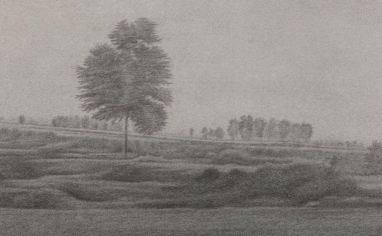
Irfan Channa’s landscapes, drawn from both lived travel and digital wandering, might seem to approach Tuan’s idea of space as freedom more directly. His work negotiates between the embodied act of journeying and the mediated act of scrolling between the land that unfolds before the body and the landscape that flickers through a screen. Even here, there is a subtle confinement. The compositions, though informed by transit, are meticulously framed; the spontaneity of movement is subsumed by the desire to capture. The artist’s attention to transition and transformation points toward freedom, but the execution remains pictorial, fixed. In Channa’s case, space becomes an image, a representation of freedom.
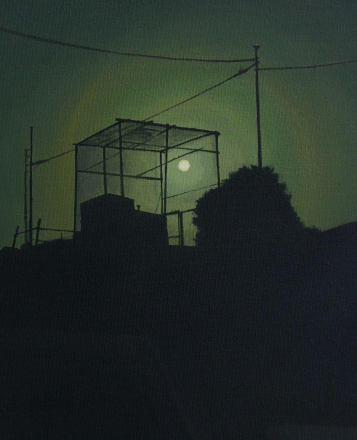
Among these voices, S. M. Raza anchors the exhibition in the place’s sensorial density. His paintings of Korangi at night, lit by the melancholy orange of low-voltage bulbs, pulse with memory. They are intimate, tender, and attentive to the atmosphere. Raza’s gaze, however, is not grounded; it floats. His recollections are aerial, dreamlike, as if the artist is always hovering above the terrain of belonging but never truly landing. The result is both haunting and evasive: place is reconstituted as vision rather than dwelling. The houses, roofs, and moonlit streets are rendered with affection, yet they remain suspended in reverie. Raza’s “reconstruction” is psychic, the city as remembered from exile.
Across the exhibition, then, the title Reconstructing Space feels both apt and ironic. The artists collectively engage with space as metaphor, for loss, for time, for the persistence of memory, but few engage with the politics or phenomenology of space as lived experience. Their practices reconstruct images of space rather than space itself. In this sense, the exhibition perhaps reflects the condition of contemporary life in Pakistan’s urban contexts, where public space is precarious, restricted, and surveilled. Artists retreat into interiors, mental, domestic, nostalgic, reconstructing not space but its safe simulacrum.
The exhibition, intentionally or not, reveals a collective anxiety: the impossibility of truly reconstructing space when the place itself feels so unstable. What we witness is not the re-making of spatial experience but its tender afterimage, the echo of freedom refracted through the security of memory. After all, to reconstruct space is no easy feat; it is not something one can simply illustrate or recall. It requires an unmaking of form, a willingness to inhabit instability, to risk the loss of security to touch freedom.