
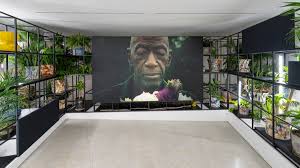
At the Guggenheim, Rashid Johnson turns the museum’s pristine white rotunda into a meditation on selfhood. A Poem For Deep Thinkers continues Johnson’s exploration of anxiety, identity and survival through a syntax of materials: black soap, shea butter, ceramics, mirrored tiles, all arranged with the rhythm of verse, rather than manifesto.
Rashid Johnson, a leading figure in contemporary American art, established a practice based on materiality and form in order to navigate questions of belonging and emotional survival. A part of a twenty-first-century generation of artists who redefined abstraction through personal and cultural memory, Johnson transforms substances such as black soap, shea butter, and ceramic tile into a visual vocabulary alluding to communal rituals of care or cleansing within the domestic interior.
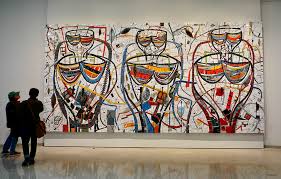
The exhibition’s centerpiece, an installation of recurring tiled panels, wax, and mirrored fragments, coalesces into a meditative environment, where repetition possesses both method and meaning. Johnson reprises familiar motifs, with grids, faces, radios and potted plants, slightly altered in each iteration. The recurrence invites the comparison to a poetic refrain, where variation itself acts as a form of progress.
A Poem For Deep Thinkers unfolds as an array of shifting environments, as opposed to a singular unified statement. Televisions display Johnson’s personal performances, while Persian carpets and clusters of houseplants soften the architecture’s clinical severity. Shelves of books and ceramic vessels appear semi-damaged, suspended between function and ruin. The cumulative effect is not a harmonious one; rather, the arrangement of objects appears provisional, alive and in flux.

The monumental scale of the exhibition, bringing together over ninety artworks spanning three decades, amplifies the intimacy of Johnson’s materials. Rather than translating personal experience into a political statement, Johnson turns inward, offering abstraction as a means to examine the ethics of care. The exhibition endures for its restraint as opposed to its grandeur, in which self-examination allows fragility to occupy a public stage.