

Scheherzade Junejo’s recent exhibition, displayed at Numaishgah Lahore, titled “Candyland,” presents a complex and layered critique of the commodification of the female body within contemporary consumer culture. Her metaphorical positioning as an “artist peddling flesh for sale” boldly centers the transactional nature of visual consumption, where the female form is objectified, aestheticized, and ultimately transformed into a consumable product for the (largely male) gaze. This work sits within a broader lineage of postmodern feminist critique, drawing upon themes of simulacra, hyperreality, and the violence of aesthetic perfection.
Junejo’s framing of Candyland as an envisioned space pushes the idea of the hyperreal, a simulated reality that replaces and erases the original. Within the theories of Simulacra and Simulation, it is often argued that signs and symbols in postmodern culture no longer refer to reality, but to other signs, creating a closed circuit of meaning that renders the real irrelevant. The “juicy, candied, texturised bodies” in Candyland resonate this idea: they are no longer real women but simulations, confectioned to satisfy an abstract desire shaped by media, pornography, advertising, and patriarchal ideologies.
These bodies are not being but being-for, a concept reminiscent of ideas where woman is cast as “Other” in a male-dominated world. In Candyland, the female form has been stripped of agency and subjectivity, transformed into “trophy” or “real estate,” metaphors that sharply critique the objectification and ownership entrenched in patriarchal culture. The reduction of women to consumables, decorative bodies, and assets to be acquired reflects a neoliberal system where everything, including identity and sexuality, becomes a commodity.

Junejo’s Candyland allegorizes a perverse utopia in which desire is satiated through curated perfection, where bodies are industrially perfected for the consumer. Here, beauty is not merely aesthetic, it is labor, discipline, and performance. Junejo’s use of terms like “texturised” and “purified” underscores the bodily labor involved in conforming to a homogenized ideal, while also exposing the sanitized violence inflicted upon bodies to meet that standard. Junejo’s “market” is not abstract; it is specific, shaped by your gaze. The accusatory “you” directly implicates the viewer, collapsing the distance between art and consumer, between voyeur and buyer. This confrontation disallows passive consumption, making the viewer complicit in the commodification and erasure of female agency.

Junejo’s claim that these were once bodies, now they are erased, speaks to the feminist discourse surrounding the loss of subjectivity through objectification. Artists like Jenny Holzer, Cindy Sherman, and Barbara Kruger in the 1980s similarly explored how media and mass culture reduce women to surfaces, images, and packages. By referencing packaging and purification, Junejo touches upon another critical layer: the postcolonial anxiety around female respectability and control. In South Asian contexts, where public female visibility is often policed, the act of packaging and purification can be read both literally and metaphorically. The female body becomes a contested site between modern visibility and traditional modesty, between personal agency and public consumption.

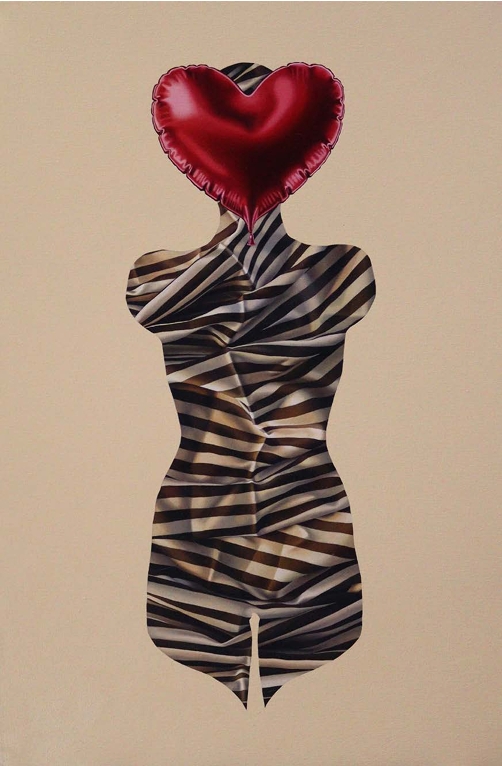
In her painting Balloon Girls, the repetition and uniformity represent factory production lines or retail displays, suggesting the mass commodification of the female body. The use of heart shapes, typically symbols of love or desire, ironically contrasts with their cold, metallic sheen, turning intimacy into product packaging. The absence of faces and limbs dehumanizes the subjects; what remains is a sculpted, polished form that caters solely to the visual and erotic economy. These balloon-women are inflated by desire but devoid of voice, subsumed by the gaze, and shaped by demand.
The painting Lady Parts is perhaps the most confronting piece: a nude, faceless female figure is frontally posed, but her head is replaced by a cattle skull – stark, sharp, and unmistakably dead. The figure is surrounded by red, glossy heart motifs. This image embodies the postmodern tension between surface and substance. Junejo brings forth a kind of “gothic consumerism”, where desire is masked as love, but consumption ultimately destroys.

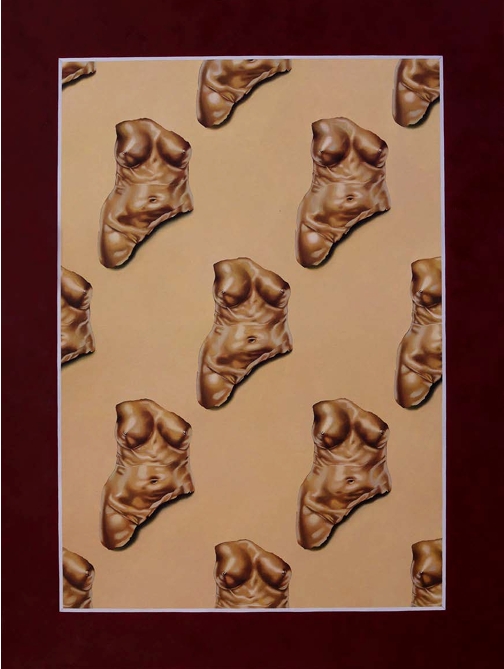
Similarly, the painting Beghairat Brigade presents a repeated pattern of distorted, wrinkled, almost melting female torsos against a muted beige background, framed in red. The repetition flattens the uniqueness of each form, rendering them surreal and eerie. This piece speaks to the aftermath of commodification. What happens to bodies when they are no longer desirable? The “shame” here is not inherent to the body, but socially constructed through a system that celebrates only youth, gloss, and conformity.
Each of these works visualizes Junejo’s fictional Candyland as a very real emotional, cultural, and political space. They don’t simply depict the female body; they dissect it, replicate it, market it, distort it, and eventually discard it, mirroring the lifecycle of consumer goods in a late-capitalist society.
In the age of Instagram filters, cosmetic surgery, and lifestyle influencers, Candyland also mirrors the culture of hypervisibility and digital self-curation. Contemporary femininity is increasingly performed in the language of branding. The woman is not only a body but a lifestyle product – optimized, aestheticized, filtered, and feed-worthy. Junejo’s critique, then, is not just of patriarchal control but of neoliberal feminism’s complicity in turning empowerment into a marketable aesthetic.
Candyland was not simply an exhibition, it was a mirror held up to a society that consumes femininity as image, as product, and as fantasy, where Scheherzade Junejo’s work functions within the critical frameworks of postmodernism, feminism, and anti-consumerist critique.