
I arrived at ZQ Gallery on a quiet Thursday evening, when the city’s noise softens and the light begins to behave strangely. Edges blur, colors deepen, and everything feels slightly provisional. It felt like the right hour to enter Between Sleep & Sight, a group exhibition curated by Ammar Aziz, whose premise borrows from André Breton’s idea of surreality: a space where dream and waking life collapse into one another. The show does not overt surrealism but instead, it lingers in quieter psychological thresholds of memory, denial, longing, afterlife, flesh and absence. And where the body becomes the primary site of uncertainty.
What binds the artists together is not style but mood: a shared interest in the in-between. Figures drift, landscapes conceal more than they reveal, objects carry wounds and surfaces seem to remember touch. Walking through the gallery felt less like moving from artwork to artwork and more like passing through states of consciousness.
Ammar Aziz’s curatorial framing makes sense here. Known for moving between poetry, film and music, his sensibility is literary rather than declarative. The exhibition reads almost like a stanza where each artist is a line break and each wall a pause
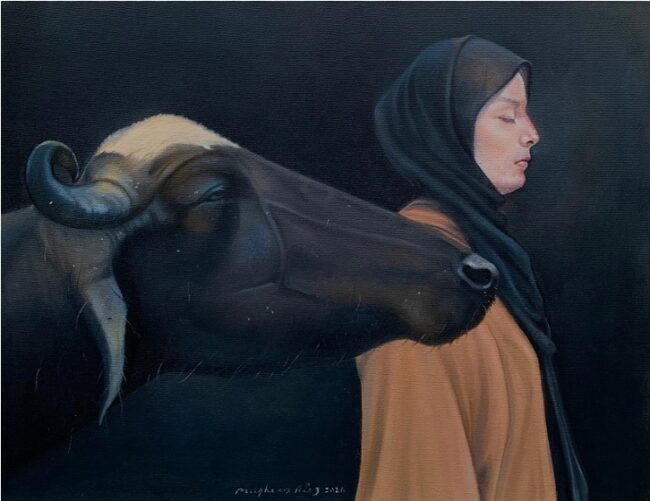
Mughees Riaz’s paintings greet the viewer with an apparent familiarity: the buffalo and the veiled female figure rendered with technical assurance. But the paintings are not descriptive; they behave like memory-scapes. His canvases seem to treat light less as illumination and more as concealment, something that veils as much as it reveals. His surfaces carry the legacy of classical landscape traditions in Pakistan, yet his symbolism destabilizes that lineage. The terrain becomes psychological. In the context of this exhibition, Riaz offers the threshold between sight and sleep as a pastoral hush. Just like a dream you enter through stillness rather than rupture.
Where Mughees Riaz is quiet, Irfan Abdullah is sharply corporeal. His sculptures made from oxidized razor blades are immediately unsettling. The materials are dangerous, domestic, and intimate all at once. Razor blades are tools of grooming, of self-maintenance, but also of harm. The accumulation of these blades produces forms that feel both fragile and defensive, almost like armoured skin. From a distance they appear delicate; up close they threaten the body. That tension between attraction and repulsion, creates a heightened awareness of one’s own physicality. I caught myself stepping back instinctively.
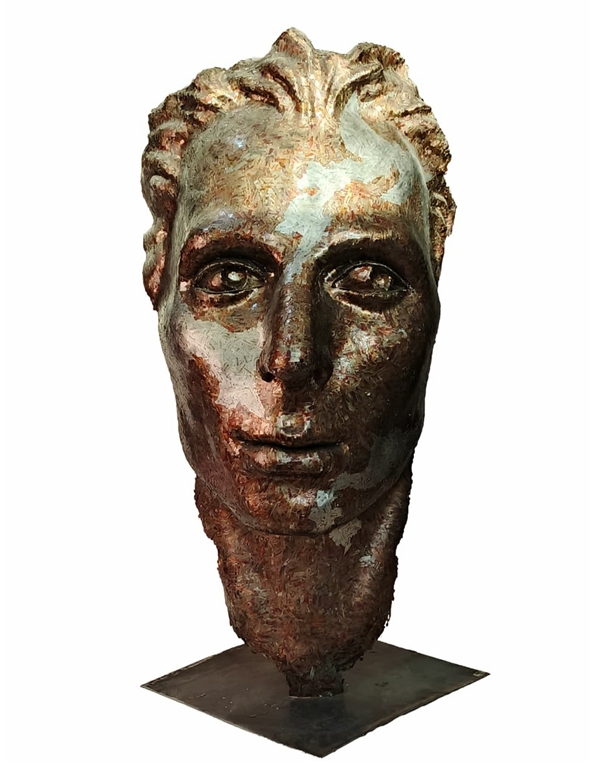
Abdullah’s stated interest in “pouring meaning into everyday objects” manifests here as a kind of archaeology of pain. Oxidation stains the metal, giving time a visible presence. The sculptures feel less fabricated than weathered, as though they’ve endured something. In the show’s dream logic, his work introduces the nightmare: the body not as memory but as wound.
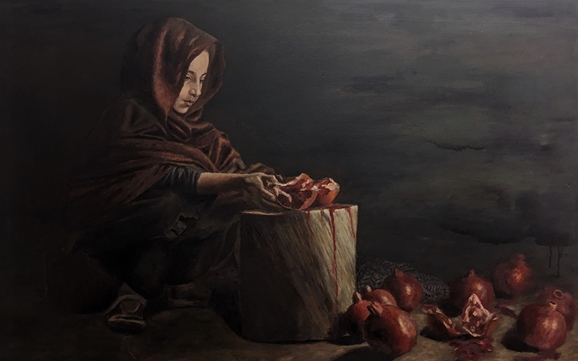
Sayed Yaqoot Jan’s paintings turn toward metaphysics more directly. Centered around the recurring image of the pomegranate, his compositions lean into symbolism with devotional clarity. The pomegranate, saturated red and heavy with seeds, becomes a cosmology. Of life, sacrifice and death. Unlike the ambiguity elsewhere in the exhibition, Jan’s work offers a narrative arc from earthly fragility to spiritual continuity. Yet they never feel didactic. The fruit’s tactility, its skin and its seeds, ground the spiritual in flesh. Heaven is imagined not as escape but as extension.
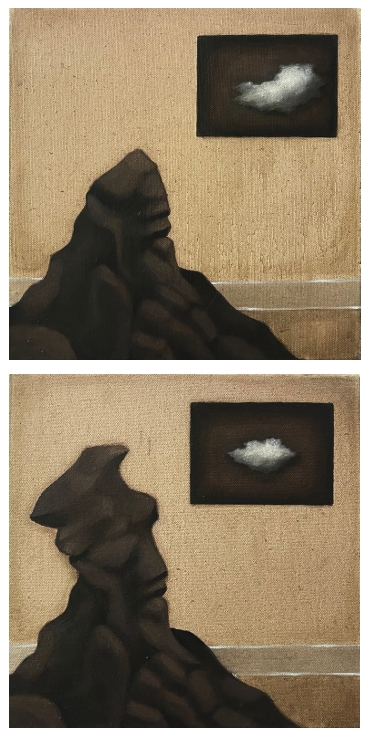
Layeba Salman’s canvases operate differently. she gives us sensation. In her works, organic shapes hover between abstraction and recognition. They might be organs, stones, fossils, or clouds. Nothing is fixed. Her surfaces feel improvised yet intentional, built through intuition rather than design. The forms appear to grow rather than be placed. There’s a bodily intimacy here, a sense that these shapes are interior, like we are looking at feelings before they’ve learned to speak.
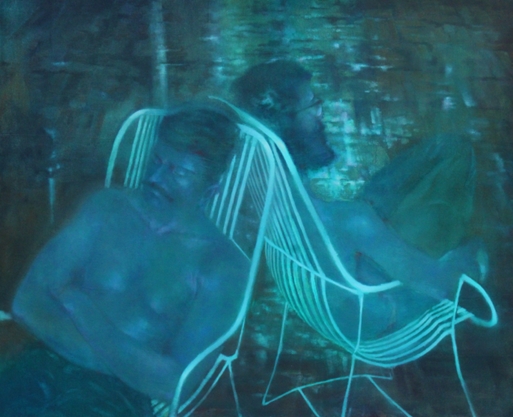
Hassan Churchill brings the human figure back into focus, but stripped of certainty. His paintings depict men who seem suspended mid-gesture, neither arriving nor leaving. Paint itself becomes the subject. Bodies dissolve into their surroundings; edges blur. The figures do not pose intentionally, they negotiate space awkwardly, as if unsure of their own presence. Churchill’s framing of the male figure as psychologically estranged is compelling. These men feel hyper-visible yet internally vacant. They exist, but they do not quite inhabit themselves. The result is quietly devastating. Rather than dramatizing crisis, he paints delay and the slow erosion of certainty.
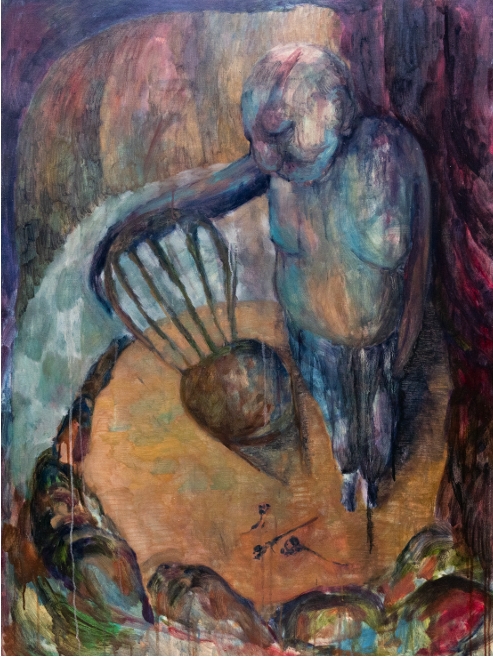
Fatima Ahmed’s paintings move closest to the subconscious. Figures slip in and out of legibility; spaces feel like rooms remembered from dreams. Her surfaces have a cinematic quality, cropped, intimate, slightly off-perspective. There’s a melancholic tonality throughout, a soft blue-grey quiet. The boundaries between subject and object blur: is the figure observing, or being observed?
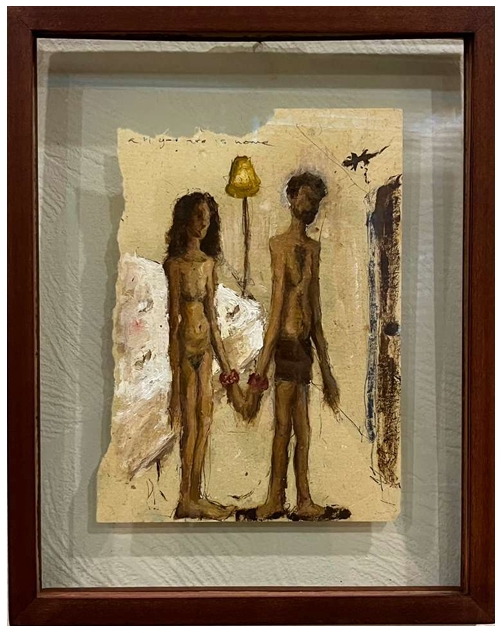
Areeba Afreen Qureshi’s small-scale paintings are among the most intimate in the show. They feel like secrets rather than statements. Her figures are close-cropped, tender, vulnerable. Skin becomes landscape. Color is lush, almost bruised. There’s a palpable sensuality, but also distance. Bodies that yearn yet hesitate. Her notion of “almostness” is evident: connection that never fully arrives.
Between Sleep & Sight succeeds not because it illustrates surrealism but because it trusts ambiguity. It understands that the most compelling images are those that do not resolve themselves. Across painting and sculpture, the artists collectively ask: what does the body know that language cannot articulate?
By the time I stepped back onto Jail Road, the city felt slightly altered, as if I were still carrying the exhibition’s half-light with me. Cars passed, vendors called out, but everything seemed slower, softer. Like the world just after waking, when dream and reality briefly coexist.
That, perhaps, is the quiet achievement of this show: it teaches you how to linger in that in-between space a little longer.
The exhibition titled ‘Between sleep and sight’ was displayed at the ZQ Gallery in Lahore from 24th January to 4th February 2026.