

Convened by Amin Gulgee, a trustee of the Karachi Biennale, and the Curator of the KB27, Noor Ahmed, the evening began with conversation. KB’s new chairperson Atteqa Malik, opened the conversation by sharing a film that showed the work done over the last decade of the Karachi Biennale. The Managing trustee, Shanaz Ramzi, discussed how art should be beyond aesthetic and should spark debates and social and political conversations.
The Artistic Director Bushra Hussain commemorates the 10 years of Karachi Biennale by reminiscing about the earlier days and then introducing Noor Ahmed as the youngest curator in Karachi Biennale’s history.
Following the press conference, the audience embarked on a 77-minute preview featuring works of 77 minutes of performance art, by 72 artists from 18 countries.
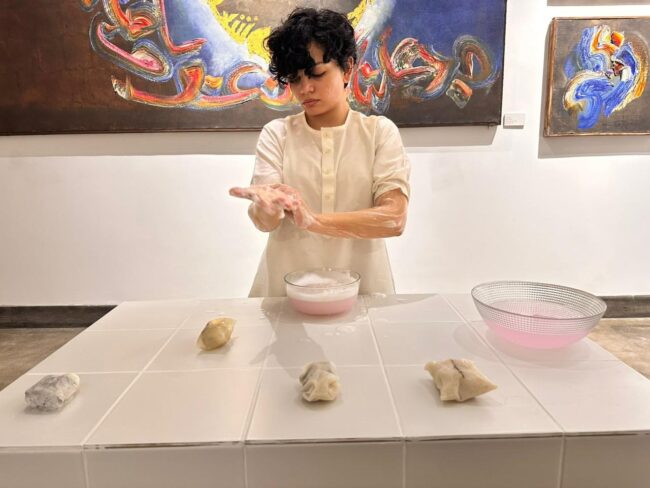
Maham Qureshi’s work titled “Tazkiyah: A Cleansing Ritual,” performed by Zunera Rashid, is a thought-provoking and powerfully executed performance that reflects on the idea of cleansing within religious and social frameworks. The term tazkiyah in Islamic thought refers to spiritual purification, the process of cleansing the self from moral and spiritual impurities. In this performance, the ritual extends beyond literal purification and becomes a metaphor for the ways religion, society, and culture attempt to discipline, regulate, and “cleanse” bodies, particularly women’s bodies. Through gesture, repetition, and embodied action, the performance appears to question: Who defines what is “pure” and what is “impure”? How does ritual become control? Can cleansing be both liberation and erasure?
The act of ritual cleansing here may simultaneously suggest devotion and critique. It holds tension between faith as personal spirituality and religion as a social structure that imposes expectations. The performer’s body becomes the site where these layered meanings unfold, vulnerability, resistance, submission, and reclaiming.
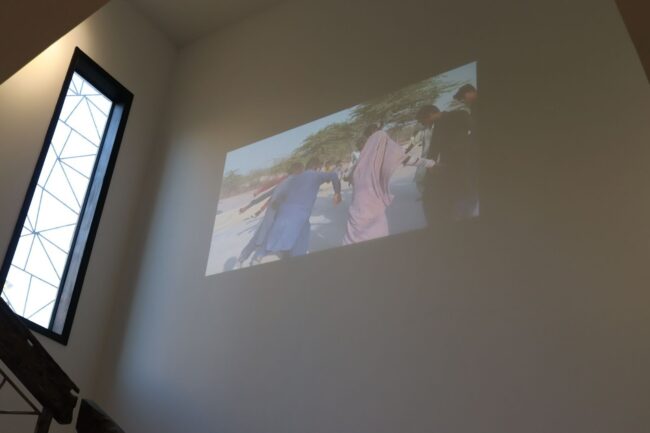
Manoj Kumar’s “Pilgrimage to Home” is a video installation that moves between temporalities, panning across footage filmed by the artist in 2024 and archival material recorded by his father in 2007. Developed during the Indus Valley School of Art and Architecture artist residency “Critical Futures,” the work situates personal memory within an institutional framework that encourages reflection on history and becoming.
The juxtaposition of present-day documentation with inherited archives creates a quiet dialogue between father and son. The 2007 footage, originally captured through the father’s gaze, carries the weight of lived experience, perhaps unselfconscious, intimate, domestic. In revisiting and reframing it. The camera becomes both witness and bridge.
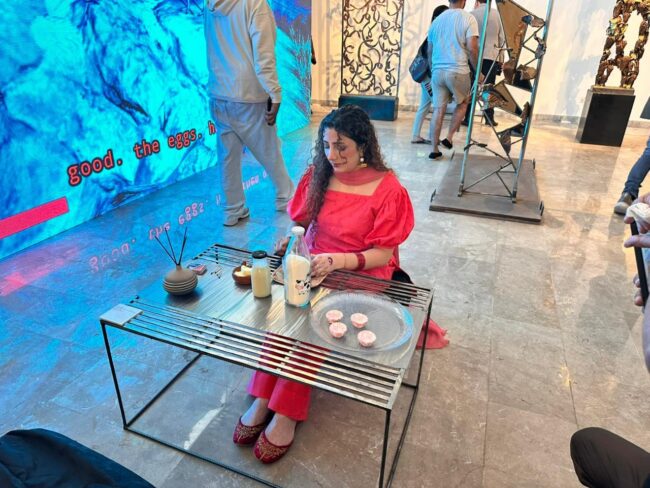
Umaina Khan made butter candies as an act of remembrance, invoking her grandmother through inherited knowledge and repetition. The act of creating for the audience transforms a private, domestic ritual into a public offering. It blurs the boundary between art and caregiving, between performance and hospitality. By sharing something edible, Khan invites viewers into intimacy, into taste, smell and sensory memory, allowing remembrance to be experienced rather than observed.
The Karachi Biennale Curtain Raiser felt like a proposition. The evening set the tone for what KB27 aspires to be: reflective, intergenerational and unafraid of complexity.
Across performance, video and more, the selected works shared an insistence on return, to ritual, to archive, to inherited knowledge. Marking a decade of the Biennale, the Curtain Raiser signaled a transition. With Noor Ahmed as the youngest curator in the Biennale’s history, KB27 gestures towards futures while remaining attentive to lineage. If the preview is any indication, this edition will continue to expand art beyond the aesthetic, into a space where conversation, confrontation and care coexist.
In revisiting ritual, archive, and offering, the evening reminded its audience that art does not simply represent the world; it participates in its making.