
In our living room there’s a pair of framed pressed peepal leaves upon which Quranic verses are beautifully inscribed. If you walk into any Pakistani household, you will likely find a framed verse hanging above a sofa, often in thick gold ornamental frame. Calligraphy has become part of the domestic visual language, as familiar as patterned cushions or carved furniture. Calligraphy has been culturally and morally sanctioned as compared with other forms of visual art, which is why many more households will display it in their drawing room walls with honor. The same doesn’t hold true for modern art galleries and museums.
Calligraphy is quite segmented among genres. Islamic calligraphy is devotional, where religious verses are scripted in ornamental style, preserving them in their meaning. The penmen, khattaat, writes script from Quran to wedding card invitations. The words “contemporary calligraphy art”, for this essay, is used for calligraphy art that is displayed in gallery and museum spaces and involves the intervention of the local and international art market. Contemporary calligraphy art is closer to a drawing in the ways that is uses the text as gestures and mark making over a surface. There are points where these different genres meet, such as they require training, discipline and dedication of the calligrapher and there are several points of departure; one being perceived as a mere vocational skill or craft and the other known to hold conceptual depth.
Artist and calligrapher Sadequain was among the first Pakistani artists to have accomplished “painterly calligraphy”, by adopting script in the same style he painted the human figure; stretched, morphed and high contrast. His turn towards calligraphy began with his respect for Urdu literature. He inscribed Ghalib’s poetry on his death anniversary in 1968. From calligraphy in Urdu language soon led to Arabic language and Quranic verses.
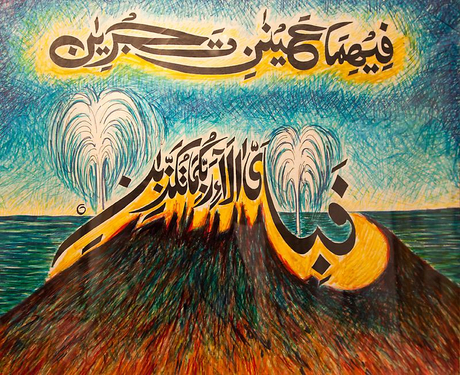
Untitled, Calligraphy 6, 1974, Sadequain, Mixed media on linen, 22.5 × 28 in. Source: Sadequain Foundation.
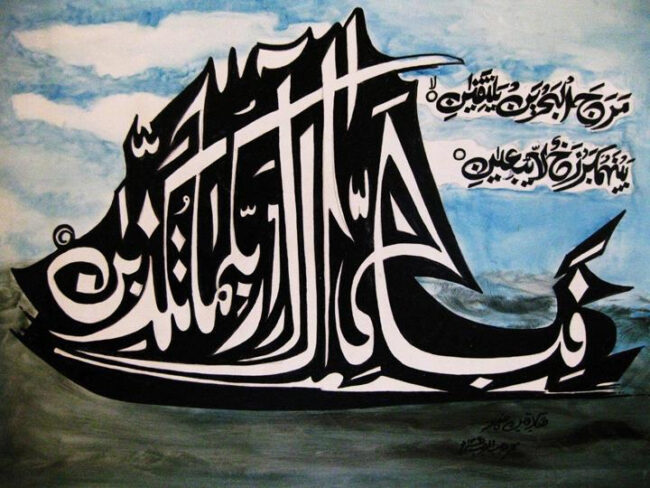
SURA-E-REHMAN SERIES 4, 1969, Sadequain, Oil on canvas, 20 × 24 in. Source: Aicon.
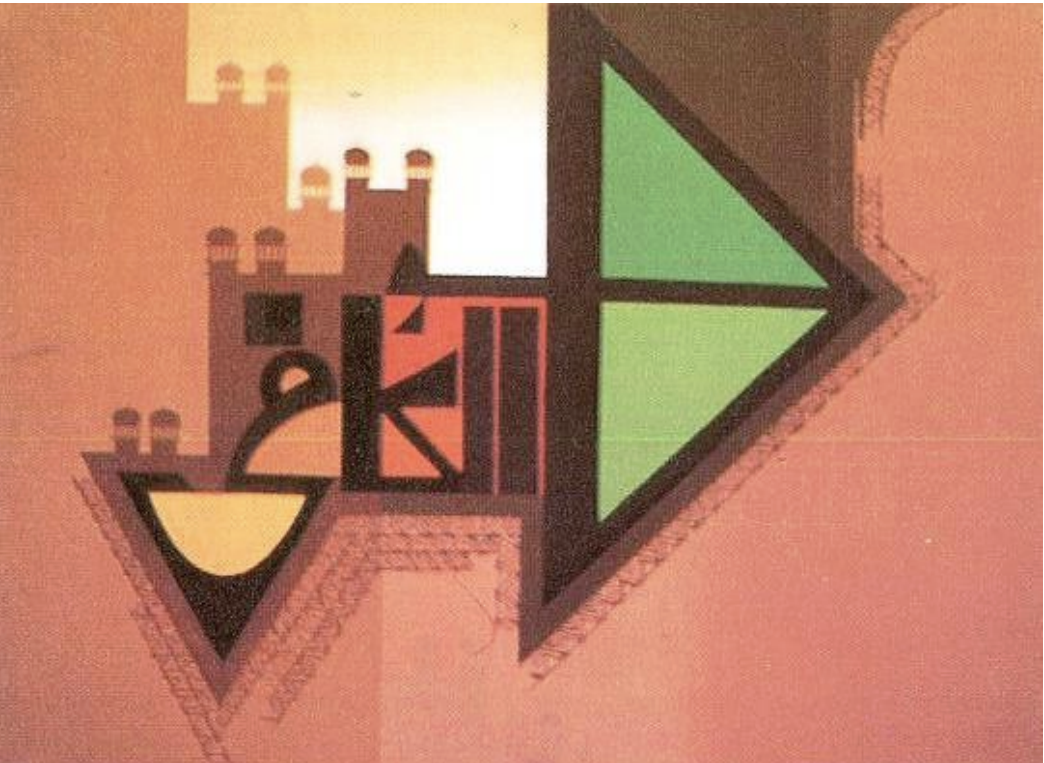
The geometrically balanced and illuminated Islamic calligraphy deviated and transformed to an expressive art with some tinges of representation, like the use of ships to carry the verses, a vase in the background or script amidst the galaxy, elongated and stylized. The text remained intact, legible and preserved, yet, carried the same existential weight as Sadequain’s paintings and drawings. On the contrary, artist and poet Aslam Kamal experimented with the organization of letters. “Khat-e-Kamal” is the name given to his unique typographic system, geometric and fused with architectural design. Aslam Kamal’s work shows that calligraphy is not a fixed medium but capable of abstraction and distortion. These artists played a significant role in reclaiming Islamic calligraphy post-partition and adding to Pakistani identity, whilst still acknowledging the cultural and religious roots.
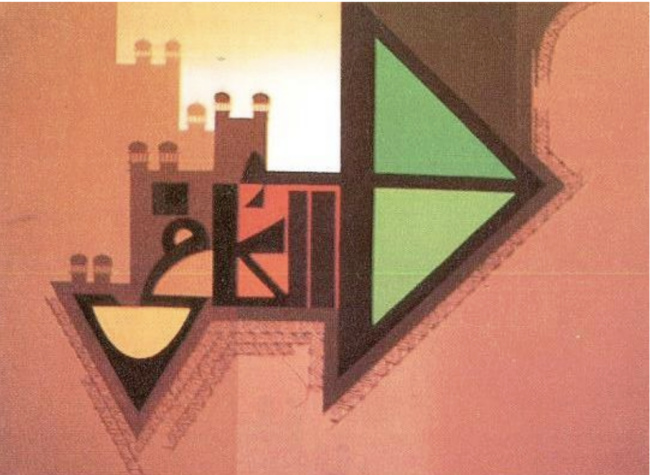
Hu al-Kāfi, 1984, Aslam Kamal, Oil on canvas, 36 × 24 in. Source: Marcella Nesom Sirhandi, Contemporary Paintings in Pakistan, p.106, Ferozesons, Lahore.
While calligraphy art has brought international recognition to Pakistani art industry, in contemporary practice, the medium of “text” is being used by conceptual artists while traditional or Islamic calligraphy is on the periphery. The conceptual Pakistani artist prefers to theoretically link their practice to the western text-based art from 1970s and beyond, that transforms text into visual expression. This transformation is evident not in just calligraphy but across all genres of art; from fine art to film and TV. The artist seeks to express social and political motives through their practice and the fragmentation and re-arrangement of script has emerged as an artistic technique.
Artist Muzummil Ruheel, who was trained in calligraphy before joining art school, uses language to critique social realities. In Misunderstanding (2019), his usage of letters is performative and literal, where the word Urdu word “taqseem” meaning “to divide” is itself divided and with its middle part missing, however, carries layers of meaning related to unity amongst community and the partition of the nation. In his 2025 solo show at Canvas gallery, “The Wild in Our Mouths”, the artist used common sarcastic phrases uttered in Urdu language and illustrated them as animals. Here text was fragmented and used as sculptural forms. His use of animals hints at another religious calligraphic system different from Quranic verses: the illustrated Islamic medieval manuscripts and bestiaries, reminding us of the pre-modern visual language that we may have forgotten to link to calligraphy.
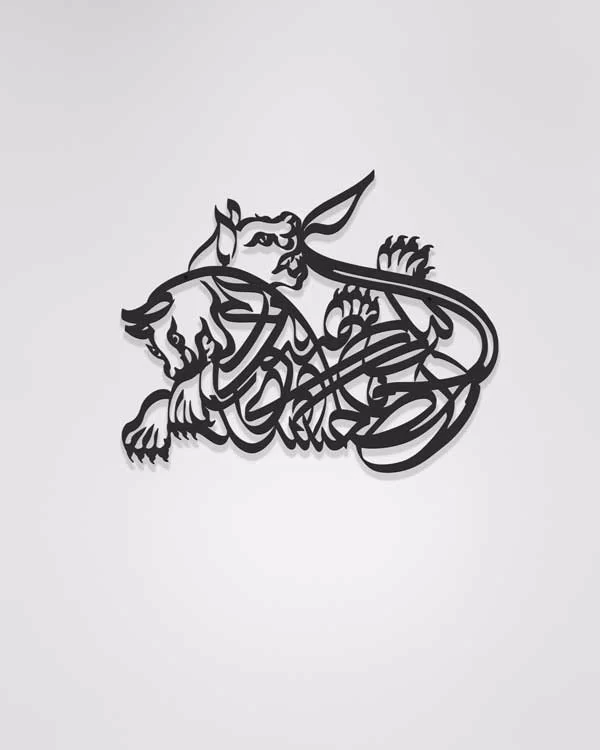
Why So Pleasant? (Itna Muskura Ker Kiyoon Khitab Ker Rahay Hoo – Wipe that fake smile off), 2025, Muzummil Ruheel, Paint, mild steel, screws, 36 × 29 × 1 in. Source: The Karachi Collective.
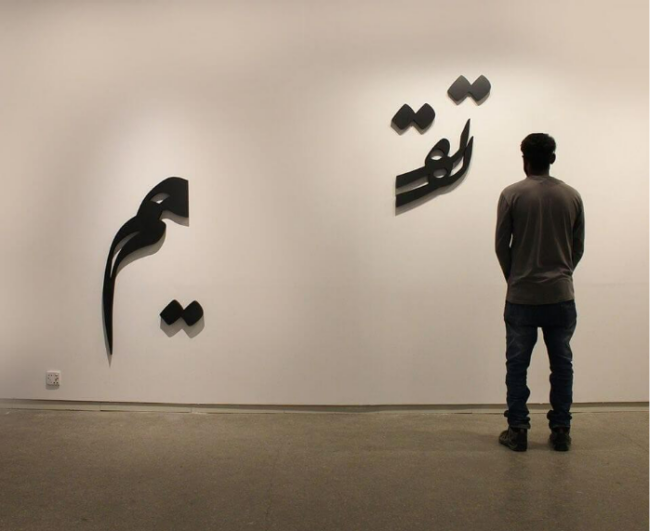
Misunderstanding, 2019, Muzummil Ruheel, Water-resistant MDF and oil paint (wall mounted), 74 × 92 × 1.5 in. Source: The Karachi Collective.
Artist Ghulam Mohammad’s focus is on the unreadability of the image. While Muzummil Ruheel’s stance may be more experimental than traditional genres of art, Ghulam Muhammad’s approach is quitter, still maintain the calm and composure of a miniature painting. The Jameel Art Prize (2016) winning artist cuts Urdu letters from magazines and produces collages on wasli in a composed format borrowed from muraqqa or calligraphic album from Mughal art. The overwhelming recomposed text moves away from the paper, showing that it has charted its own path, despite the grid it lays in. Isn’t communication the same? No matter how we structure certain sentences, the meaning is decided the listener. Or, the speaker and listener may exist on the opposite ends of meaning. The artist breaks the text; it is no longer meant to be deciphered and understood. Now, is calligraphy simply drawing? Once detached from inherited frames, letters can move, inviting interpretation and experimentation.
Ghulam Mohammad, in his usage of calligraphy, conforms to both traditional ornamental and laborious style of a craftsmen and contemporary contexts of language and identity. The artist connects calligraphy to the Mughal empire, when it was a celebrated art. Patronage always lays at the center of celebration of art and artists. Before, it was the royals, the Mughals that prioritized it. Now, calligraphy lays at the hands of the art institution. Akin to how craft is separated from art, so is the case of calligraphy art, though the earlier paragraphs of this essay show it wasn’t always so.
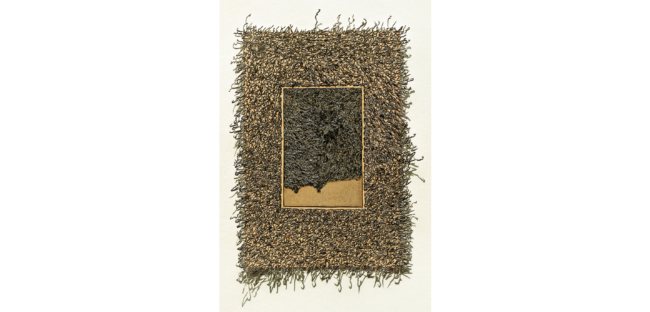
شناسائی (Shanasai ) Acquaintance, 2020, Ghulam Muhammad, Iranian ink and paper collage on wasli, 22 2/5 × 16 1/2 in | 57 × 42 cm.
Now, the practice of traditional or Islamic calligraphy is considered “safe,” it is less questioned, less experimented with, and less critical in gallery contexts. Where criticality has become the norm of society and visual culture, traditional or Islamic calligraphy may be considered simple and direct. Where visual art is meant to disturb, calligraphy may exist as a form of expression of devotion without the need to provoke anyone to defend its position and worth in the industry. Where “safe” holds the definition as stated earlier, it forced me think how unstable these times are. Constant rigor, disruption and provocation is a measure of the value of a work of art; this is a reflection of neoliberal visual culture.
Artists Sadequain and Aslam Kamal practiced devotion and expression together. Contemporary artists Ghulam Mohammad and Muzummil Ruheel present the critique of society through the fragmented language, however, they haven’t abandoned the tradition of calligraphy in favor of critique, only expressed through practice. The contemporary artists require structure to build their work upon, which the traditional arts provide. To see calligraphy only as devotional or only as text-based work is to misunderstand and limit its breadth.
References
Khan, Farah. “Pioneers of Modern Calligraphy in the Art Scene of Pakistan.” Ancient Punjab 6 (2018).
Sadequain Foundation. “Calligraphies.” Accessed March 1, 2026. https://sadequainfoundation.com/calligraphies/.
The Karachi Collective. “Double Dealing in the Art of Words.” Accessed March 1, 2026. https://thekarachicollective.com/double-dealing-in-the-art-of-words/.
The Karachi Collective. “Loss and Tension in the Exploration of Text as Image in Pakistani Art.” Accessed March 1, 2026. https://thekarachicollective.com/loss-and-tension-in-the-exploration-of-text-in-as-image-in-pakistani-art/.