

Lao Tzu once said, “The journey of a thousand miles begins with one step.” The journey of life is a metaphor for our quest to understand the universe. The journey of metaphor then, leads us through the landscape of the mind, where words become bridges between the tangible and the intangible. Art has transformative powers that can communicate profound truths, evoke emotions, and provoke thought through the language of imagery and metaphor. Metaphors have a way of holding the most truth in the least space.
In celebration of the Lahore Literary Festival, an exhibition curated by Rohtas Gallery, ‘The Path of Metaphor’ opened to the public in late February of 2024. The exhibition proved to be a captivating exploration into the diverse trajectories of four women artists who began their artistic journeys together at the National College of Arts in 1993. Against the backdrop of evolving cultural and feminist discourse in the 90s, these artists embarked on distinct pathways shaped by their individual experiences and perspectives. While Faiza Butt found a home in the UK, maintaining a strong connection to Lahore as a diaspora artist, Farida Batool, Masooma Syed, and Risham Hosain Syed returned to settle in their hometown, contributing significantly to its artistic landscape. Their collective body of work, spanning decades and continents, is a testament to their resilience and creativity.
Risham Syed
“The Path of Metaphor” served as an abstract theme that evoked a journey of symbolic exploration and interpretation. In this context, the phrase suggests a trajectory of meaning-making, where artists navigate through layers of symbolism, allegory, and rhetorical language to convey deeper truths and insights about their own experiences. Each artwork becomes a stepping stone along this path, inviting viewers to contemplate how metaphors can illuminate and enrich our understanding of the world.
Masooma Syed
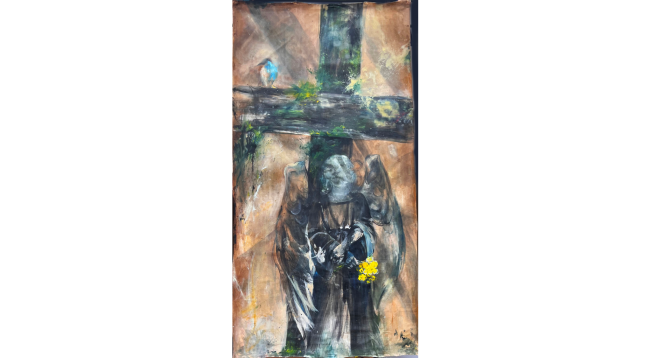
Upon entering, the viewer first met with the massive panels of Masooma Syed hanging from the walls of the Alhamra Art Gallery. Syed’s artistic vision unfolded as a captivating exploration of chaos and refuge, manifesting in both her monumental abstract expressionist panels and her intricate installations. With bold strokes and dynamic gestures, Syed’s painting commands attention, inviting viewers into a world of raw emotion and vibrant energy. Each panel becomes a canvas for the artist’s inner turmoil, a space where chaos and order converge in a mesmerizing movement of color and form. Through layers of paint and texture, Syed navigates the complexities of her mind, seeking solace amidst the tumultuous currents of life.
Masooma Syed 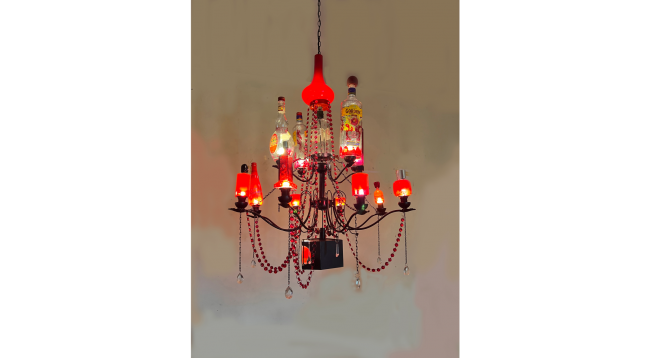
M S
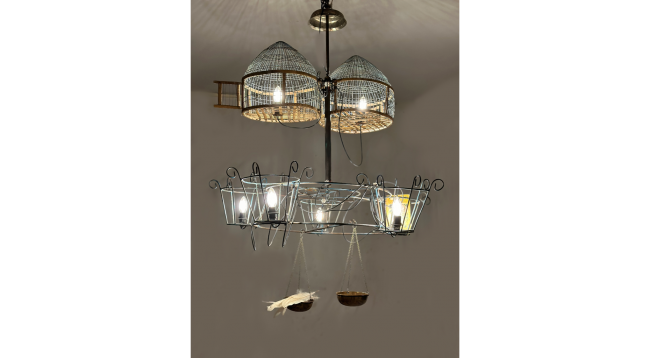
In contrast to the expansive canvases, Syed’s installations offer a more intimate encounter with her artistic vision. The chandeliers, crafted from found objects, serve as symbols of transformation and resilience. Amidst the chaos of the material world, Syed finds beauty and meaning in unexpected places, breathing new life into discarded fragments of the past.
Moving ahead, Faiza Butt’s artistry unfolded as a compelling exploration of identity, gender, and cross-cultural narratives, manifested through text-based installations and pointillism drawings. In her radical approach, Butt skillfully breaks away from traditional two-dimensional practices, opting instead to employ text as a medium for storytelling and expression. Through carefully curated phrases and words, she constructs narratives that transcend linguistic boundaries, inviting viewers into a dialogue that is at once universal and deeply personal.
In her pointillism drawings, Butt further explores themes of rebellion and self-expression, rejecting the confines of Western artistic traditions in favor of embracing her South Asian heritage. Through meticulous dotting techniques, she infuses her drawings with a sense of dynamism and depth, weaving together elements of popular culture and classical imagery to create visually stunning compositions. At the core of Butt’s work lies a deep-seated commitment to challenging societal norms and amplifying marginalized voices. Her art serves as a powerful platform for advocacy and activism, throwing the spotlight on issues of gender, identity, and cultural representation. Through her bold experimentation and fearless exploration, Butt invites viewers to join her on a journey of self-discovery and empowerment.
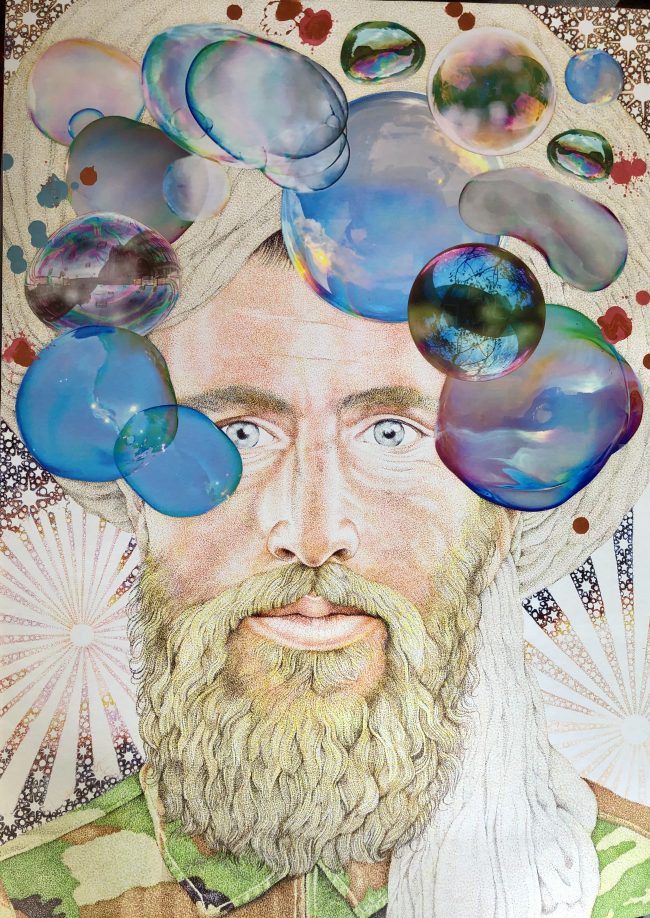
Faiza Butt
Climbing up the gallery, the viewer met with Farida Batool’s virtuosity, which emerges as a thought-provoking exploration of the human condition and our relationship with the environment. Through her installations, Batool confronts viewers with a powerful visual metaphor—a garden ensnared by barbed wire, symbolic of the pervasive impact of climate change and environmental degradation.
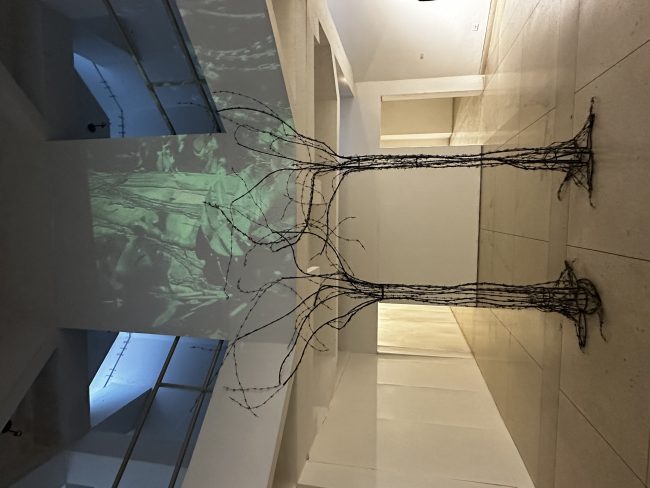
Farida Batool 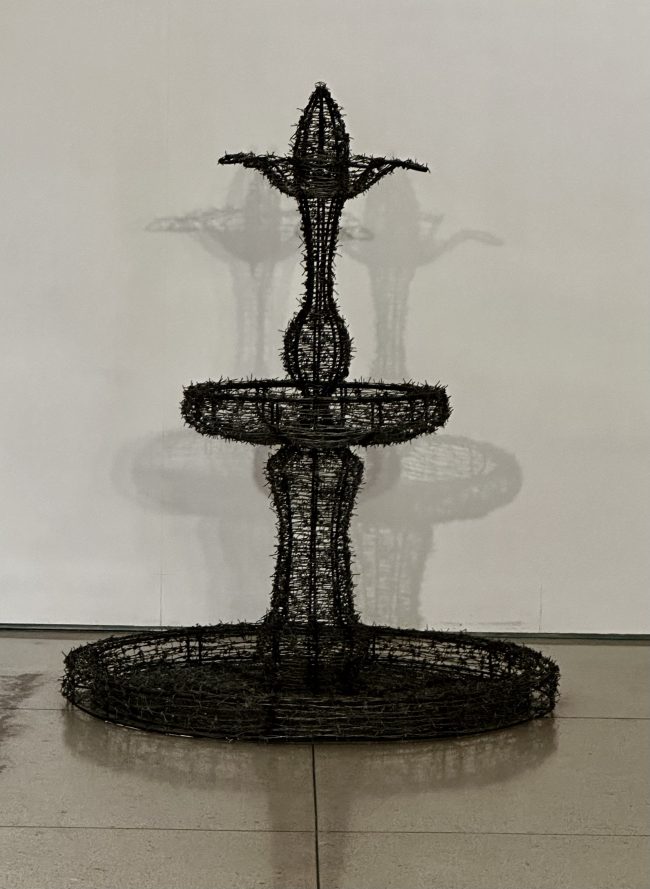
Farida Batool
In her metal sculptures, Batool deftly manipulates the cold, rigid material to evoke the lushness and vibrancy of a garden, juxtaposed against the harsh reality of its confinement by barbed wire. The juxtaposition challenges viewers to confront the paradox of humanity’s simultaneous reverence for nature and its destructive exploitation.
Similarly, her lenticular prints offer a dynamic visual experience, showcasing images of gardens obscured and constrained by wires. The interplay of light and shadow in these prints creates an eerie, almost surreal effect, underscoring the conflict between the sublimity of nature and the encroaching threat of human intervention. Farida Batool’s work offers a profound interrogation of societal norms and collective complacency. Through her works, she prompts viewers to question how we have normalized environmental destruction and accepted the limitations imposed upon us. The garden, traditionally a symbol of growth, vitality, and freedom, becomes a wretched metaphor for the constraints and compromises that define the human experience.
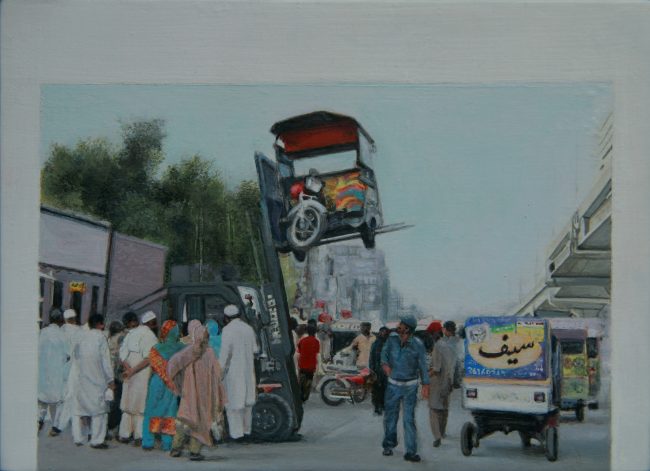
Risham Syed
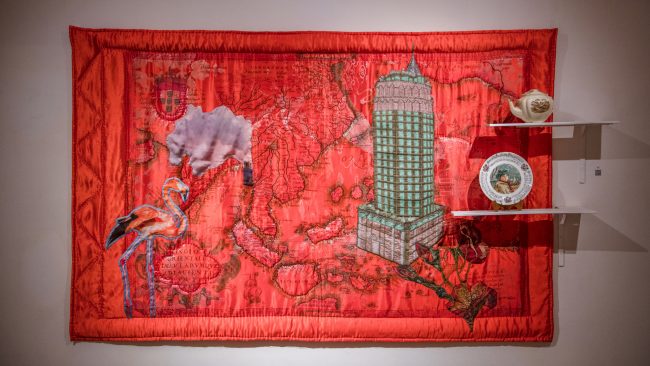
Moving ahead were the awe-inspiring tapestries of Risham Syed. Syed draws inspiration from her native city of Lahore, delving deep into questions of colonial legacy, cultural identity, and environmental consciousness. Through a diverse range of mediums, including painting, fabric, embroidery, and found objects, she constructs a narrative that transcends geographical boundaries and speaks to broader global themes. Her use of fabric, embroidery, and found objects adds layers of texture and depth to her work, inviting viewers to engage with the personal and historical dimensions of her art. Each piece becomes a tapestry of memories, associations, and social commentary, weaving together strands of past and present to create a rich and immersive experience.
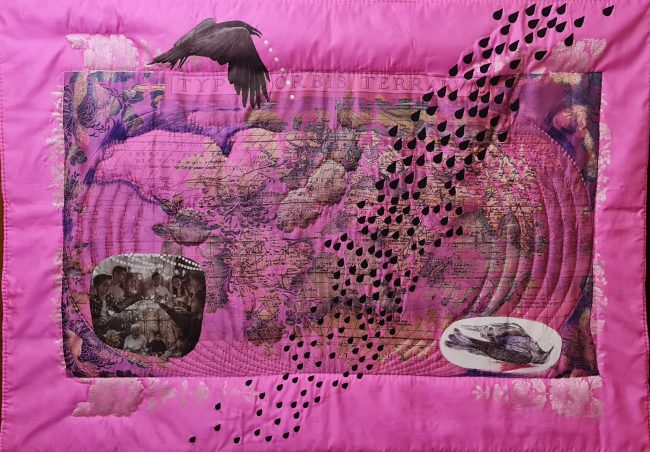
Risham Syed
From the colonial past to the present moment, Syed’s paintings and installations offer a heart-rending reflection on the complex interplay between personal experience and collective memory. By highlighting Lahore’s cultural heritage and contemporary challenges, she prompts viewers to reconsider their connections to place, history, and the environment.
‘The Path of Metaphor’ presented a rich tapestry of artistic expression, incorporating a diverse range of mediums. By juxtaposing earlier works with their current practice, the exhibition offered viewers a glimpse into the evolution of these four artists’ journeys over time. It served as a reflection on the intersections of personal narrative, cultural identity, and artistic exploration. As visitors navigated through the exhibition, they were invited to immerse themselves in a world of metaphor and meaning, where each artwork told a unique story and sparked conversations about the power of art to transcend boundaries and defy categorization.
COMMENTS